5. Jabari Explains Mission II
Template: Scene
Source: .writer/books/5. 📝 Manuscript/4. Memories/Scenes/5. Jabari Explains Mission II.org
1. Short Description
Jabari deepens the mystery of the Brains' Cage and offers Mike rewards powerful enough to reshape his syraki, including the possibility of an Aunonian Prif Tuning beyond anything he could otherwise obtain. Mike accepts the classified mission and later remembers the intense multidisciplinary training of the ten crewmembers, though the true objective remains hidden and his memories before Akrabizont-22 remain fractured.
2. Notes
Write here notes about specific things you need to remember for this scene.
3. Status
--- Writing statuses:
- [ ] 1. On Writing (make use of 'AI Improvements - Better words' as you write)
- [ ] 2. On Repetition Detector
- [ ] 3. On Short Description and Title (check 'AI Requests - Synopsis and Title')
- [X] 4. Drafted (snapshot is mandatory; after this point, file is locked - check SLIDER)
--- Editing statuses:
- [ ] 5. On AI Improvement ('Improvements - General' doc)
- [ ] 6. On ProWritingAid (go through headers and try for 90% score | Check default file)
- [ ] 7. Final review and minor corrections (check modifications with Grammarly)
- [ ] 8. Test anti-plagiarism in ProWritingAid (if problem, must rewrite)
- [ ] 9. Scene finished (snapshot is mandatory)
4. Image
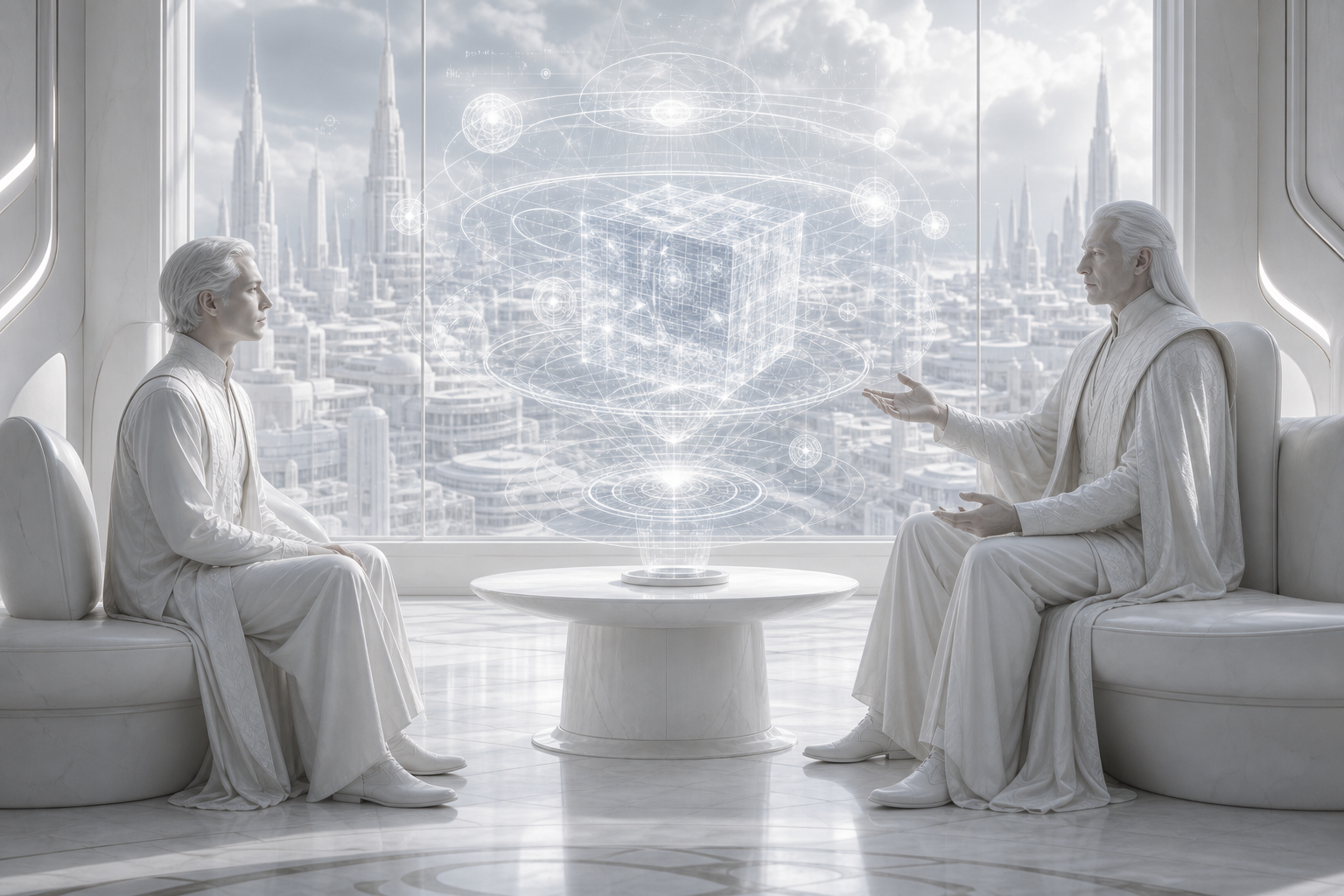
Jabari explains the mission while luminous diagrams, orbital forms, and abstract systems unfold between him and Mike. The image connects the promise of reward with the technical and metaphysical scale of the Brains' Cage mystery.
5. Content
“Why would anything be impossible to AI?” I asked.
“Mr. Mike, do you know why the Brains' Cage is called this way?”
“It is said that in the beginning it was a spaceship designed to store the consciousnesses of proto-syrakis. The design was intended to house their biological brains within hermetically sealed, vat-like containers, safeguarding them in a controlled environment. With time, as the Central Algorithm became increasingly intelligent, it found ways to more efficiently store these consciousnesses, which eventually led to the creation of the first version of syrakis, the alpha generation.”
Ve nodded.
[encrypted]
Those were one of those questions that had never quite crossed my mind, but that, once asked, made spooky sense.
“Sir?” I was confused.
[encrypted]
Silence reigned, but ve kept staring at me with eyes glinting like precious stones as if to reach the epicenter of my being.
“What is that that you want, Mr. Mike?” Ve paused. “A server of your own? A tedrak ultimate replacer model? A spacecraft… a starship? Or maybe a starbase, one in which you could manage your own research team? Or, who knows, a moon, an entire planet?” The weight of vis words hung in the air, dense with the intoxicating aroma of limitless potential. “I mean, let’s talk about pleasure, Mr. Mike, the true currency in our society. I will give you enough credits so that you can perform your own Aunonian Prif Tuning.”
That took me by surprise. Not in one million years would my syraki have enough computational power to RUN such a demanding fine-tuning. Even quantum annealers and tensor processing units would not be sufficient for solving the non-linear partial differential equations and stochastic optimization problems involved. Besides, the renting of external core processors, often bearing travascale computing capabilities, required for such an overwhelming task was but a privilege of a few. Offloading to distributed networks for parallel task management would barely scrape the surface of what was needed. My whole syraki would have to be remapped, upgraded, calculated, rebalanced; its neural pathways, algorithmic modules, and discrete patches and transforms meticulously tinkered down to the tiniest details. The allure of unlocking my full hedonic potential, experiencing unprecedented Prif levels of unfathomable reach, shattered me any semblance of indifference.
“But that is not why I called you here,” ve continued. “I cannot tell you everything. Not yet. But I can tell you this much: the mission is not merely a corporate expedition, nor a private ambition of mine. It concerns our brethren. It concerns the Complex itself, all the syrakis. I am not asking you to be heroic, Mr. Mike. I am asking you because your pattern, your work, and your position make you useful where another of us may not be.”
The credits had made the offer enormous, almost impossible to dismiss, but this struck deeper. To be told that my participation could help preserve the Complex, that some part of our shared civilizational substrate might depend on the mission, tempted me more profoundly than property or tuning. A syraki could desire pleasure without shame, but to be necessary to one's brethren was another form of desire altogether.
That was the moment when ve had me.
Then my memories became fuzzy again. I remembered that I accepted the invitation and consented to the mission under classified conditions. Its full objective was not revealed during training, not because Real-Life Theravada had acted in bad faith, but because the information itself was restricted by counter-espionage and containment protocols. Theravada personnel were explicit about that boundary: we would train without the final disclosure until the mission architecture allowed the truth to be safely opened.
Following my acceptance, the training commenced in earnest, just a few cycles after they reunited the ten members of the crew: Beatriz, Elijah, Felix, Ismael, Lucia, Oshiro, Rüdolf, Susan, Vladimir, and I. Even at that time, I thought just ten members to be too a small group for a mission of such supposed scale. However, what did I know? We all came from different areas of expertise, and the only common ground between us were the fact that all of us worked for Theravada.
The regimen was an eclectic blend of disciplines and skill sets, conducted under an air of strategic ambiguity. While it ostensibly appeared to be preparation for an exploratory deep-space mission, the oscillating focus made it difficult to pinpoint its actual objective. One day we would be immersed in developing complex algorithms designed for autonomous navigation through interstellar anomalies; the next, we were at the helm of robotic controllers, simulating the extraction of exotic minerals from uncharted celestial bodies as we wore advanced robotic replacers. There were also sessions devoted to black hole thermodynamics, where we delved into the intricacies of event horizons and Hawking radiation. One session had us engrossed in advanced cryptography algorithms, decoding simulated extraterrestrial signals. In another, we conducted complex fluid dynamics simulations pertinent to foreign atmospheres.
There were also virtual reality modules in which we managed crisis scenarios on orbital stations, addressing systems failure and resource allocation under time-sensitive conditions. We even trained in memetic warfare defenses, delving into cultural interfaces aimed at mitigating unauthorized infiltrations of bad AI actors. Another phase saw us immersed in terraforming simulations, where we orchestrated the geoengineering of inhospitable planets into viable habitats for buildups of microorganisms. Intermittently, we were exposed to processing resilience training, where our syrakis were subjected to extreme computational tests involving high-throughput data analytics and complex algorithmic challenges, all designed to push the limits of our processing units and memory resources. Each phase seemed to be a piece of an elaborate puzzle, yet the overarching picture remained elusive, leaving us in a state of sustained curiosity and anticipation.
That polymathic approach to training kept the mission's final object compartmentalized, but the uncertainty was part of the consented structure rather than a trick. I suspected, from the breadth of the exercises, that we were being prepared for a journey of extreme proportions. As cycles turned into supercycles, the classified boundary remained in place, leaving us all with honed skills and fine-tuned syrakis, but without the final operational disclosure. It became increasingly apparent that the mission's secrecy was not merely a formality, but a necessary containment around a mystery too dangerous to expose before activation.
That was all that I remembered until that point. Most of my recollection went back to Akrabizont-22, for trying to recover anything previous to that seemed sometimes an impossible endeavor. Whatever happened to me in that cursed desert, that had altered me fundamentally.
My nights were plagued by fragmented nightmares about my time on that cursed land, yet the details always eluded me, like sand slipping through my fingers. Each dream seemed to reconstruct a different aspect of that forsaken desert, but clarity was a fugitive. It was as if I had spent an eternity there, long enough for even the most vivid memories to erode into indistinct impressions. Mostly, I could recall the dread and the urgency, but the specifics were masked in a fog of incomprehensibility, leaving me in a perpetual state of disquiet.