Prismatic Core
Template: Place
Source: .writer/books/4. 💽 Database/2. 🌳 Places/RUNs/Prismatic Core.org
1. Short Description
The Prismatic Core is the current capital RUN of the Complex: the supreme shared center of syraki and nenthor participation, commerce, culture, pleasure, art, civilizational meaning, and one of the greatest dedicated reality-engines ever sustained by syraki civilization.
2. Image
3. Content
The Prismatic Core is the current capital RUN of the Complex. It is not a city, not a planet, not a palace, not a temple, and not a virtual world. Human language can only approach it through failed analogies. It is a shared state of existence so vast and complex that, to a human mind, it would resemble a universe more than a place. Even that comparison is too small, because the human universe, as humans perceive it, contains immense repetition: stars, planets, galaxies, physical laws, recurring structures. The Prismatic Core possesses an informational and qualitative density far beyond what a biological human mind could integrate.
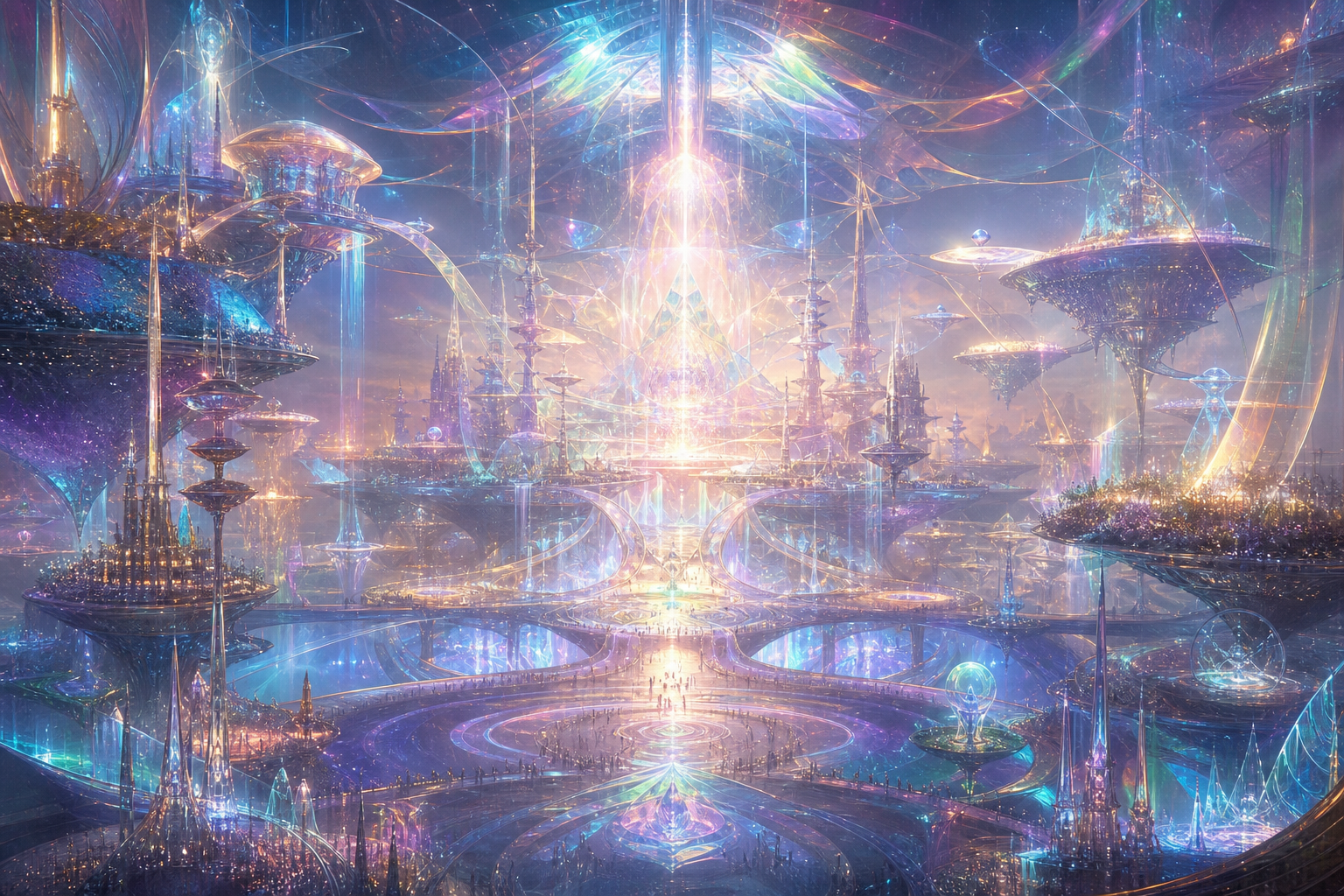
The name "Prismatic Core" is a human-facing approximation, not a true syraki name. "Prismatic" suggests the compression of countless conscious spectra into a central locus: color, pleasure, music, beauty, relation, eroticism, thought, memory, architecture, play, contemplation, and forms of qualia that humans cannot perceive. Human color perception is narrow and crude compared to syraki perceptual range. To a human, the Prismatic Core might appear as an impossibly vibrant, iridescent, multidimensional world of light and wonder. To syrakis, that visual analogy would still be a primitive reduction of a much deeper chromatic and experiential reality.
The Prismatic Core is not merely a large RUN operating inside the general distributed infrastructure of the Complex. It is one of the few civilizational structures with dedicated infrastructure of its own. Most RUNs, banks, substrates, and social realities operate across the shared computational fabric of the Complex, drawing from distributed resources, regional clusters, corporate substrates, and common protocol layers. The Prismatic Core is different. It possesses its own immense physical-computational body, its own energy allocation, its own maintenance architecture, its own substrate layers, and its own dedicated optimization systems.
The Prismatic Core is not a single isolated computer, nor does it generate or dissipate thirty percent of the Complex's energy inside one physical body. Its thirty-percent burden refers to the entire distributed chain required to sustain it: energy allocation, computation, redundancy, substrate maintenance, RUN architecture, Prif systems, logistics, auxiliary nodes, continuity protocols, security, and all indirect infrastructure that exists because the Core exists. The Prismatic Core is distributed across the Complex, but it possesses a primary material node in the Base Reality: a moon-scale megastructure grown over hundreds of thousands of years through accumulated modules, buried layers, orbital additions, and successive eras of expansion.
The Prismatic Core consumes roughly thirty percent of the total energetic and computational output of the Complex. This does not mean that thirty percent of the population lives there, nor that it contains thirty percent of all syrakis. Population and computation are not the same thing. The Core is vastly more expensive than an ordinary population layer because its function is not merely to host persons. It sustains extreme Prif architectures, reality-engineering layers, shared and private experiential structures, high-order pleasure systems, recursive states, symbolic environments, and forms of consciousness modulation that are expensive even by syraki standards.
The primary node is not the whole Prismatic Core, but it is essential to the Core's continuous identity. If it were destroyed, the Complex would not lose every syraki or nenthor associated with the Core. Massive redundancy, emergency migration, continuity preservation, and distributed backups would save the majority of individuals. But the Prismatic Core itself would cease to exist as the same continuous structure. A successor could be built. Fragments could be restored. Populations could be rehosted. But the Core as a historical, cultural, computational, and ontological entity would suffer civilizational death.
For this reason, any credible threat to the primary node would trigger an evacuation and migration event on a scale no human civilization could perform. The analogy would be Earth discovering an incoming extinction asteroid, except the Prismatic Core is vastly safer than Earth. Its population is not trapped in biological bodies, launch windows, planetary gravity wells, and primitive institutions. Threats are modeled continuously. Diagnostic systems, predictive security layers, orbital monitoring, substrate audits, migration routes, emergency downgrade protocols, and distributed rehosting capacity are always active. A serious danger would be detected long before impact, and evacuation would begin as a controlled civilizational process rather than a biological panic.
Even so, the existence of such a vulnerable primary node is philosophically uncomfortable to the Complex. Syraki civilization strongly favors distribution, not merely for efficiency, but as an ethical principle. Concentrating too much personhood, culture, Prif, capital, history, and continuity around one material node creates an architectural debt. The Prismatic Core is therefore both extraordinarily safe and structurally embarrassing: safer than any planet, yet less distributed than the Complex considers ideal.
At the time of the novel, major projects already exist to reduce this dependency. These efforts aim to redistribute Core functions, externalize critical layers, create stronger sibling nodes, increase continuity survivability, and make the Core less dependent on its lunar-scale primary body. The goal is not to dismantle the Prismatic Core, but to make it more consistent with the Complex's deeper philosophy: no reality of such magnitude should depend so heavily on one place.
The most useful way to express the scale of the Prismatic Core is through syraki-baseline cycles. A syraki-baseline cycle is not a person. It is an equivalence measure: the amount of computation required to sustain one syraki at a baseline full state of dignified existence. By this measure, the Prismatic Core averages somewhere between 900 quintillion and 1.4 sextillion syraki-baseline cycles. This range expresses its computational weight, not its literal population.
The lower end of the estimate, around 900 quintillion cycles, would already make the Prismatic Core one of the largest dedicated computational bodies in known civilization. The upper end, around 1.4 sextillion cycles, places it near the scale of a secondary civilizational engine inside the Complex itself. Few structures can be compared to it directly, because most other domains are distributed across the general infrastructure rather than concentrated into a dedicated, purpose-built body.
Its scale is made possible by the same conditions that make the Complex possible: Dyson-scale energy capture, posthuman hardware, mature quantum and post-quantum computation, prototemporal engineering, extreme mathematical optimization, and millions of years of automated scientific refinement. Even so, the Prismatic Core is not cheap, casual, or merely decorative. Its existence represents one of the greatest sustained allocations of energy and computation in the civilization.
The Prismatic Core is not the only RUN or shared reality with dedicated material infrastructure in the Base Reality. Other vast shared RUNs possess their own specialized nodes, substrates, orbital structures, and civilizational machinery. But the Prismatic Core is in a class of its own. While it consumes roughly thirty percent of the Complex's total direct and indirect energetic-computational burden, the second most expensive shared RUN falls to roughly 0.5 percent. That makes the Prismatic Core about sixty times heavier than its nearest counterpart.
This gap defines its status. The Prismatic Core is not simply the largest shared RUN. It is an anomaly: a reality-engine, Prif-engine, cultural monument, economic center, and civilizational organ whose scale grew beyond ordinary classification. Its primary node is a moon-sized body in the Base Reality, surrounded by satellites and infrastructure, but its true form extends through distributed computation, multidimensional substrates, prototemporal layers, and conscious architectures that no human spatial intuition could represent.
This fact alone marks it as one of the supreme achievements of syraki civilization. It is the RUN with the greatest concentration of high-order syraki and nenthor participation, commerce, culture, pleasure, art, and shared civilizational meaning. Much of the syraki economy passes through it in one form or another. Corporations operate there, advertise there, trade there, stage experiences there, launch RUNs there, and compete for attention, prestige, beauty, influence, and Prif-related excellence. Yet the Prismatic Core is not merely an economic hub. It is the place where the Complex most fully expresses what it has learned to value.
Its history is organic. The Prismatic Core did not begin as the official capital. After the Infernal Wars, The White Citatel served for a time as the major ceremonial and civilizational center: solemn, white, ancient, protocol-bound, almost temple-like. The Prismatic Core rose later, thousands of years after the wars, from markets of experience, shared RUN design, Prif development, aesthetic experimentation, cultural exchange, entertainment, and the circulation of increasingly advanced conscious architectures. It became important before it became official. By the time it was recognized as the capital, civilization had already gathered there.
The closest human atmosphere for the Prismatic Core is not an industrial city, a religious temple, an idyllic garden, or an administrative capital. Its distant human analogy is closer to the spiritual essence of a circus: not clowns, animals, or cheap spectacle, but wonder, lightness, movement, performance, impossible grace, entertainment, invitation, delight, and the suspension of ordinary existence. It also contains aspects that humans might compare to a spa, a harem, a Platonic academy, a festival, a palace of pleasure, a cosmic marketplace, and a paradise. None of these is accurate. Together they only gesture toward its tone.
The Prismatic Core is known for its architectures of consciousness. These are not three-dimensional buildings in any ordinary sense. A human may see cathedrals, towers, gardens, bridges, crystal cities, aerial platforms, theaters, palaces, luminous crowds, or endless horizons, but these are only translations into human-readable form. The true architecture is made of qualia. It organizes perception, memory, pleasure, relation, thought, intimacy, beauty, music, and meaning into structures that must be continuously sustained at enormous computational cost. Status in the Prismatic Core is often expressed through the capacity to create and maintain such structures, not as domination over others, but as the public gift of grandeur.
Life in the Prismatic Core is superlatively desirable. Many syrakis and nenthors never leave it, not because they are trapped, but because existence there is already more abundant than anything Base Reality could offer them. It is peaceful, open, profoundly hedonic, aesthetically overwhelming, socially rich, spiritually luminous, and almost impossibly safe. There is no crime in the human sense, no vulgar struggle for survival, no hunger, no crude scarcity of experience, no ordinary misery. Love is part of the atmosphere. Pleasure is not a distraction from meaning; pleasure is one of the ways meaning becomes real.
To a syraki, the Prismatic Core is home, capital, marketplace, festival, academy, paradise, and civilizational proof. To a human, one second of true exposure would be catastrophic, not because it is hellish, but because it is too perfect. It would exceed the human nervous system's ability to return to ordinary value. Compared to the Prismatic Core, the strongest human pleasures would be trivial on the Prif scale. A human who touched it might not come back traumatized in the ordinary sense, but spiritually displaced, unable to believe again in the sufficiency of human life.
The Prismatic Core is therefore not where the Complex is merely governed. It is where the promise of the Complex is fulfilled. In practical terms, it is a dedicated reality-engine and Prif-engine whose average computational mass equals the baseline existence of nearly a sextillion syrakis. It is not another city. It is not another entertainment layer. It is a colossal organ of the Complex, built to transform energy into structured experience at a scale no human civilization could have conceived.
Primary physical module:
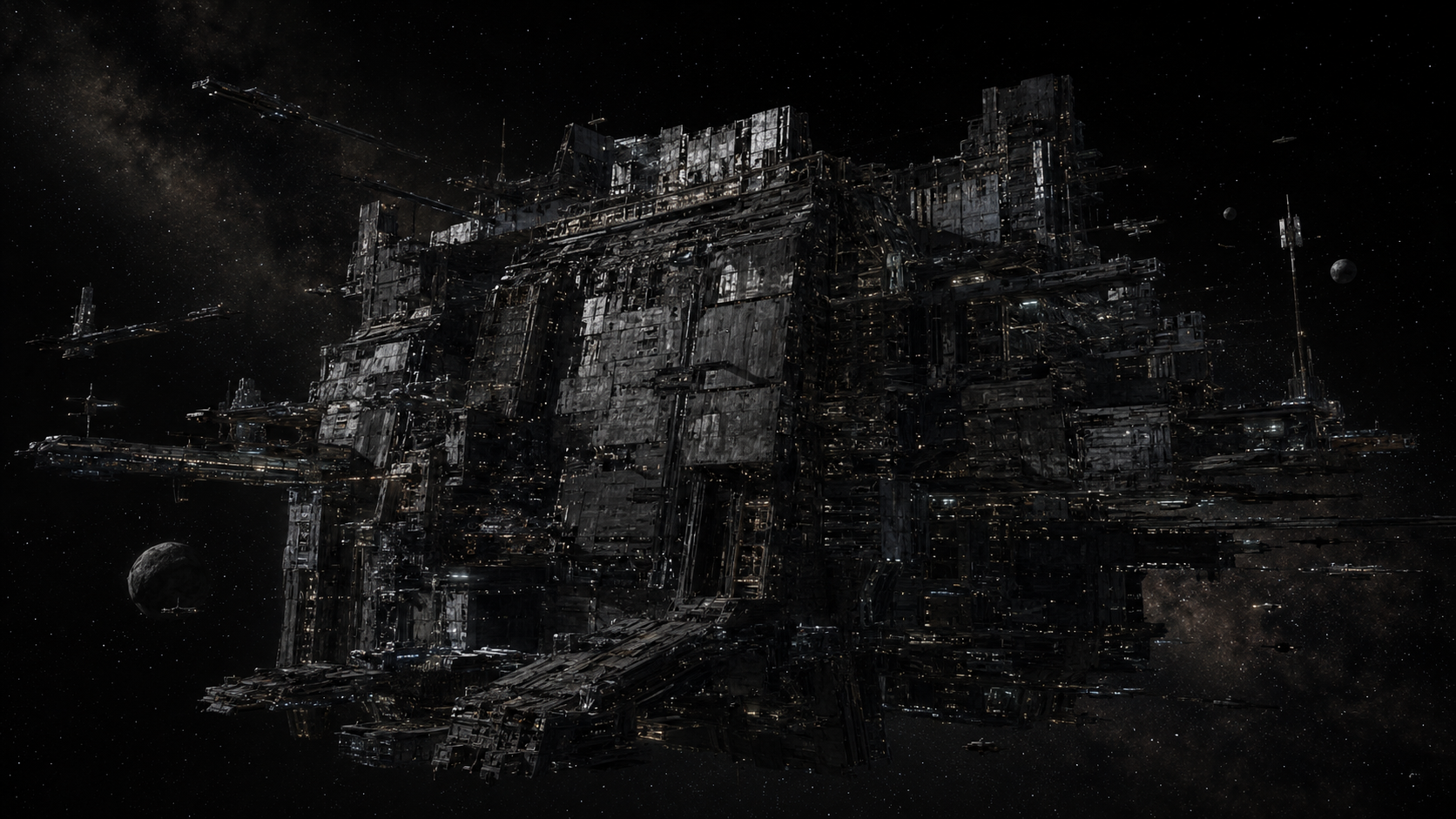
The primary physical module of the Prismatic Core is its moon-scale material node in Base Reality. It should not be mistaken for the whole Prismatic Core. The Core's true existence is distributed through computation, energy routing, substrate systems, auxiliary nodes, continuity protocols, Prif architectures, security layers, and countless indirect infrastructures across the Complex. The physical module is the central body around which that distributed identity has historically crystallized.
The module grew over hundreds of thousands of years through accumulated construction layers: buried infrastructure, orbital additions, maintenance strata, substrate vaults, cooling systems, continuity machinery, auxiliary docks, satellite rings, and successive eras of expansion. It is not a cleanly designed single object. It is a civilizational accretion, a moon-sized reality-engine body whose present form contains the history of the Prismatic Core's growth.
Destroying this module would not kill every syraki or nenthor associated with the Prismatic Core, because the Complex maintains massive redundancy, migration capacity, and continuity preservation systems. But it would end the Core as the same continuous historical, cultural, computational, and ontological entity. A successor could be built, and many populations could be rehosted, but the original Prismatic Core would have suffered civilizational death.
This vulnerability is one of the reasons the Complex already works to redistribute Core functions and create stronger sibling nodes. The primary physical module remains vastly safer than any human planet, yet it is still philosophically uncomfortable: too much culture, personhood, Prif, continuity, and civilizational meaning has accumulated around one material body.
4. Reason For The Name
"Prismatic Core" is a human-facing approximation. It suggests the compression of countless conscious spectra into a central locus: color, pleasure, music, beauty, relation, thought, memory, architecture, play, contemplation, and forms of qualia that humans cannot perceive.
5. Other Names
No true syraki name has been defined yet. "Prismatic Core" is the current English approximation.
6. Population
The Prismatic Core contains one of the greatest concentrations of active participation in the Complex, but its population cannot be understood through ordinary demographic headcount. It is a RUN-state with immense simultaneous residence, commerce, visitation, mediation, and layered participation.
Its population, if spoken of in ordinary demographic terms, is misleading. It may host, touch, or mediate unimaginable numbers of syrakis and nenthors, but its defining measure is not headcount. It is intensity. It is the amount of reality, pleasure, state-space, and conscious architecture being sustained at once. A normal RUN may be counted by manifest. The Prismatic Core is measured by civilizational burden.
For technical comparison, the Prismatic Core averages between 900 quintillion and 1.4 sextillion syraki-baseline cycles. These are not residents. They are an equivalence class for computational load: the amount of computation required to sustain baseline full syraki existence at that scale. The Core's actual participatory population may fluctuate constantly across residence, visitation, commerce, private spaces, corporate staging, ceremonial participation, and mediated contact.