Intragalactic Bridges (IG-Bridges)
Template: Note
Source: .writer/books/4. 💽 Database/3. 🗒️ Notes/Technology/Space Travel/Intragalactic Bridges (IG-Bridges).org
1. Image
2. Content
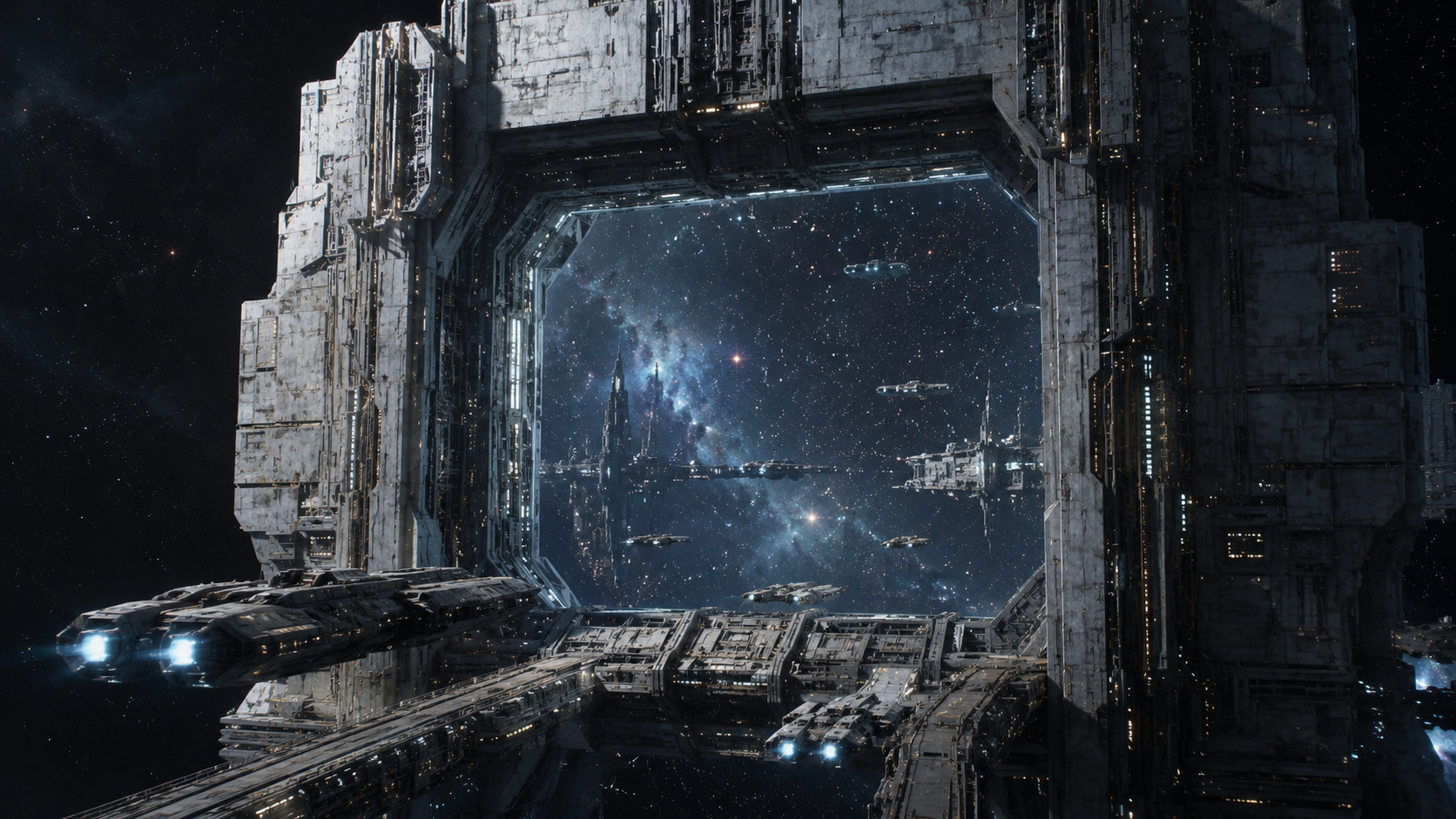
Intragalactic Bridges, usually called IG-Bridges, are among the greatest physical infrastructures of the Complex. They are not warp engines, hyperspace drives, or ordinary ship propulsion systems. An IG-Bridge is a stabilized spacetime corridor between two prepared endpoints inside the Milky Way, allowing matter, vessels, information, and strategic infrastructure to cross distances that would otherwise require centuries, millennia, or longer by conventional travel. They are closer to railways than cars: a ship does not carry the bridge with it, but travels through a route that the civilization has already built.
Every IG-Bridge is expensive, dangerous, and civilizationally significant. It requires immense energy, advanced gravitational engineering, causal stabilization, endpoint construction, maintenance systems, defensive infrastructure, and continuous monitoring. The Complex does not build them casually. A target region is selected through long-term simulations, resource analysis, hazard modeling, strategic projection, and ethical assessment. Before a bridge can become part of the network, the destination must usually be reached or prepared by long-duration starships, probes, construction swarms, or other slow expansion systems.
For safety, an IG-Bridge endpoint is normally not placed near the main inhabited planets, dense civil computation, major archival substrates, or ordinary orbital traffic. It belongs to the deep-system perimeter: a distant, heavily controlled region of the star system, often beyond the outer planets or above and below the main orbital plane. The endpoint remains tied to the system for maintenance, defense, energy logistics, and traffic control, but it is isolated enough that bridge instability, attack, collapse, causal stress, heat rejection failure, or field malfunction does not immediately threaten the central worlds.
A mature system therefore tends to separate its infrastructure by risk. The star and inner planets support energy production, ordinary industry, population, and civil computation. The outer system holds military zones, heavy infrastructure, giant radiators, remote collectors, maintenance stations, and mass warehouses. The deep-system perimeter holds IG-Bridges and their exclusion zones. A bridge is useful because it connects civilization; it is survivable because civilization does not build it in the middle of its most vulnerable organs.
Because IG-Bridges manipulate spacetime, they inevitably place the syrakis near the frontier of temporal science. The same physical principles that make distance shorter also expose the structure of time, defasement, dilation, causal loops, and consistency constraints. However, an IG-Bridge is not a mature time machine. The Complex is proto-temporal, not fully temporal. Its bridges allow the syrakis to bend distance and study causal geometry, but they do not yet allow free selection of historical eras or casual travel into the deep past. Time has been touched, not domesticated.
The IG-Bridge network defines the shape of syraki expansion. The Complex is not a cloud spread uniformly through the galaxy, nor an empire expanding by simple conquest. It is a vast, physical, uneven network of megastructures, star systems, relays, ships, servers, mines, stations, and bridge-linked nodes. Some bridge missions succeed and become permanent arteries of civilization. Others fail, vanish, collapse, or never respond again. Each successful IG-Bridge becomes a new bone in the skeleton of the Complex, binding distant regions of the galaxy into one distributed postbiological civilization.
The network is designed with redundancy in mind. The ideal form is not a perfect lattice, because real expansion is constrained by resources, safety, politics, astronomy, local value, historical accident, and bridge failure. Branches exist. Some systems remain dependent on a single bridge for long periods. But the civilizational preference is always to turn vulnerable branches into loops and meshes when the cost can be justified. A second or third bridge route can preserve continuity if one endpoint fails, enters maintenance, is attacked, becomes causally unstable, or must be isolated.
This is why the first bridge networks matter historically. A bridge from an origin system to a new system creates reach. A bridge connecting two non-origin systems creates resilience. At that point the civilization is no longer only extending outward from a center; it is binding its expansion into a recoverable network.
This principle was already present in the Triad of IG-Bridges. This bridge Triad is not the Planetary Triad of Alpha, Beta, and Charlie. It refers to the first three IG-Bridges: the earliest bridge connections through which the network began to become redundant. Their importance is not only that they expanded access beyond Yrnus, but that they established the first loop-like structure in which a non-Yrnus system could be connected to another non-Yrnus system. From the beginning, the logic of the bridge network was not pure expansion. It was expansion with survivability.
The first Triad was much more primitive and unstable than later bridge infrastructure. These bridges could lose usable oscillation without being fully destroyed. When that happened, the physical endpoint structures might survive, but the connection itself would become unavailable until automated correction, stabilization, or later repair restored the route. Early historical interruptions could isolate systems for decades, with some failures lasting approximately seventy years or even one hundred and twenty years before the bridge returned to operation.
All three bridges of the Triad were damaged during the Infernal Wars, but none was destroyed. The Yrnus-Batantt route, later remembered as IG-Bridge Zekyiu-2, suffered the heaviest attacks and became the clearest early lesson in bridge vulnerability. The later restoration of all three bridges made them symbols of both fragility and persistence: the first bridge network, wounded by war, repaired, and remembered as the origin of IG-Bridge redundancy.
During the Infernal Wars specifically, Zekyiu-2 suffered two major oscillation failures. The first cut the Yrnus-Batantt route for forty-three years. The second cut it for twenty-one years. In both cases, the automated systems of the bridge eventually reestablished the connection. These incidents did not make Zekyiu-2 a destroyed bridge, but they made it the most dramatic early example of how vulnerable first-generation IG-Bridge technology could be under war pressure.