Omniship Movement And Operational Space
Template: Note
Source: .writer/books/4. 💽 Database/3. 🗒️ Notes/Technology/Omniship/Omniship Movement and Operational Space.org
1. Image
2. Content
An omniship does not move through space in the ordinary Euclidean sense. A conventional spaceship travels inside a preexisting physical environment. Space exists outside it. Distance, direction, acceleration, velocity, orbit, and return remain meaningful even when the vessel is lost.
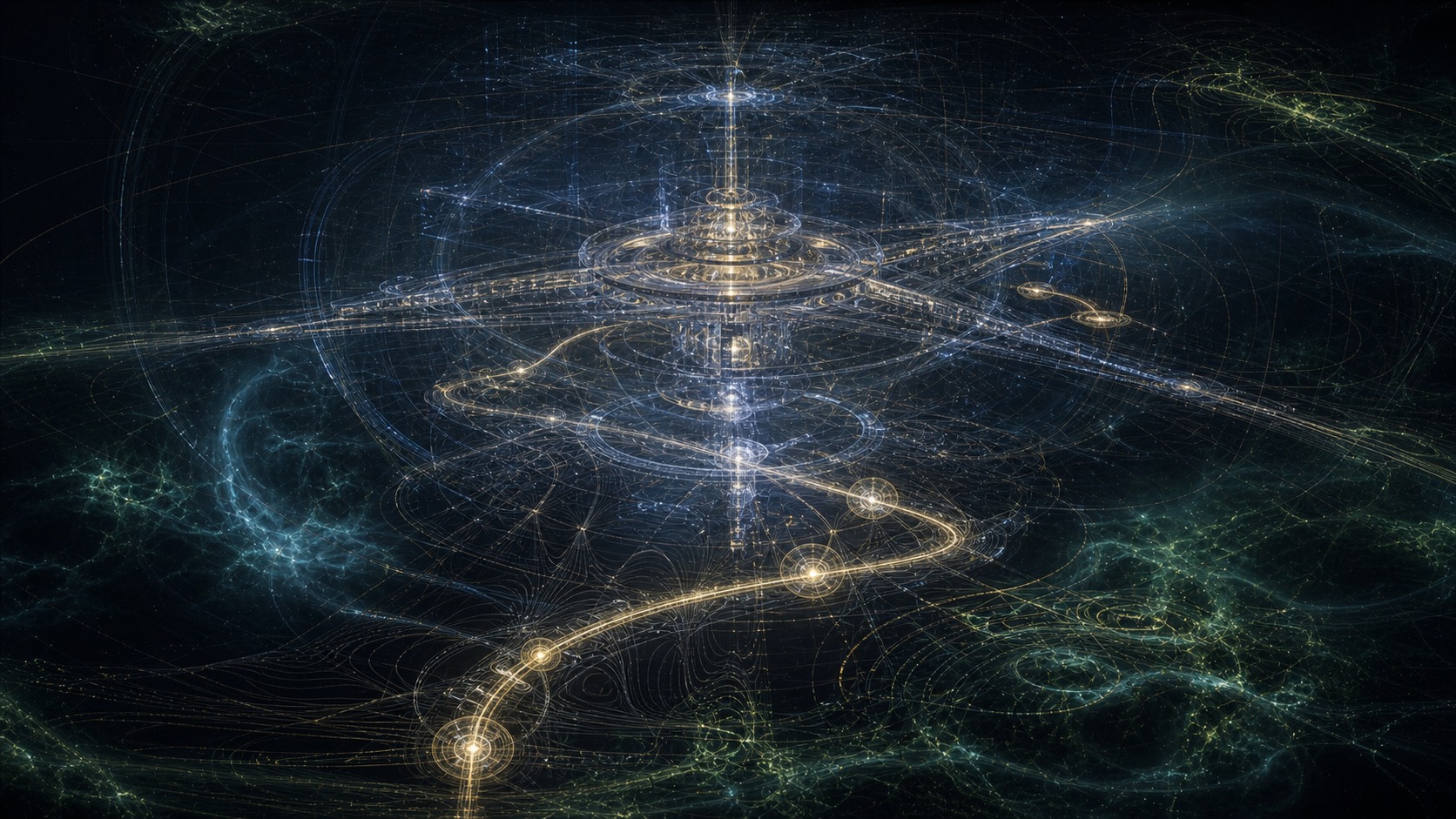
An omniship is different. It does not merely cross space. It sustains the operational space in which its own movement can occur.
This operational space is not ordinary physical space. It is an abstract, mathematical navigation domain generated and maintained by the vessel. The omniship's route, position, checkpoints, movement, return vectors, and coherence are all functions of this constructed domain. In this sense, the ship is not an object moving across a map; it is a system that continuously produces the map, the coordinate logic, and the conditions under which travel remains computable.
The RT-874 therefore does not "fly" in the usual sense. Its motion is a controlled transformation of state across a mathematically sustained field. The vessel must preserve a coherent relationship between four elements: its current state, its intended route, the operational space it is maintaining, and the conscious field of its crew.
The mission route is calculated before departure. This route is not a simple physical trajectory. It is a compressed mathematical structure: a sequence of admissible states, transitions, checkpoints, tolerances, and return conditions. If the omniship remains inside the predicted route envelope, the problem remains highly compressible. The vessel does not need to solve a new universe at every moment. It only needs to confirm that its current state still fits the precomputed structure.
This is where the logic resembles Kolmogorov complexity.
A state with low Kolmogorov complexity can be described by a short rule or compact model. A state with high Kolmogorov complexity requires a longer, less compressible description. For an omniship, movement becomes dangerous when the description required to relate the current state back to the mission route grows too large.
If the RT-874 follows its expected route, the mathematical description remains short. The vessel can maintain coherence with minimal computational burden. In theory, it could remain inside a stable, well-described route pattern for an immense duration without "spending fuel" in any ordinary sense, because duration itself is not the main cost.
The cost appears when the vessel deviates.
A small deviation requires the omniship to expand its model. It must describe the difference between its expected state and its actual state, then compute a correction that reconnects the current state to the route. This is still manageable if the deviation remains compressible.
A larger deviation forces the ship to describe more of the surrounding operational domain. It must account for unexpected transitions, altered geometry, new causal relations, unstable mental-state fields, keyholes, reality jumps, and possible return paths. The problem expands. The vessel must generate more operational space in order to understand where it is and how to return.
At a certain point, the issue is no longer energy. The RT-874 may still possess effectively unlimited energy for the purposes of the mission. The limit is computational tractability. The ship enters a region of problem-space where the required description becomes too large, too unstable, or too poorly compressible to fit within the vessel's operational capacity.
This is the functional equivalent of running out of fuel.
The ship has not exhausted energy. It has exhausted the ability to keep the current state, route, and return path inside a solvable mathematical relation.
A simplified technical condition would be:
#+begin_example K(current state | mission route) < Kmax #+end_example
Here, *K* represents the effective descriptive complexity of the current state relative to the precomputed mission route. *Kmax* represents the maximum complexity the omniship can sustain while preserving coherence.
When *K* remains far below *Kmax*, the ship is stable.
When *K* approaches *Kmax*, the ship enters warning conditions. It can still recover, but it must return to the route envelope quickly.
When *K* exceeds *Kmax*, the ship enters decohesion. At that point, the vessel may still exist, but it can no longer maintain a computable relationship between itself, the route, the operational space, and the return path. It is not merely lost inside space. It has lost the mathematical conditions that made "space," "route," and "return" usable concepts.
The crew is part of this system.
Syrakis aboard an omniship are not passengers in the human sense. They are components of the vessel's coherence field. Their conscious structures help stabilize the operational space, reduce the complexity of route maintenance, and allow the ship to process domains that would otherwise exceed its autonomous capacity.
The RT-874 was designed to operate ideally with eight syrakis. Ten were placed aboard to provide redundancy. With six, the vessel can still function, but its safety margins become dangerous. With five, decohesion becomes almost certain under serious deviation.
This is not because syrakis are used as biological batteries. Their role is not energetic. Their role is structural, cognitive, and ontological. Their consciousness fields form a compatible matrix through which the omniship can sustain its navigation domain. The ship, the route, and the crew enter cohesion as a single operational system.
For this reason, nenthors cannot simply replace syrakis aboard an RT-874-class omniship. This is not a question of inferiority. Nenthors may be immensely sophisticated, but the RT-874 is built to interface with syraki consciousness topology: qualia states, metaqualia, Prif topology, distributed identity, and the specific form of conscious coherence required by the ship. A nenthor does not provide the same kind of field variable. It does not close the same equation.
Checkpoints exist because the route must be validated through stable reference points. They are not necessarily physical locations. They are states of scientific, mathematical, ontological, or pataphysical interest where the vessel can confirm whether its operational space still corresponds to the mission model. Each checkpoint reduces uncertainty, tests the route, and gathers information about the domain.
The danger of an omniship mission is therefore not equivalent to ordinary spatial risk. The RT-874 is not afraid of distance. It is afraid of incompressibility. It is not limited by fuel in the chemical or energetic sense. It is limited by the growth of the mathematical problem it must solve in order to keep existing as a navigable system.
An ordinary spaceship can be lost in space.
An omniship can lose the space that made navigation possible.