Milliarium Aureum Principle
Template: Note
Source: .writer/books/4. 💽 Database/3. 🗒️ Notes/Technology/Omniship/Milliarium Aureum Principle.org
1. Image
2. Content
The Milliarium Aureum Principle is one of the central principles of omniship navigation.
It does not refer simply to the point of origin, the final destination, or any single coordinate inside a mission. Origin and destination are defined before departure through prior studies, simulations, and route construction, but the principle itself concerns something deeper: the route as a singular operational reality.
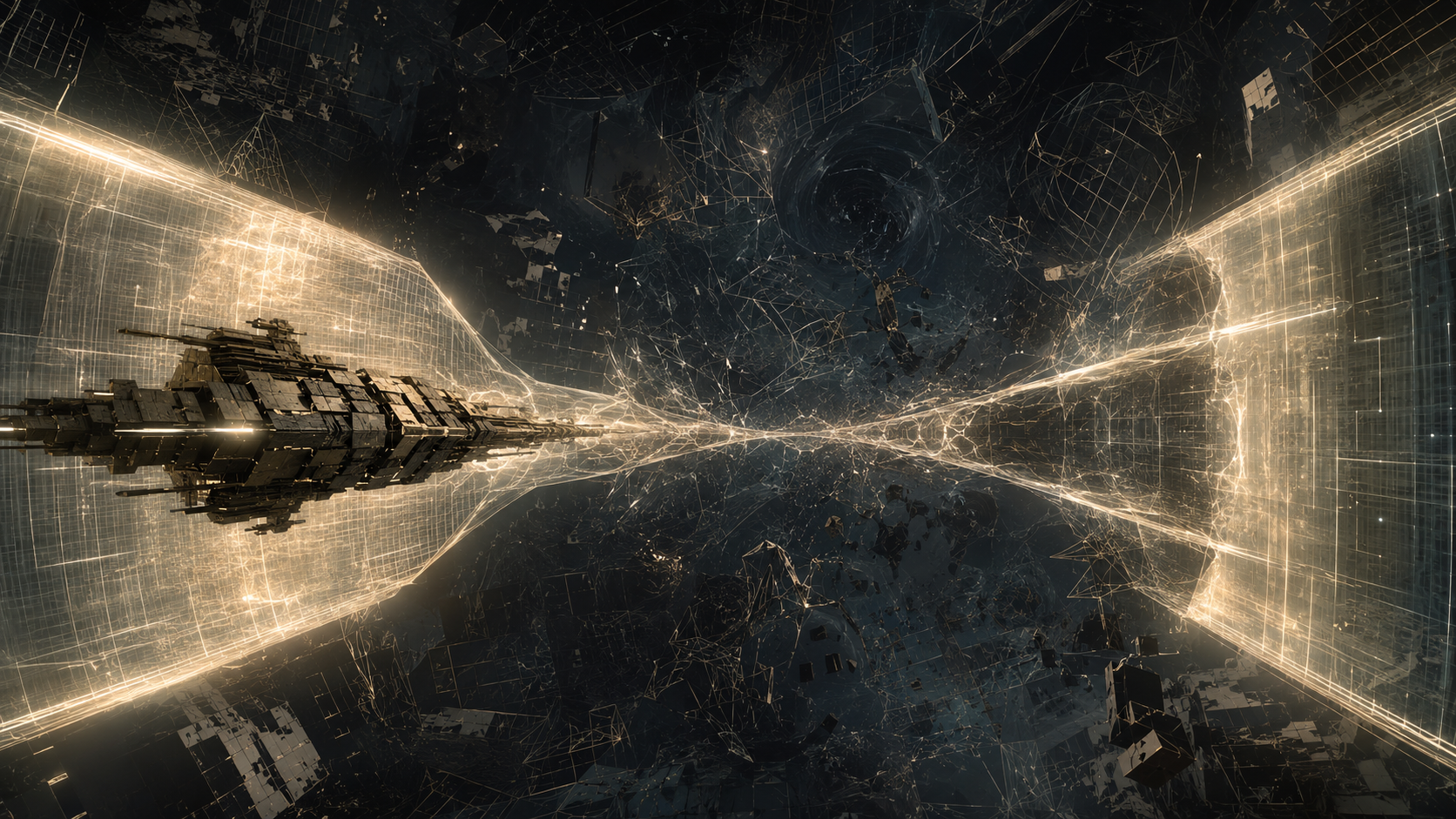
An omniship does not travel along a path that already exists. It generates the navigable path through calculation. The route is not a line between point A and point B. It is a complete mathematical structure containing origin, destination, checkpoints, tolerances, allowed deviations, correction ranges, coherence limits, and return conditions. The route is the reality in which the journey remains possible.
For a conventional vehicle, leaving the road means entering terrain outside the planned path. The world still exists around the vehicle. The road can be found again.
For an omniship, leaving the route is far more dangerous. Since the ship sustains the operational space of its own movement, a severe deviation does not merely place the vessel outside the path. It damages the mathematical reality in which the path existed. The ship is then forced to recalculate not only its direction or destination, but the route as a whole.
This is why an omniship always attempts to remake and preserve the route at any cost. The route must remain computable as a total structure. It is not enough to ask how to reach the destination from the current state. The vessel must determine whether the current state can still be reintegrated into the mission-route as a coherent whole.
If the deviation remains within tolerance, the omniship can expand the route model, correct the drift, and preserve coherence. If the deviation becomes too severe, the route begins to lose recoverable structure. At that point, the ship is not simply lost in space. It is losing the space in which navigation was meaningful.
The route has different stability conditions along its length. Near the beginning and near the end, the route has greater tolerance. These regions are easier to maintain because the relationship between the ship and the total mission-structure remains more mathematically stable.
The most dangerous point is the center of the route. The central region is the most unstable, the most difficult to preserve, and the least tolerant of serious deviation. A major drift near the middle of the route is much more likely to push the omniship toward decohesion.
Once true decohesion occurs, recovering the route becomes practically impossible. It is not metaphysically impossible in an absolute sense, but it is technically impossible as navigation. A return could occur only through an absurd coincidence, not through calculation. Even if decohesion begins near the origin or near the destination, once the route is lost, the vessel no longer possesses the mathematical reality required to restore it reliably.
The Milliarium Aureum Principle therefore defines the fundamental obligation of omniship travel: the vessel must not merely follow the route. It must keep the route existing as a computable operational reality.