Chaos Theory, Kolmogorov Complexity, And Omniship Route Stability
Template: Note
Source: .writer/books/4. 💽 Database/3. 🗒️ Notes/Technology/Omniship/Chaos Theory, Kolmogorov Complexity, And Omniship Route Stability.org
1. Image
2. Content
Omniship navigation can be described as a form of controlled motion through a pataphysical phase space.
A conventional spacecraft moves through a preexisting physical space. An omniship does not. It generates and maintains the operational space in which its own movement remains possible. Its route is not merely a path between two points, but a singular mathematical reality composed of origin conditions, destination conditions, checkpoints, tolerances, permitted deviations, correction ranges, coherence thresholds, and return structures.
Because of this, omniship navigation is closer to the control of a chaotic dynamical system than to ordinary propulsion.
In a chaotic system, the rules may be deterministic, but small deviations can grow rapidly until prediction and control collapse. A route may be known in advance, but remaining close to that route requires continuous correction. The ship must keep its actual state close enough to the precomputed mission-structure for the route to remain recoverable.
The local instability of the route can be described through the logic of Lyapunov exponents. A positive Lyapunov exponent indicates that two nearby trajectories diverge over time. For an omniship, this means that a small deviation from the expected route can grow into a major divergence if it is not corrected quickly enough.
A simplified expression is:
#+begin_example delta(t) ~= delta_0 e^(lambda t) #+end_example
Here, delta_0 represents the initial deviation, delta(t) represents the deviation after time has passed, and lambda represents the local Lyapunov exponent. When lambda is high, even a tiny deviation can become dangerous. The ship must correct immediately, because the error grows faster than the route can absorb it.
This helps explain why the middle of an omniship route is the most dangerous region. Near the beginning and near the end of the route, the structure has greater tolerance. The relationship between the vessel and the mission-route is easier to preserve. Near the center, the route is mathematically less stable. The local Lyapunov structure is harsher, the predictive horizon is shorter, and deviations grow more aggressively.
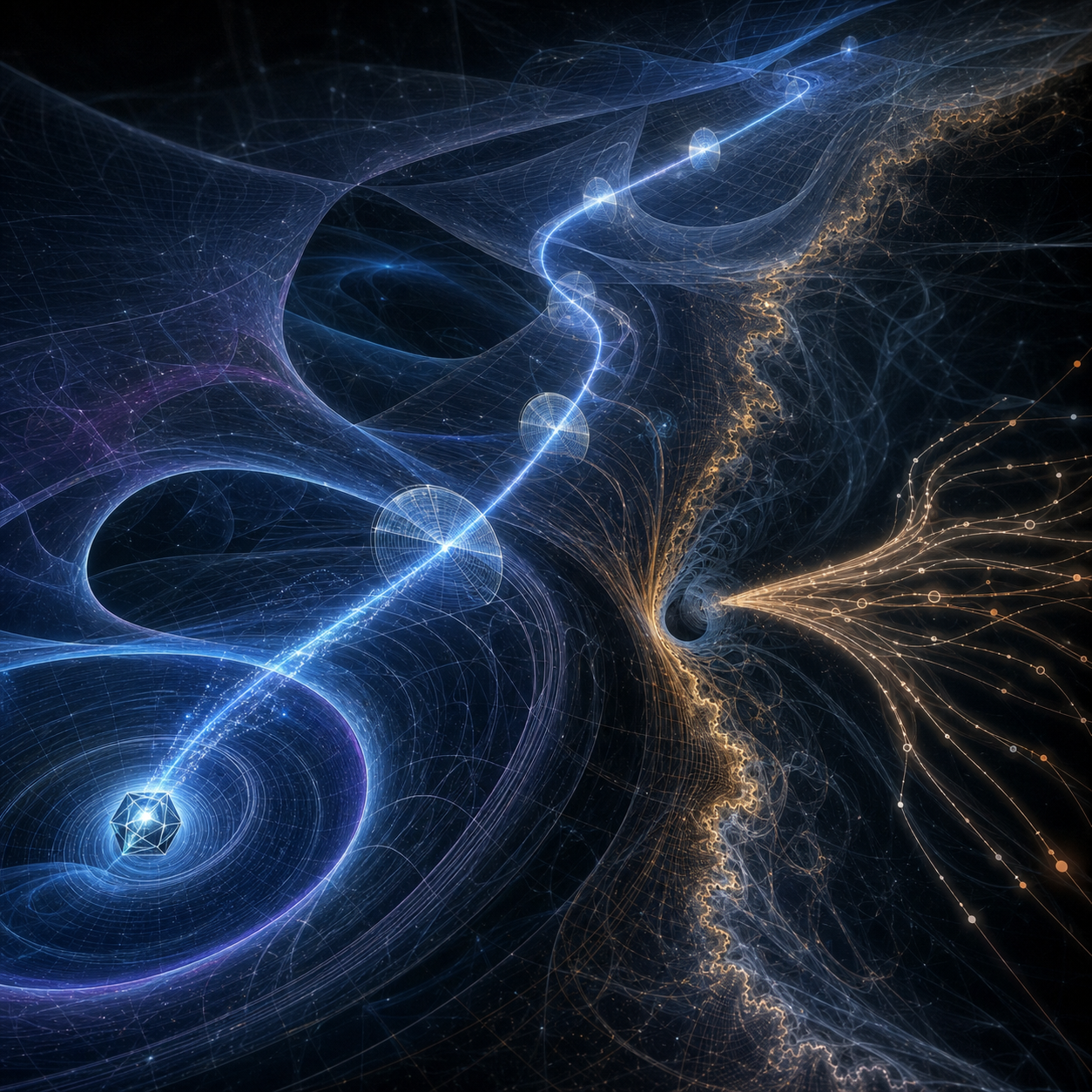
The route can also be understood as a basin of coherence. As long as the omniship remains inside this basin, deviations can still be corrected. The vessel may drift, but it remains dynamically related to the route. If it crosses the boundary of the basin, it enters a different regime. At that point, the original route is no longer recoverable as a controlled navigation structure.
The boundary between coherent navigation and decohesion may be understood as a separatrix: a dynamic frontier between two incompatible regimes. On one side, the route remains recoverable. On the other, the ship has left the basin of coherence. In complex pataphysical domains, this separatrix may be folded, unstable, or fractal. A small difference in state may determine whether the omniship returns to the route or falls into decohesion.
Q-holes are critical regions within this structure. They are not ordinary holes in space. A q-hole is a narrow zone of transition where a small trajectory error can produce a disproportionate transformation of the ship's future state. In chaos-theory terms, a q-hole may function like a dangerous passage near a separatrix or a narrow opening between basins of coherence. Passing through the wrong q-hole can shift the omniship into another dynamic regime, trigger reality jumps, or destroy the recoverability of the original route.
Reality jumps can be described as discontinuous transitions between unstable regimes of the operational space. They are not simple spatial displacements. They are jumps between different representational, causal, mental-state, or route-coherence configurations. A reality jump may preserve some aspects of the vessel while altering the mathematical context in which the vessel's position, route, and return conditions are interpreted.
The checkpoints of an omniship route can be understood through the analogy of Poincare sections. In dynamical systems, a Poincare section is a way to study a complex trajectory by observing where it intersects a lower-dimensional slice of the system. Similarly, an omniship checkpoint is not necessarily a physical location. It is a validation surface inside the route's operational reality. When the ship reaches a checkpoint, it confirms whether its current state still intersects the expected structure of the mission.
This means that checkpoints are not arbitrary destinations. They are diagnostic crossings. Each one tests whether the omniship remains inside the mission's basin of coherence. Earth, The Reliquary, Rendezvous, The Vortex, and Akrelabium are therefore not merely places visited by the RT-874. They are structural confirmations of the route's continued mathematical identity.
The concept of shadowing is also important. In chaotic systems, a calculated trajectory may shadow a real trajectory for some time. The model remains close enough to reality that prediction still works. Eventually, however, accumulated error may cause the calculated trajectory and the real trajectory to diverge. When this happens, the model no longer describes the system usefully.
For an omniship, route stability depends on shadowing. The real state of the vessel must continue to shadow the precomputed route. If the vessel drifts too far, the mission model may still exist mathematically, but it no longer corresponds to the ship's actual state. Decohesion begins when the RT-874 can no longer make its current state shadow the route strongly enough to preserve navigation.
The predictive horizon defines how far ahead the ship can still calculate meaningful corrections. In stable parts of the route, the predictive horizon is longer. The ship can see farther into the consequences of its own state and correct accordingly. In unstable regions, especially near the center of the route or near q-hole density, the predictive horizon collapses. Calculations lose validity too quickly. The ship may still compute, but its computations expire before they can stabilize the route.
Kolmogorov complexity describes the other side of the problem.
A low-complexity state can be described by a compact rule or short model. A high-complexity state requires a much longer description. For an omniship, the danger is not simply distance, time, or energy expenditure. The danger is the growth of the minimum description needed to relate the current state back to the mission-route.
If the ship remains close to its expected path, the description stays compact. The route remains compressible. The vessel does not need to generate an entirely new operational reality; it only needs to confirm and correct within the existing one.
If the ship deviates, the description grows. The vessel must describe the deviation, the new local structure, the altered coherence conditions, the possible return paths, the relation to previous checkpoints, and the continued validity of the mission-route. If the state becomes too complex, too unstable, or too incompressible, the omniship can no longer fit the current state back into the original route structure.
This is why an omniship does not run out of fuel in the ordinary sense. Energy may remain available. Computation may continue. The vessel may still exist. But the route becomes too complex to recover. The ship has not exhausted energy; it has exhausted the ability to maintain a computable relationship between its current state and the route as a singular operational reality.
The Milliarium Aureum Principle expresses this requirement. The vessel must not merely move toward a destination. It must preserve the route as a whole. Origin, destination, checkpoints, corrections, and return conditions must remain part of a single computable structure. If the route is lost, the ship is not merely off course. It has lost the operational reality in which the concept of being on course remained meaningful.
After true decohesion, route recovery becomes technically impossible. Not metaphysically impossible in an absolute sense, but impossible as navigation. A return could occur only by absurd coincidence, not by controlled calculation. It would be like throwing a stone toward the Andromeda Galaxy and expecting it to land randomly on one exact intended point.
The hard-science logic behind omniship movement therefore combines several concepts: chaotic dynamics, Lyapunov divergence, basins of coherence, separatrices, q-holes, Poincare-like checkpoints, shadowing, predictive horizons, and Kolmogorov complexity. These concepts do not reduce the omniship to ordinary physics. Instead, they provide a technical foundation for a posthuman form of navigation in which mathematics, consciousness, route integrity, and operational reality become part of the same system.