The Historical Human Snubber
Template: Note
Source: .writer/books/4. 💽 Database/3. 🗒️ Notes/Technology/Consciousness/Interfaces And Modulation/The Historical Human Snubber.org
1. Image
2. Content
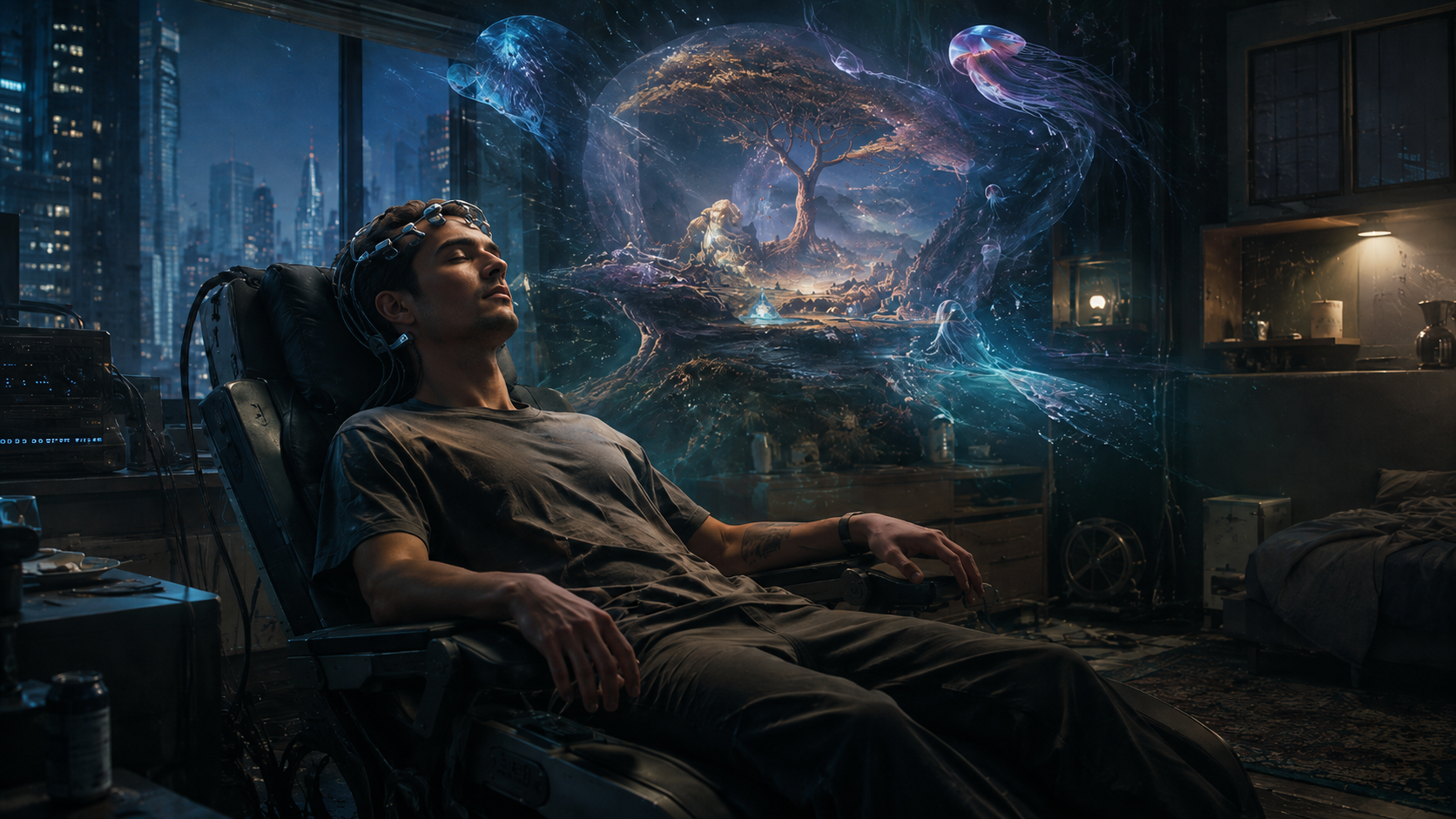
The Snubber was an early human brain-computer interface developed before the legendary Brains' Cage. It belonged to a human civilization more technologically advanced than present-day Earth, but still recognizably human: unequal, commercial, unstable, escapist, and full of ordinary human dysfunction. This was not a Star Trek-like society. It was humanity with better neurotechnology.
The Snubber was not a VR headset in the visual sense. It did not cover the eyes. It was a head-mounted neural device attached to the top of the head and the nape of the neck, connecting the user's brain to a computer through advanced neural mapping, stimulation, and feedback. To an ordinary consumer, it functioned like an entertainment device. To history, it was one of the first crude doors into engineered experience.
The device allowed software to interact directly with the brain. It could produce artificial sensory states: sight, sound, touch, smell, bodily presence, erotic sensation, environmental immersion, and other primitive qualia-like experiences. It was not a RUN, and it was not true reality engineering. It was a crude ancestor of both, still dependent on human brains, human bodies, human software, and human safety protocols.
A Snubber required individual calibration. Each user's brain had to be mapped before the device could produce reliable experience. Early setup might involve guided prompts: think of red, think of blue, imagine cold metal, remember the smell of rain, move your imagined hand, recall a pleasant sensation. Through these exercises, the Snubber built a personal neural driver, translating software instructions into that individual's sensory and affective patterns.
The technology began as expensive and experimental, but by the period relevant to the Brains' Cage legend it had become a consumer device accessible to much of the middle class. It was not cheap, but it was no longer reserved for the elite. In social terms, it occupied a place similar to a powerful entertainment console: desirable, expensive enough to matter, but common enough to reshape culture.
The pornography industry popularized the Snubber. This was not incidental. Direct neural stimulation made erotic software one of the most profitable and culturally transformative uses of the device. Many people first encountered the Snubber not as a medical breakthrough or philosophical gateway, but as entertainment, fantasy, and sexual escape. Most users did not understand the historical importance of what they were using.
The ruling and commercial classes had reason to encourage its spread. The Snubber functioned as a social anesthetic. In a society still marked by inequality, frustration, loneliness, and instability, direct neural entertainment offered distraction, pleasure, sedation, and managed escape. It did not solve human suffering. It made suffering more marketable and easier to endure.
The same quality that made the Snubber powerful also made it dangerous. Humans did not possess the consciousness architecture required to safely handle direct manipulation of the reward system. Unlike the syrakis, whose minds would later become capable of measuring, modulating, and surviving extreme pleasure states, human beings remained vulnerable biological organisms. Their reward systems could be hijacked.
Legal Snubbers included defensive protocols: intensity caps, duration limits, physiological monitoring, emergency shutdowns, anti-loop systems, addiction-prevention routines, and restrictions on direct reward stimulation. These systems existed because everyone knew the technology could go wrong. The danger was not theoretical. Human motivation could be overwritten by pleasure.
Black-market modifications removed those limits. Hacked Snubbers allowed users to bypass safety caps, access illegal sensory intensities, and enter extreme reward loops. Some users paid for experiences that locked them into continuous pleasure, including orgasmic or euphoric loops from which they could not meaningfully choose to exit. This was not a failure of discipline. The stimulation could become so intense that ordinary motivation collapsed beneath it.
Fatal Snubber deaths became a known social horror. It was not uncommon for someone to be found dead at home with a Snubber still attached to their head, physically wasted, dehydrated, starved, and degraded after days or weeks inside a pleasure loop. The body died because hunger, thirst, fear, and survival had lost priority. The only mercy was that the user may have died in a state of immense pleasure. The horror was that pleasure itself had become the trap.
This made the Snubber one of the most ambiguous technologies of its age. It was entertainment, medicine, pornography, therapy, escape, addiction, luxury, and social control at once. It revealed that experience could be engineered, but it also revealed that human beings were not built to survive unlimited access to their own reward systems. They had opened a door before they had become beings capable of walking through it safely.
Despite its vulgar and dangerous beginnings, the Snubber opened the historical path toward the Brains' Cage. Once humans could map sensory experience, stimulate pleasure, build virtual worlds, and interface software with the brain, the next applications became inevitable: trauma treatment, artificial paradise, end-of-life experience, brain preservation, and post-mortem continuation. The same technology that began as neural entertainment could become funerary infrastructure.
The Snubber therefore represents one of the earliest links in the chain leading from humanity to the syrakis. It was not noble, perfect, or fully understood by its users. Most people saw it as a device for games, pornography, fantasy, and escape. Yet inside that crude consumer product was the first practical recognition that experience itself could be engineered. From that recognition came proto-RUNs, brain-in-a-vat afterlife contracts, the Brains' Cage, and, perhaps, the distant origin of the Complex.