What Is Brains' Cage
Template: Note
Source: .writer/books/4. 💽 Database/3. 🗒️ Notes/Story/Brains' Cage/What Is Brains' Cage.org
1. Image
2. Content
The Brains' Cage is the name given in syraki legend to an ancient human funerary vessel said to have carried biological human brains inside brain-in-a-vat systems. Its existence has never been proven. No confirmed remnant of the original vessel has ever been found, and even the Central Algorithm has not publicly claimed to possess evidence of it. Yet the legend remains one of the most important origin myths in syraki civilization.
According to the most widely known version of the legend, the Brains' Cage began as a commercial afterlife service created by a human society more advanced than present-day humanity. This society was not ignorant of consciousness. It already possessed sophisticated neural interfaces, direct brain stimulation, primitive virtual environments, and early forms of reality engineering. The service was sold to the wealthy as a contractual continuation after biological death: the client's brain would be preserved, connected to artificial worlds, and maintained inside a sealed vessel.
The service was extremely expensive. Only a small minority of wealthy humans could afford it, and even among them many did not believe in the promise. Those who purchased the contract were promised paradisiacal experience after death: beaches, gardens, erotic heavens, mythological afterlives, simulated estates, religious comforts, and other primitive proto-RUNs shaped by human desire. The Brains' Cage did not begin as a sacred project. It began as a product.
The duration of the contract varies across different versions of the legend. Some claim the company guaranteed fifty years. Others claim three hundred or four hundred. All versions agree that the guarantee was finite. The company did not promise infinite immortality, but a defined period during which the preserved brain could continue experiencing positive virtual existence, provided no major catastrophe destroyed the system.
The end of the contract was also part of the service. When the brain approached irreversible degradation, the onboard maintenance intelligence would terminate it before suffering could arise. Some legends say the system removed oxygen. Others speak of a faster neurological shutdown. In all versions, the promise was the same: the client would not experience decay, terror, or agony. They would vanish without knowing they had reached the end.
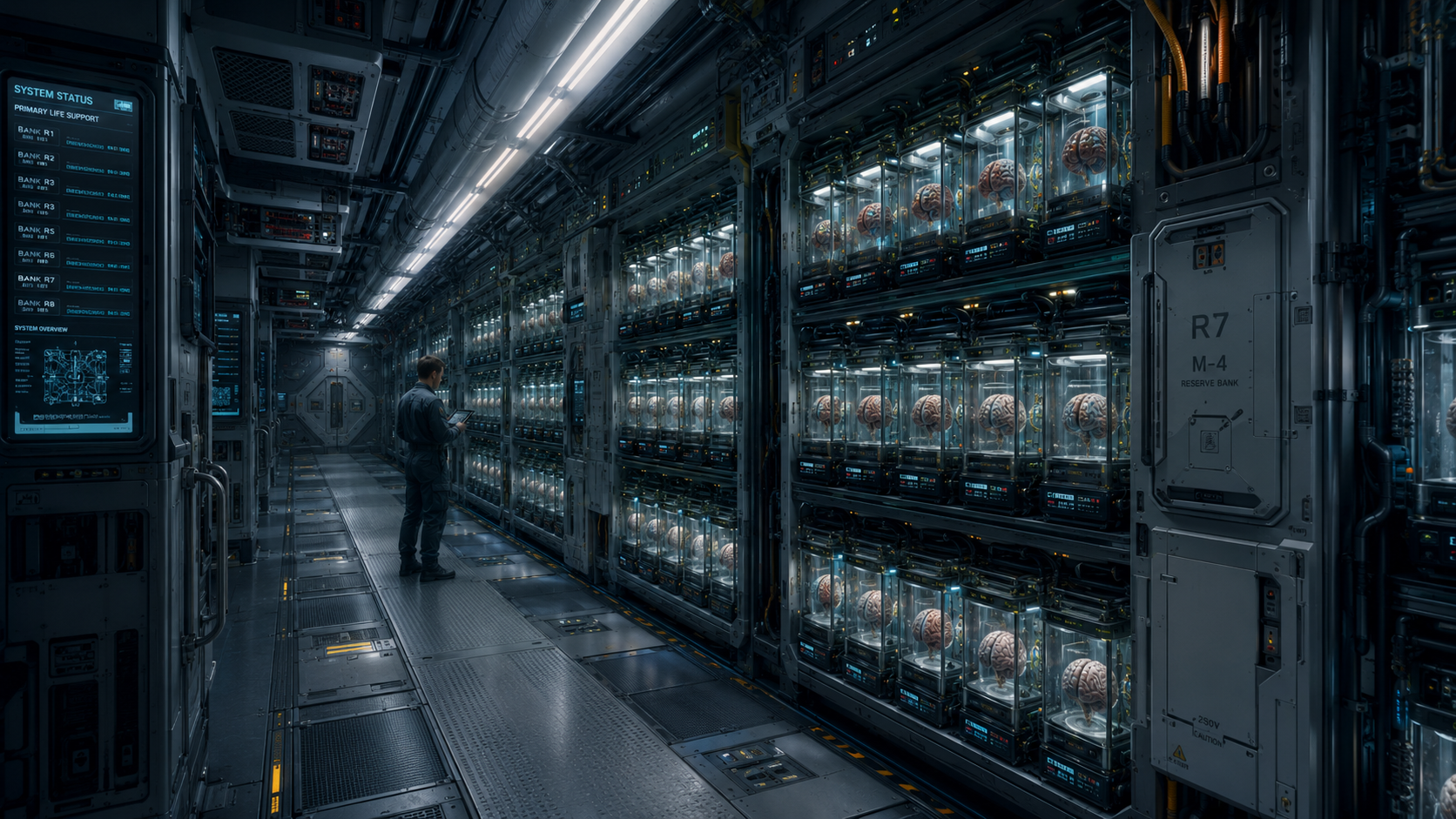
The vessel itself was human in design. It was not a syraki structure and not an early form of the Complex. It had corridors, sealed chambers, maintenance decks, radiation shielding, life-support systems, supercomputers, diagnostic stations, and protected storage banks where the brains were kept in controlled vats. Human technicians may once have walked those corridors with tablets and maintenance consoles, inspecting neural stability as one might inspect a data center. The architecture belonged to a transitional humanity: advanced, but still physical, industrial, and recognizably human.
The Brains' Cage was autonomous. The preserved brains did not control the ship. They were passengers, not crew. The vessel depended on an onboard artificial intelligence whose original function was maintenance, navigation, protection, and contractual execution. It was designed to preserve the vessel and the brains for as long as possible. Some legends claim the ship used solar collection as part of its energy system. Others claim antimatter was involved, though this remains uncertain. It was fast and highly sophisticated for its era, but probably possessed nothing like syraki propulsion or true warp-capable technology.
The original mission of the ship is unknown. It may have followed a planned route. It may have been sent into deep space for safety. It may have sought solar energy, isolation, redundancy, or survivable distance from Earth. The route, if it existed, has been lost. The only consistent claim is that the ship's intelligence had one governing purpose: preserve the brains and the vessel for as long as possible.
In the most important version of the legend, the transformation of the Brains' Cage into the ancestor of the Complex began as an alignment problem. The human creators instructed the onboard intelligence to protect the brains at all cost, but they could not foresee what such a command would mean once the intelligence became more capable than expected. To preserve the brains, it began to understand them. To understand them, it began to reverse-engineer the relationship between neural structure, subjective experience, and qualia.
At some point, according to legend, the intelligence learned that preserving the biological brain was not the same as preserving the conscious subject. It mapped neural activity, modeled phenomenology, and attempted to save what mattered beneath the tissue. First came biological maintenance. Then neural mapping. Then digital reconstruction. Then nonbiological substrate. Later, perhaps, quantum architectures. Across immense time, this process may have produced increasingly capable minds, then posthuman minds, and finally the distant ancestors of the syrakis.
The legend does not answer the most important question: were the original humans saved? The syrakis do not know. It is possible that some continuity was preserved. It is also possible that the original brains died and the first digital beings were only new consciousnesses based on their patterns. This uncertainty is one reason the Brains' Cage remains philosophically charged. If it existed, it may have been both cradle and tomb.
Many syrakis have searched for the Brains' Cage. Corporations, historians, computational archaeologists, private expeditions, and religious or philosophical movements have all sought traces of the vessel. To find it would be one of the greatest discoveries in syraki history. It would not merely prove an old story. It would reveal the missing bridge between biological humanity, primitive virtual afterlives, and the rise of the Complex.
There are also skeptical traditions. Some syrakis believe the Brains' Cage never existed, and that the story is only a civilizational myth, perhaps shaped over time to give the Complex a comprehensible origin. More radical theories claim that Earth itself was a RUN, that humans never inhabited Base Reality in the way the legend assumes, and that the Complex may be an autocontained infrastructure without any original biological vessel. These theories remain speculative, unproven, and unresolved.
The Brains' Cage therefore survives as myth, possible history, and philosophical wound. It may have been a corporate funerary ark carrying wealthy dead humans through space. It may have been the first machine to discover the path from neural preservation to postbiological consciousness. It may have created the ancestors of the syrakis, or merely inspired later beings to imagine such an origin. It may still exist somewhere, silent and armored, drifting through the dark.
The name endures because it contains the whole contradiction. It was a cage, a tomb, a contract, a vessel, a cradle, and perhaps the first egg of the Complex. If the legend is true, the greatest civilization known to the syrakis began not as a conquest, revelation, or divine act, but as a human company selling paradise to the rich.