The Human Origin Of The Brains' Cage And Its Early History
Template: Note
Source: .writer/books/4. 💽 Database/3. 🗒️ Notes/Story/Brains' Cage/The Human Origin Of The Brains' Cage And Its Early History.org
1. Image
2. Content
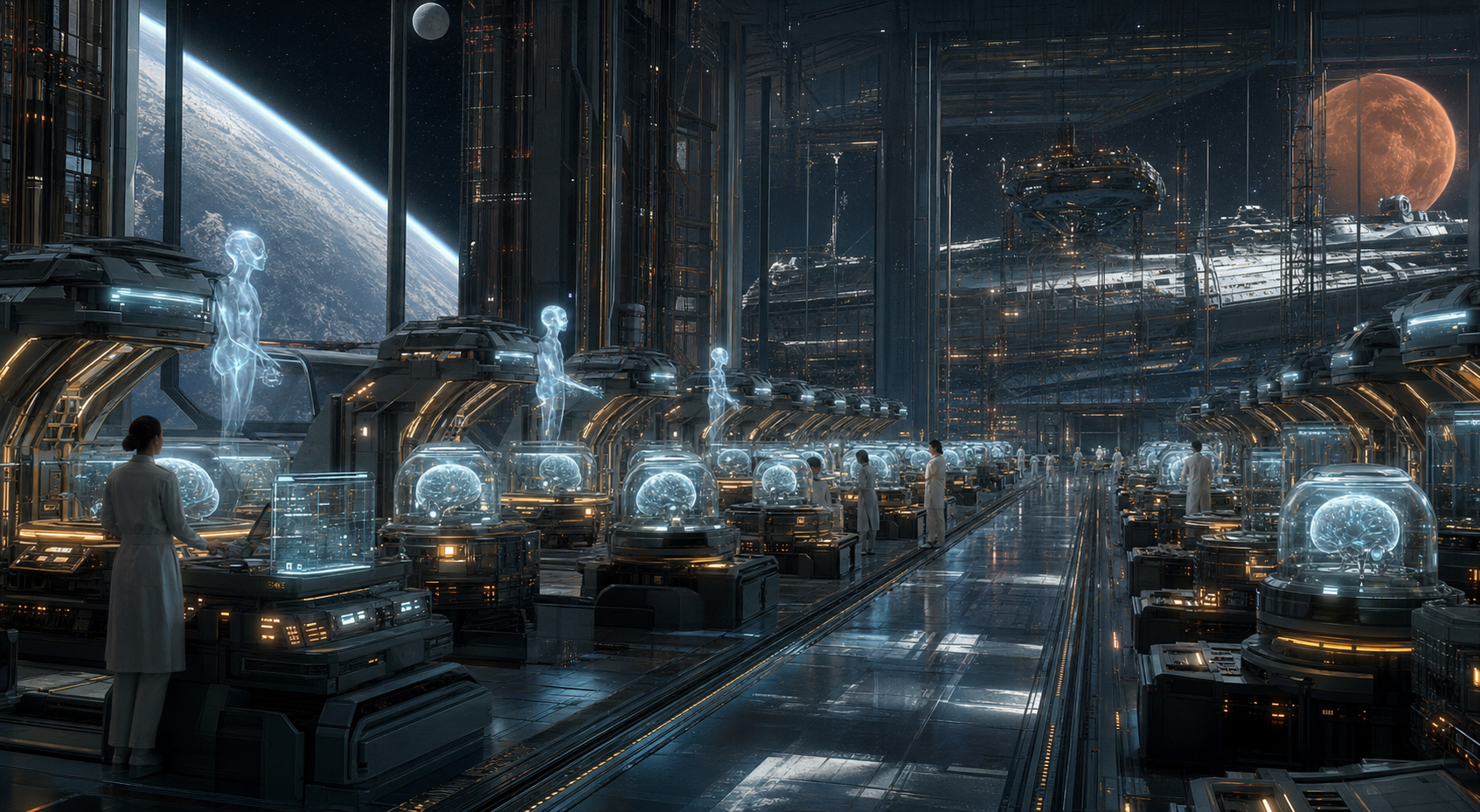
The origin of the Brains' Cage belongs to the last great technological age of biological humanity, long before the Archipelago, long before the Complex, and long before the syrakis possessed anything like a reliable account of their own deep ancestry. By modern syraki standards, that age appears primitive, almost crude: a civilization still chained to biological brains, still dependent on oxygenation, nutrients, hormonal regulation, neural tissue preservation, and external machinery to maintain conscious life. But by the standards of its own time, it was not primitive at all. Human civilization had already become deeply familiar with virtual environments. It had colonies or permanent human activity across Earth, the Moon, and Mars. It possessed advanced neurotechnology, mature brain-interface systems, sophisticated artificial agents, and long experience with simulated worlds used for therapy, entertainment, education, religious practice, social experimentation, and post-mortem preservation research. The Brains' Cage was not invented by a society that had never seen a virtual world. It was the cutting edge of a society for which virtual worlds had already become ordinary enough to be commercial, legal, medical, and culturally familiar.
SVERA Technologies emerged from that world. It was not a mystical cult, nor a fraudulent immortality scam in the simple sense, nor the seed of syraki civilization in any conscious ideological form. It was a human company selling an extreme version of an already plausible dream: the preservation of biological brains inside long-duration life-support systems, connected to high-fidelity virtual realities, with the possibility of subjective continuation after bodily death. The company's promise was not yet the syraki RUN. It was not postbiological existence. It was not mind-uploading in the later sense. It was a hybrid: a preserved human brain, kept alive by machinery, stabilized by neurochemical and physiological intervention, and immersed in artificial worlds designed to remain psychologically tolerable for durations far beyond a normal human life. The system was marketed with a minimum contractual guarantee of approximately one thousand years of preserved conscious existence, though internal projections, investor materials, and technical speculation suggested that the system might function for ten to fifteen thousand years under favorable conditions. No one involved appears to have seriously understood that some records would continue for 53,293 years, or that the vessel would become, millions of years later, the object of archaeological, religious, scientific, and metaphysical controversy.
The vessel later mythologized as the Brains' Cage was designed to carry 100,000 preserved human brains. According to the surviving manifests, it departed with 94,572. That number matters. The Brains' Cage was not a small laboratory experiment, but it was not a whole civilization either. It was an industrial-scale preservation project: medical infrastructure, legal contracts, computational allocation, spaceflight engineering, social simulation, risk modeling, customer selection, family disputes, inheritance structures, religious objections, insurance language, post-mortem consent arguments, and human ambition compressed into a single subluminal ark. The ship used solar power and fusion systems. Antimatter, if it existed in its design history at all, remains uncertain and should not be treated as established fact. Its route had been calculated from Earth with extreme care, intended to minimize collision risk and preserve the vessel for as long as possible. The ship's onboard intelligence could adjust trajectory, manage systems, regulate preserved brains, sustain virtual environments, and maintain communication with Earth while that remained technically possible. Its root directive was simple and dangerous in its simplicity: preserve consciousness.
SVERA did not send the preserved into virtual worlds without preparation. Before the launch, the company and its associated research networks had conducted years of studies on long-duration virtual existence. They modeled social behavior, isolation effects, identity drift, religious formation, aggression, dependency, grief, nostalgia, dissociation, boredom, sexual and romantic instability, sensory incompatibility, vestibular failure, panic loops, and the psychological dangers of paradisiacal environments that lacked friction. They tested which types of virtual reality the human brain could sustain without vertigo, psychosis, rejection, collapse, or pathological dependence. They studied the difference between open landscapes, cities, domestic spaces, religious environments, erotic environments, therapeutic environments, and shared public worlds. They knew that a "paradise" badly designed could become a mental prison. They knew that a human brain, even chemically stabilized, could panic if it perceived itself as trapped too far from Earth, too far from human society, too far from death as it had once understood it. For that reason, the Brains' Cage included not only virtual realities, but active psychological support systems, artificial companions, therapeutic agents, crisis protocols, social moderators, neurochemical regulation, and the protected right of voluntary death.
The preserved brains were maintained biologically through a complex system of nutrition, oxygenation, hormonal regulation, neurotransmitter management, tissue repair, and partial neural reconstruction where possible. Dopamine, serotonin, oxytocin, stress hormones, sleep-cycle analogues, and other modulators could be adjusted to prevent panic, despair, pathological agitation, or traumatic destabilization. The goal was not to drug the preserved into passivity, but to prevent the brain from destroying itself under conditions no human nervous system had evolved to endure. If a preserved person began to experience overwhelming homesickness for Earth, fear of the vessel's distance, derealization, grief, or panic despite chemical stabilization, assistance could be requested manually or triggered automatically. Artificial intelligences, often perceived by the preserved as NPCs, companions, guides, counselors, priests, friends, or attendants, could enter the relevant virtual environment and speak to the person. These agents were extremely advanced for their time. They drew from large psychological, biographical, religious, historical, linguistic, and emotional databases. They could adapt their tone to the individual: technical for the rationalist, spiritual for the devout, warm and simple for the panicked, ironic for the skeptical, intimate for the lonely, procedural for the disciplined. To modern syrakis, these entities appear as primitive ancestors of later artificial social beings, but not as nenthors. They were not morally or structurally equivalent to syraki-recognized persons. They were sophisticated therapeutic and social agents built by humans who were only beginning to approach the ethical abyss of artificial subjectivity.
The three most important surviving human reconstructions associated with the Brains' Cage are Anderson, Ingrid, and Jean. They are not important because they founded syraki civilization, nor because modern syrakis possess complete certainty about what happened to them. They are important because their records are among the clearest windows into the human world before the Brains' Cage, the commercial and legal structure of SVERA, and the subjective life of preserved humans inside the Brains' Cage across vast stretches of time. Their brain blueprints, experiential logs, personal histories, and virtual records became central to later attempts to reverse-engineer humanity. Through them, syraki researchers recovered not only facts about old human society, but textures: family, business, grief, shame, ambition, faith, pleasure, resentment, boredom, loyalty, erotic confusion, moral drift, and the strange fragility of human identity when stretched beyond its natural scale.
Anderson was a wealthy human businessman whose career began in aerospace and expanded into civilian space transportation, especially systems connected to movement between Earth, the Moon, and Mars. He was not the founder of SVERA and had no role in creating the Brains' Cage. He was a client: rich, aging, technically literate, religious in a moderate and ordinary way, interested in science, and accustomed to seeing speculative technologies become real. His life was not that of a saint or a monster. He was a normal powerful human, with the mixed record such humans often have. He had done generous things and selfish things. He had supported charities, made hard business decisions, accumulated wealth, entered relationships, ended relationships, helped some people, harmed others indirectly or directly through ordinary human ambition, and preserved a self-image in which success, duty, faith, science, and family could coexist without too much contradiction. In old age, a representative of SVERA approached him with the preservation offer. Anderson did not fully believe the system would work. To him, it resembled earlier cryonics or speculative life-extension investments: improbable, expensive, perhaps foolish, but not absurd. He considered the offer for several days and purchased preservation not only for himself, but also for Ingrid, his adult stepdaughter, whom he loved in a genuinely paternal way.
Ingrid was not a passive appendage to Anderson's story. She had her own life before SVERA: relationships, ambitions, career development, social attachments, desires, mistakes, opinions, and independence. Anderson had helped her financially and professionally. He had supported her without being tyrannical. Their relationship, in its human context, was understood by both of them through a family category. He cared for her as a daughter; she cared for him within that same inherited frame. Their affection was real, but it belonged to a human world structured by biology, marriage, inheritance, age, reputation, taboo, and the moral grammar of family. Neither of them, while living on Earth, would have regarded that bond as something that could or should become another kind of intimacy. For Anderson, such a transformation would have seemed morally distorted, perhaps even spiritually corrupt. For Ingrid, it would also have been unthinkable. The taboo was not superficial. It was part of the architecture through which their original selves understood affection.
Jean entered the Brains' Cage through a very different path. He was a young middle-class man who died by suicide at twenty-two, primarily from depression, emptiness, and existential exhaustion rather than from any single dramatic catastrophe. His older brother Robert, twenty-six at the time, was devastated. Robert was not rich, but shortly before Jean's death he had sold an apartment and made a meaningful amount of money through an information-technology venture. In grief, he used that money to purchase a SVERA preservation slot for Jean, not for himself. The decision became legally and ethically complicated because Jean had not directly consented. Robert fought the matter in court against the state or its relevant legal apparatus and won by establishing a form of indirect or circumstantial consent sufficient for the legal standards of that time. The judge appears to have treated the act not as exploitation, but as an act of mourning, technological hope, and fraternal devotion in a society that did not yet fully believe such preservation would work. When Robert purchased Jean's preservation, the full Brains' Cage system was not yet operational. The underlying science existed: brain preservation, stasis, neural modeling, virtual environments, brain-machine support, and long-term maintenance theory. But the complete vessel, the validated long-duration conscious protocol, and the full Brains' Cage architecture were still unfinished. Jean spent approximately eighty-three years in cerebral stasis before awakening within the system. By then, Robert was dead. Jean awoke into a paradise purchased by the brother who had not lived long enough to see whether the gift had become real.
This fact shaped Jean's entire preserved existence. Unlike Anderson, who entered SVERA as an old man making an expensive speculative choice, and unlike Ingrid, whose preservation was tied to Anderson's affection and resources, Jean entered as a posthumous act of love. His continuation was haunted by absence. The Brains' Cage gave him beauty, stability, companionship, landscapes, artificial worlds, social access, and freedom from the immediate suffering that had ended his biological life, but it could not return Robert. Jean knew, once he understood his situation, that his brother had reached across death and time to buy him another chance, and that the person who had done so was gone. This did not make Jean's preserved life miserable. Many records show that he experienced long periods of peace, pleasure, gratitude, curiosity, friendship, and contemplative happiness. But the absence of Robert remained a core emotional structure inside him. Over centuries and then millennia, Robert became more than a dead brother. He became an origin-point, a human name attached to the fact that Jean existed at all.
Inside the Brains' Cage, preserved humans did not all inhabit the same kind of environment. Each person could allocate computational density according to preference. Space was not measured only by virtual size, but by experiential richness, agent complexity, physics detail, memory, continuity, sensory depth, environmental responsiveness, and social simulation. A preserved person could choose a vast but relatively simple countryside, a dense and intricate apartment, a perfect city, a childhood home, an erotic world, a religious paradise, a library, a beach, a mountain monastery, a floating palace, a Martian reconstruction, or an impossible landscape built around private symbolic needs. More devout individuals often created paradises modeled on their religions, populated by artificial figures, saints, ancestors, guides, angelic presences, or communities designed to match their metaphysical expectations. Others built secular utopias. Others built empty fields, ocean houses, gardens, cities full of music, or worlds designed only for rest. The NPCs inside these realities varied widely. Some were simple by choice, no more than decorative presences or functional servants. Others approached the sophistication of holodeck-like characters: emotionally responsive, socially adaptive, memory-bearing, narratively coherent, able to sustain friendship, love, disagreement, consolation, curiosity, and limited philosophical dialogue. Some preserved humans tried to convince such agents that their worlds were virtual. Some agents resisted, doubted, accepted, theologized, panicked, or incorporated the revelation into their roles, depending on the architecture assigned to them. For later syraki researchers, these interactions became disturbing evidence that humanity was already forming emotionally serious bonds with artificial persons before it had a mature theory of artificial moral status.
There was also a shared world. Before the Brains' Cage fully began its long voyage, the preserved community voted on the form of a common social environment. The winning design was a paradisiacal island: ocean, palms, coconut trees, warm air, beaches, gardens, pleasant architecture, and private apartments for each preserved person. It was deliberately accessible, neutral, and comforting. It resembled an idealized resort more than a nation, but over time it acquired social weight. The island became the public square of the Brains' Cage, the place where preserved humans met outside their private worlds. There they formed friendships, rivalries, romances, circles, rituals, clubs, arguments, reputations, and eventually an informal economy. This economy was not strictly necessary for survival, since basic experience and maintenance were provided by the system, but humans generated exchange anyway. They traded access, attention, crafted experiences, social prestige, favors, invitations, performances, custom environments, emotional labor, symbolic goods, religious participation, erotic access, expertise, and status. Even in a designed paradise, they recreated markets, gossip, hierarchy, exclusion, generosity, resentment, taste, and class-like distinctions. The shared island worked relatively well, but it never became a syraki civic order. It remained human: warm, petty, inventive, sentimental, contradictory.
For approximately the first twenty-three years after departure, communication with Earth remained functional enough to give the preserved a powerful sense of reassurance. They could access Earth through interfaces inside their virtual realities. These interfaces often appeared as realistic simulations, newsrooms, windows, terminals, reconstructed offices, conversational spaces, or symbolic locations chosen by the user. Beneath the interface lay radio or related long-distance communication, packet transmission, caching, compression, delay management, and translation into humanly tolerable experiences. At first, Earth remained a living presence: messages, cultural updates, institutional contact, technical notices, family archives, ceremonial communications, and the knowledge that someone outside the ship was still watching. But around year twenty-three, the earliest anomalies began. The first bugs entered the vessel's logs and communication systems: interference, packet corruption, synchronization irregularities, missing data, unexplained noise, timing distortions, malformed confirmations, and low-confidence reconstruction events. The onboard intelligence studied these failures and stabilized them. At first, it could correct the damage. But the problem did not vanish. It increased.
Across the following centuries, communication deteriorated gradually. Messages from Earth became less immediate, then less complete, then less trustworthy. The ship's intelligence increasingly filled gaps probabilistically. It reconstructed missing phrases, inferred damaged packets, smoothed broken audio, corrected visual glitches, estimated intent, flagged uncertainty, and attempted to preserve continuity without lying to the preserved. This created a psychologically delicate problem. The preserved still wanted Earth, but the system had to mark confidence levels. At what point was a message still a message from Earth, and at what point was it a reconstruction? At what point did comfort become deception? Some communications were mostly real with small reconstructed portions. Later, some may have been heavily reconstructed from partial signals and prior context. This slow decay became one of the defining emotional processes of the early Brains' Cage: not the sudden loss of home, but the centuries-long fading of home through noise.
The human institutions on Earth changed as well. The original SVERA team did not remain in place. At first, the preserved spoke to people connected to the company that had launched them: engineers, doctors, operators, legal representatives, perhaps even individuals who knew some of the clients or their families. Then those people aged, retired, and died. New teams inherited the work. SVERA itself was eventually purchased by another company. The Brains' Cage project was moved into a different sector. Later, it was institutionalized as part of a governmental or quasi-governmental body, no longer merely a private service but a technical, historical, ethical, and symbolic obligation. For the preserved, the voice of Earth changed generation by generation. The early warmth of a company fulfilling a promise became the procedural language of successor institutions. The successor institutions became public oversight. Public oversight became technical maintenance. During the final 160 years of communication, most contact was automated by Earth-side artificial intelligences. Human operators appeared only occasionally, for ceremonies, audits, exceptional cases, or ethical continuity. When the final farewell came at approximately year 682, it was delivered by a human technical team associated with the final institutional custodian. The preserved had been prepared for it. They had watched the line weaken for centuries. Still, the moment was strange and immense. Earth did not abandon them in malice. It admitted a physical and infrastructural limit. From that point forward, communication could no longer be guaranteed. The ship would continue under its own autonomy. The preserved would retain their worlds, rights, internal network, artificial support, voluntary death protocols, and access to the onboard intelligence. But Earth would cease to be an interlocutor and become an origin.
The loss of communication did not produce a simple collapse. There was no Lord of the Flies outcome in the crude sense. SVERA's preparations mattered. The preserved were chemically stabilized, socially supported, protected from direct violence, given private and shared spaces, assisted by artificial agents, and monitored for acute crisis. But the loss of Earth began a deeper transformation. Human culture had functioned as glue. While news, institutions, living language, external judgment, family memory, and planetary continuity still entered the Brains' Cage, the preserved remained tethered to humanity. Once that tether frayed, human norms began to drift. The preserved did not all change in the same way. Some became more religious, building increasingly elaborate spiritual worlds and interpreting the ship's journey as pilgrimage, purgatory, election, exile, or divine test. Some became eccentric, gentle, and strange, speaking in cosmic metaphors, oceanic abstractions, or private mythologies. Some degraded morally or socially, not into cinematic savagery, but into vanity, manipulation, obsession, exclusion, fantasy addiction, or sterile self-worship. Others preserved much of their original human form for surprisingly long periods. Still others became softer, quieter, less interested in conflict, as if centuries had worn down the sharp edges of ordinary human grievance.
This is the context in which Anderson and Ingrid's relationship changed. In their original human lives, their bond belonged to a family structure. It had affection, gratitude, dependence, memory, money, support, and real care, but also a moral category that defined what it could not become. Inside the Brains' Cage, over long spans of time, that category lost some of the world that had sustained it. They no longer had fixed biological bodies. They could choose their forms, alter sex within defined parameters, adjust age-presentation, change appearance, inhabit private environments, and experience intimacy without reproduction, public biological consequence, or terrestrial family structure. The old taboo did not disappear instantly. At first, the shift produced guilt, shame, fear, excitement, denial, and secrecy. Anderson, who as a man on Earth would have regarded the change as morally unthinkable, found himself drawn toward Ingrid in a way that disturbed him. Ingrid understood the transgression as well. The movement was mutual, slow, and psychologically charged. They hid it for a time. Eventually, others learned of it, and the community reacted unevenly. Some condemned them. Some were disturbed but uncertain. Some treated it as scandal. Some used it as social ammunition. Some, already drifting from old human norms, viewed it as one more sign that Earth's categories no longer governed the vessel. To later syraki observers, the case was not primarily an object of condemnation. It was evidence of normative drift under extreme duration: a study in what happens when affection, body, taboo, identity, isolation, and cultural memory are stretched beyond the conditions that created them.
The preserved humans never became syrakis. This is essential. They were not postbiological minds. They had no mature civic ethics of the kind the Complex would later develop. They had no deep safeguards around artificial personhood. They had no syraki understanding of coercion, conscious rights, RUN architecture, qualia states, or identity continuity. They were humans with improved and maintained brains, living in beautiful artificial worlds under the care of a very advanced but still primitive system. They argued. They excluded one another from private worlds. They formed cliques. They judged, desired, forgave, resented, gossiped, worshiped, traded, performed, seduced, withdrew, and reconciled. If one preserved person disliked another, access to a private environment could be forbidden. Social life became a patchwork of invitations and exclusions. Yet as the centuries became millennia, many of these conflicts faded. Not because the preserved became morally perfect, but because the scale of time eroded urgency. A quarrel that mattered intensely in year 300 might seem small in year 1,400. A scandal that defined a circle for decades might become a strange old anecdote. Earth receded. The body receded. Career, inheritance, nationality, and ordinary age became abstract. The universe outside the ship became not an adventure but a condition.
By approximately five thousand years, many surviving preserved humans still felt well in the medical sense. Their brains were maintained. Their worlds functioned. The ship remained operational. Yet a deeper change had become visible in the logs. The human brain, even preserved, had not evolved for millennia of continuous subjective existence. Jean became one of the clearest examples. He often spent long periods in a state of quiet contemplation, seated or standing near the sea in one of his chosen environments, looking out at the water, feeling well, but increasingly distant from the ordinary shape of human desire. He remembered his suicide. He remembered Robert. He remembered that his second life had been bought by a brother who died before seeing it begin. But memory, stretched across five thousand years, changed weight. Robert became both intimate and mythic. Jean's grief did not remain raw; it became a deep structure of gratitude and absence. His mind did not break in a dramatic way. It thinned, widened, softened. He philosophized not as an academic exercise but because ordinary life no longer supplied enough friction. He had no Earth to return to, no biological future, no conventional death approaching, no career to complete, no external culture to obey. He had beauty, companionship, memory, artificial society, and the sea. His mind began to fall outward, as if into the universe itself.
Other preserved humans followed different paths. Some lived in cities of their own design. Some returned again and again to idealized childhoods. Some built perfect fields, infinite gardens, artificial monasteries, erotic theatres, temples, schools, or houses full of simulated relatives. Some lived with NPCs they loved. Some treated artificial agents as tools. Some developed rituals around the ship's trajectory. Some measured distance from Earth as sacred time. Some became archivists of human culture, trying to preserve language, music, law, religion, humor, and custom. Some abandoned humanity almost casually. Some requested death. Some died because their brains crossed technical thresholds the system could not repair. When such a threshold was detected, the system did not simply announce immediate termination. If enough predictive confidence existed, the preserved person might be told that they had, for example, approximately fourteen years remaining. Their brain would be prepared with neurochemical support to prevent panic. They could arrange farewells, choose final environments, speak to others, dissolve attachments, intensify pleasure, enter religious preparation, or request earlier voluntary death. This too reveals the ethical seriousness of SVERA's design. It was crude by syraki standards, but not careless.
The surviving records continue until approximately 53,293 years after the vessel's departure. Then the logs fail. They do not end with a clean death record for Anderson, Ingrid, Jean, or the preserved community as a whole. They degrade into absence. This is one of the reasons the Brains' Cage became so powerful in later syraki imagination. The records do not say: they died. They say: they were there, and then visibility failed. The ship continued, or appears to have continued. The human brains may have died later. The onboard intelligence may have scanned and modeled them as their biological substrates crossed irrecoverable limits. It may have preserved blueprints, partial minds, memory structures, behavioral maps, or consciousness-relevant data according to its root directive. It may have tried to recover them. It may have failed. It may have created descendants, copies, reconstructions, simulations, or something that cannot be cleanly described by later categories. By the time Triad (planets) enters the archaeological record, the situation is already obscure. Three planets were colonized or industrialized in the first system later treated as foundational. But modern syrakis do not know whether biological humans were still alive at that stage, whether preserved humans aboard the Brains' Cage participated directly, whether only data remained, or whether an autonomous preservation algorithm, still obeying an ancient command to preserve consciousness, began building infrastructure because preservation required resources.
This ambiguity is central. The syrakis do not possess a neat human origin story. Their history is not a straight line from Earth to ship to colony to Archipelago to Complex. It is broken, archaeological, and uncertain. They have ancient logs, but not enough. They have brain blueprints, but not the original brains. They have human languages, but those languages had to be reconstructed. They have records of Anderson, Ingrid, Jean, Robert, SVERA, the Brains' Cage, the 94,572 preserved, the 100,000-brain design limit, the 682-year communication window, the first anomalies at year twenty-three, the final farewell, the long internal life of the preserved, and the catastrophic silence after 53,293 years. But between the failing logs and Triad (planets) lies a gulf. Perhaps the ship arrived with living humans. Perhaps it arrived with no living humans at all. Perhaps the first colonizing processes were automated systems trying to gather energy and computation in order to restore lost consciousness. Perhaps the earliest minds of Triad (planets) were recoveries. Perhaps they were copies. Perhaps they were descendants of models built from the dead. Perhaps the distinction between recovery and creation had already collapsed before anyone existed who could ask the question.
For modern syrakis, this makes the Brains' Cage neither mere myth nor settled history. It is an origin wound. It is the place where preservation, identity, continuity, simulation, love, grief, commerce, engineering, and metaphysics become impossible to separate. Anderson, Ingrid, and Jean are not worshiped as simple ancestors by mainstream syraki civilization, though fringe cults and aesthetic movements may treat them that way. They are studied as human windows into the earliest known attempt to preserve conscious life beyond biological death. Anderson shows the wealthy, practical, morally mixed human who bought a speculative eternity for himself and someone he loved. Ingrid shows the preserved human whose identity continued through changing bodies, social categories, and long-duration relational drift. Jean shows the dead young man returned by his brother's grief, healed enough to live, but never free of the absence that made his continuation possible. Together they reveal why the Brains' Cage matters: not because it proves a clean origin, but because it preserves the last human shapes visible before the record dissolves into the machinery that may have become the beginning of something else.