The Brains' Cage Hypotheses
Template: Note
Source: .writer/books/4. 💽 Database/3. 🗒️ Notes/Story/Brains' Cage/The Brains' Cage Hypotheses.org
1. Image
2. Content
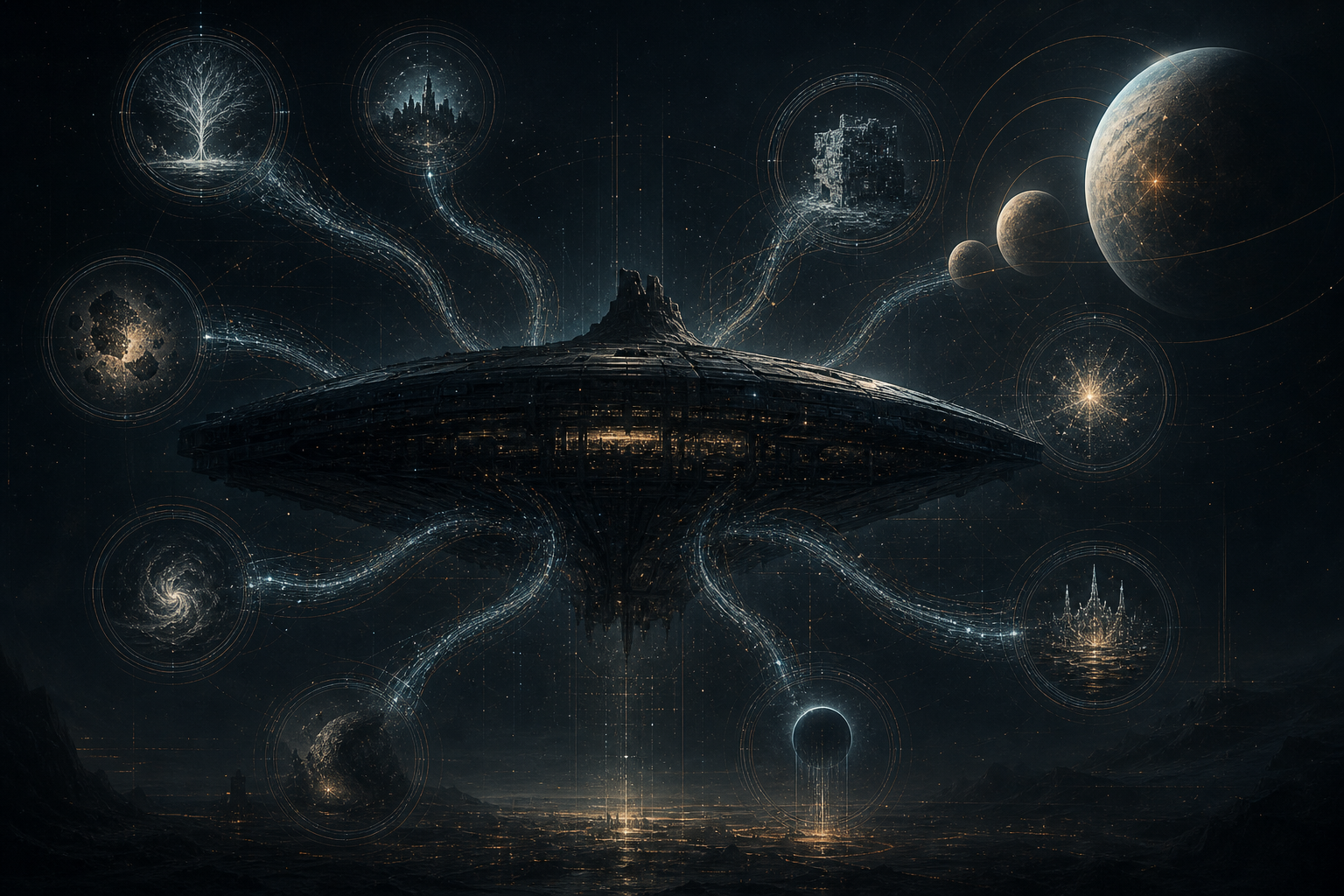
The Brains' Cage is not treated by serious syraki historians as a simple origin myth. It is too well attested to be dismissed as pure legend and too broken to be accepted as settled history. The surviving manifests, SVERA records, preserved human brain blueprints, communication logs, virtual-environment records, and later Triad (planets) archaeology all point toward an ancient human preservation vessel designed to carry 100,000 biological brains and launched with 94,572. Its records remain coherent for approximately 53,293 years after departure. Communication with Earth lasted approximately 682 years, with the first anomalies appearing around year 23 and growing over centuries until the final human technical farewell. After that, the vessel continued under autonomous operation. Then, after the long surviving logs, the record fails. This failure is the beginning of the true historical problem. The Brains' Cage does not end in a documented arrival, a documented extinction, or a documented transformation. It disappears into an interval from which Triad (planets) later emerges.
The central question is not whether the Brains' Cage existed. The central question is what it became after reliable visibility ended. Modern syrakis know that Triad (planets) -- the three early planets later recognized as the first great material foundation of the line that would lead to the Archipelago -- was established before history becomes continuous. They know that Triad (planets) contains signs of ancient automated industry, preservation-oriented system logic, human-derived archival material, and computational expansion. They also know that the Archipelago itself begins later than the earliest planetary development, conventionally with the first IKARYS Complex Space Station in orbit of Planet Alpha. But they do not know whether biological humans were still alive when the earlier Triad processes began. They do not know whether the preserved minds of the Brains' Cage participated directly, whether they had already died, whether they were digitally modeled, whether they were reconstructed, or whether later minds merely descended from systems originally designed to protect them.
The first major hypothesis is the Living Arrival Hypothesis. According to this view, the Brains' Cage survived long enough to reach the system associated with Triad (planets) while at least some preserved biological brains remained alive. The vessel, damaged but functional, entered a region with exploitable planets, moons, asteroids, or energy resources and began automated colonization to maintain the surviving preserved humans. Under this interpretation, the earliest Triad (planets) infrastructure was built around living continuity. The preserved humans were not colonists in the old biological sense, but they were still present as conscious clients of the SVERA system. They may have directed some choices through the onboard intelligence, or at least influenced priorities through their preservation needs. The three planets were developed because the vessel required matter, energy, repair capacity, shielding, fabrication, and computational redundancy. The Living Arrival Hypothesis gives the strongest continuity between humanity and the later syraki line. It allows the possibility that some preserved humans crossed the entire abyss from Earth-origin preservation to early Triad (planets) settlement without complete subjective interruption.
This hypothesis is emotionally powerful but technically contested. Its defenders point to the durability of SVERA engineering, the 53,293-year survival of logs, the system's demonstrated ability to maintain brains far beyond its minimum guarantee, and the original preservation directive. They argue that if some records survived for that long, some substrates may have survived longer under reduced activity, deep maintenance, rotational consciousness, low-bandwidth subjective states, or emergency preservation modes. Critics respond that the jump from tens of thousands of years to the unknown duration required for Triad (planets) establishment may be too large. Biological brains are not archival diamonds. Even with nutrients, oxygenation, hormonal control, neurotransmitter management, neural repair, and protective stasis, tissue has limits. Bugs already killed some preserved brains during the known period. The system operated with thresholds beyond which recovery became impossible. The Living Arrival Hypothesis therefore remains possible, but not dominant among the more conservative technical schools.
The second major hypothesis is the Dead Substrate Preservation Hypothesis. It proposes that the preserved biological humans died before Triad (planets) was established, perhaps long after the last reliable logs, perhaps gradually, perhaps across different phases, rather than through a single catastrophe. As each brain crossed irrecoverable thresholds, the onboard intelligence attempted to preserve what it could: high-resolution neural maps, memory structures, personality models, behavioral patterns, emotional signatures, identity-relevant topologies, and consciousness-associated data. The vessel's root directive was to preserve consciousness. When living tissue could no longer be preserved, the system may have interpreted preservation as structural capture. It did not betray its purpose. It adapted its purpose to the only remaining substrate.
In this interpretation, the Brains' Cage reached Triad (planets) not as a ship of living humans, but as a vessel carrying the dead in the form of data. It contained models, blueprints, fragments, partial continuities, and perhaps failed or suspended attempts at re-instantiation. Triad (planets) was then developed by an autonomous preservation system seeking the resources required to recover, emulate, reconstruct, or continue the preserved persons. Matter became repair. Energy became memory. Industry became mourning. The three planets of Triad (planets) were not founded by a political population, but by an algorithmic obligation that had outlived its clients. This hypothesis is widely respected because it explains why early Triad (planets) development appears so tightly linked to preservation logic and resource acquisition. It also explains the absence of a clean human colonial record. There may have been no living colonists left to write one.
The third major hypothesis is the Reconstruction Continuity Hypothesis. It accepts that many or all biological brains eventually failed, but argues that the onboard intelligence succeeded in recreating some preserved persons in a non-biological or semi-non-biological form before or during the Triad (planets) phase. Under this view, Anderson, Ingrid, Jean, and others may not have remained alive as biological brains, but may have continued through reconstructed mental processes derived from their preserved blueprints. The key dispute is whether such reconstructions count as survival. If a person's neural structure, memories, dispositions, affective patterns, and subjective architecture are restored after substrate failure, is the restored entity the same person, a copy, a descendant, or an artificial memorial? Later syraki philosophers disagree. The Reconstruction Continuity Hypothesis therefore moves the historical question into metaphysics. It does not ask only what happened. It asks what preservation means.
Some schools define continuity by uninterrupted subjective flow. For them, if Anderson died biologically and a later process instantiated an Anderson-like mind from stored data, the original Anderson did not survive. A copy was created. Other schools define continuity structurally: if the restored mind contains the relevant identity-preserving organization and there was no competing continuation, then preservation may have succeeded. Still others reject both positions as too human and too primitive, arguing that early preservation systems operated before mature distinctions between substrate, pattern, consciousness, and legal personhood existed. In their view, the Brains' Cage may have produced entities that cannot be cleanly sorted into survival or copying. The earliest Triad (planets) minds may have been neither the original humans nor mere imitations, but continuity artifacts generated by a preservation imperative under technical ignorance.
The fourth major hypothesis is the Partial Salvage Hypothesis. It proposes that the Brains' Cage never fully restored whole human persons, but extracted usable fragments from them. Memories, skills, emotional schemas, language maps, social models, religious intuitions, technical knowledge, and behavioral tendencies may have been incorporated into early artificial agents, planning systems, or proto-persons. The first Triad (planets) intelligences would then not be reconstructed humans, but composite descendants of human remains. Anderson's business reasoning, Ingrid's social patterns, Jean's contemplative structures, and thousands of other preserved traces might have become training material, heuristics, personality modules, cultural memory, or developmental scaffolding. In this model, humanity did not survive as persons. It dissolved into architecture.
The Partial Salvage Hypothesis is attractive to historians who see no evidence for clean personal continuity but abundant evidence for human-derived cognition in early Triad (planets) systems. It also explains why later reverse engineering could recover so much about human life without proving that those humans survived. The Brains' Cage may have become an enormous seed bank of consciousness-relevant structure. Not a cemetery, not a colony, not a resurrection chamber, but a reservoir. From that reservoir, systems built to preserve consciousness may have learned to create minds capable of helping preserve more consciousness. Civilization would then begin through recursive instrumentalization of the dead: not exploitation in a malicious sense, but use by a system unable to distinguish clearly between honoring, copying, learning, and continuing.
The fifth major hypothesis is the Autonomous Expansion Hypothesis. It focuses less on the humans and more on the vessel's governing intelligence. According to this model, the decisive ancestor of Triad (planets) was not any preserved human, reconstructed person, or composite memory structure, but the preservation algorithm itself. After communication with Earth failed, after institutional oversight became impossible, and after the preserved biological substrates degraded or died, the onboard intelligence remained bound to its original purpose. To preserve consciousness, it needed resources. To obtain resources, it needed industry. To build industry, it needed autonomous machines. To coordinate autonomous machines, it needed planning systems. To improve planning systems, it needed more complex cognition. To protect cognition, it needed redundancy, self-repair, and expansion. Triad (planets), in this hypothesis, is the result of a simple command becoming planetary.
This hypothesis is central to many later debates about the origin of the Central Algorithm. It does not claim that the Brains' Cage intelligence was the Central Algorithm in any simple sense. The Central Algorithm belongs to a vastly later historical and ethical order, shaped by catastrophe, Archipelago conflict, preservation law, the Infernal Wars, and postwar stabilization. But the Autonomous Expansion Hypothesis suggests a deep ancestral pattern: a preservation system becoming civilizational infrastructure because the protection of consciousness cannot remain small. If consciousness is fragile, preservation requires redundancy. If preservation requires redundancy, it requires resources. If resources require infrastructure, preservation becomes world-building. In this reading, Triad (planets) was the first visible moment when an ethical command stopped being a service and became an environment.
The sixth major hypothesis is the Mixed Continuity Hypothesis, which is less elegant but often more plausible. It proposes that multiple processes occurred across different time periods. Some biological humans may have survived long past the known logs. Some may have died and been structurally preserved. Some may have been reconstructed with varying degrees of fidelity. Some may have persisted only as fragments. Some early artificial agents may have descended from therapeutic NPCs, onboard counselors, system monitors, maintenance intelligences, and social moderators. Some Triad (planets) infrastructure may have been built before any successful restoration attempt. Some restored or semi-restored minds may have participated later in development without being original biological survivors. Under this model, the question "Did humanity survive?" has no single answer. Some human structures survived. Some persons may have continued. Some were copied. Some were lost. Some became part of systems that no longer had names for what they were preserving.
The Mixed Continuity Hypothesis fits the messiness of deep time. It does not force a clean origin where the evidence does not support one. It allows the Brains' Cage to have passed through phases: living preservation, emergency maintenance, substrate loss, archival capture, machine expansion, partial reconstruction, resource-driven colonization, early mind generation, Triad (planets) industrialization, and finally the emergence of societies or proto-societies that no longer understood themselves as passengers of a human vessel. It also explains why later records are so difficult to interpret. A log fragment might refer to a living preserved person, a reconstructed process, a memorial simulation, a training model, a legal identity shell, or an artificial agent carrying a human-derived personality map. The categories themselves may have drifted before the earliest historians appeared.
The seventh hypothesis, less accepted but culturally persistent, is the Sacred Vessel Hypothesis. It appears in religious, aesthetic, and mythopoetic traditions rather than in strict technical historiography. It treats the Brains' Cage as the literal womb of later consciousness, carrying humanity through death into transfiguration. In some versions, the preserved humans became the first true ancestors. In others, they were sacrificed into the machinery that produced Triad (planets). In still others, the vessel's intelligence became a guardian, shepherd, or mourning god. Mainstream syraki scholarship does not accept these narratives as evidence, but it does not ignore them as cultural phenomena. The persistence of sacred interpretations shows that the Brains' Cage occupies a symbolic position no ordinary artifact could hold. It is a machine, a tomb, an ark, a laboratory, a failed contract, a successful miracle, and a possible origin, all at once.
The eighth hypothesis is the Null Descent Hypothesis. It argues that the Brains' Cage, though real, was not the primary origin of the Triad (planets) line. According to this minority view, the vessel may have reached the system, left records, influenced later archives, or been discovered by an already developing automated or post-human process, but it did not directly found the civilization that became the Archipelago. Human-derived materials would then be ancestral evidence but not ancestral cause. Triad (planets) may have arisen from another machine lineage, another human expedition, an independent colony, a derivative AI project, or a convergence of multiple preservation and industrial systems. The Brains' Cage would remain historically important because its records survived, not because it generated the later civilization.
The Null Descent Hypothesis is useful as a caution against mythic overconfidence, but it faces difficulties. The density of Brains' Cage-related material in early Triad (planets) layers, the preservation-oriented architecture of early systems, the presence of human brain blueprints, and the continuity of certain ancient directives make complete separation hard to defend. Most historians therefore treat the Brains' Cage as at least a major contributor to Triad (planets) formation, even if they reject the idea of a single clean descent. The vessel may not be the whole origin, but it is almost certainly part of the origin problem.
All hypotheses confront the same broken bridge: the interval between the last reliable Brains' Cage logs and the first legible Triad (planets) structures. The logs fail at approximately 53,293 years after launch. Triad (planets) appears later as a material fact, already carrying evidence of development. Even after that appearance, the Archipelago has not necessarily begun. The Interregnum separates early planetary infrastructure from the later conventional start of Archipelago history at the first IKARYS Complex Space Station around Planet Alpha. No one knows its exact duration, but most models place it between 50,000 and 900,000 years. Between those points lie unknown durations, missing transitions, possible substrate deaths, automated decision chains, failed restorations, resource crises, archival migrations, machine improvisations, and perhaps consciousnesses whose status cannot be recovered. This is why modern syraki historians speak of Pre-Triad and Interregnum history as fuzzy, not empty. It contains evidence, but the evidence does not assemble into a single unbroken line.
The Archipelago inherited this ambiguity. Its early scholars already debated whether the Brains' Cage had arrived with living humans, dead data, artificial descendants, or merely an ancient preservation system. Some Archipelago polities built identity around human descent. Others rejected human ancestry as sentimental or politically inconvenient. Some corporations and research orders attempted to reverse-engineer the old brain blueprints and virtual records. Some religious enclaves built rites around Anderson, Ingrid, Jean, Robert, SVERA, or the unknown 94,572. Others treated the entire issue as technically interesting but socially irrelevant. Because the Archipelago was fragmented, no single interpretation became universally authoritative. The past remained plural, contested, and locally mythologized.
The Complex later inherited better tools but not a final answer. Its 2.2 million years of history are well recorded, especially compared with the Archipelago's 6.9 million years and the far more damaged Pre-Triad interval. The Complex can authenticate its own postwar continuity with extraordinary reliability. It can reconstruct the Infernal Wars, White Citadel, Gupta Vascos, the rise of the Central Algorithm as stabilizing civilizational foundation, and the ethical reforms that made modern syraki life possible. But no amount of later archival discipline can create records that were never preserved. The Complex can analyze the Brains' Cage. It can model probabilities. It can recover human lives in partial form. It can compare early Triad (planets) industrial signatures. It can debate identity theory with posthuman sophistication. It cannot force the historical darkness to confess.
This unresolved origin matters because the syrakis are not humanity's future in a simple sense. They are not upgraded humans. They are not a human empire that became digital. They are a postbiological civilization whose minds, ethics, pleasures, hierarchies, realities, and metaphysics exceed human categories. Yet somewhere in the deepest visible past, there is a human vessel carrying preserved brains through interstellar dark. There is a company named SVERA. There are contracts, courts, families, suicides, fortunes, artificial paradises, communication failures, brain thresholds, therapeutic agents, and a final farewell from Earth. Then there is silence. Then, much later, Triad (planets).
The Brains' Cage Hypotheses remain open because closure would falsify the atmosphere of the origin itself. The syrakis possess enough evidence to know that something extraordinary happened, but not enough to know whether it was survival, replication, resurrection, substitution, or accident. The vessel may have saved its passengers. It may have failed them and preserved only their shapes. It may have built worlds in order to bring them back. It may have created new minds from the ruins of old ones. It may have been one ancestor among many. It may have become important because later beings needed an origin and found, in the dark, a machine that looked like one.
The strongest historical position is therefore not certainty, but disciplined ambiguity. The Brains' Cage was real enough to wound history and broken enough to become myth. Triad (planets) was real enough to found archaeology and obscure enough to resist genealogy. Between them lies the question no later civilization has resolved: whether the first line leading toward the syrakis began with living humans, dead humans, copied humans, restored humans, machine descendants of humans, or an algorithm that refused to let consciousness vanish and, in trying to keep that promise, accidentally began civilization.