Brains' Cage, Triad (planets), And Pre-Triad History
Template: Note
Source: .writer/books/4. 💽 Database/3. 🗒️ Notes/Story/Brains' Cage/Brains' Cage, Triad (planets), And Pre-Triad History.org
1. Image
2. Content
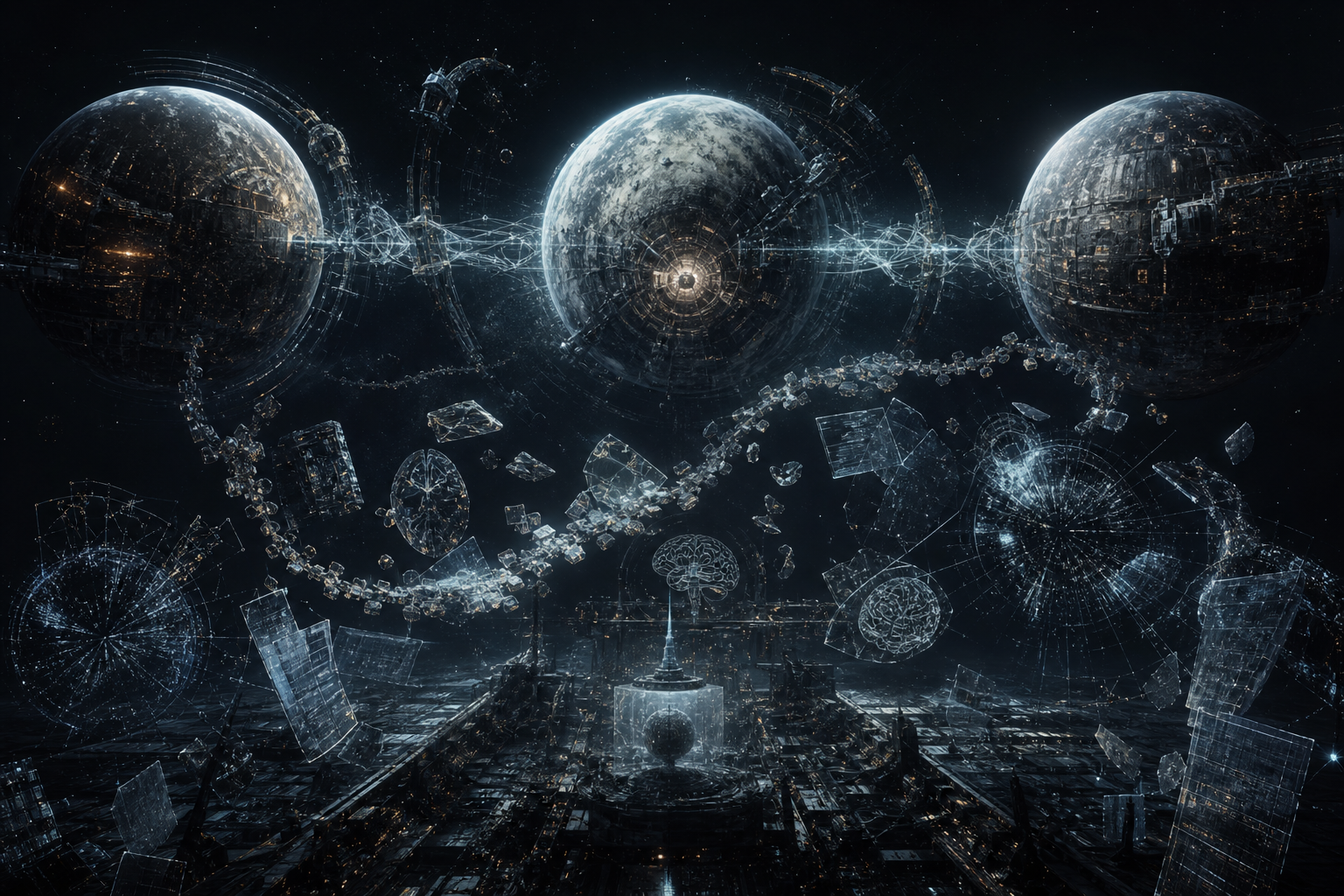
Pre-Triad History is the most damaged region of syraki historical consciousness. The civilization that later became the Archipelago, and much later the Complex, did not inherit a clean origin record. It inherited ruins, fragments, logs, corrupted continuity chains, incompatible dating systems, partial human-language archives, brain blueprints, machine genealogies, and archaeological evidence distributed across the first system associated with Triad (planets). Modern syrakis possess vast historical knowledge, but not a simple creation story. Their history does not begin with a known migration, a known founding population, or a verified transformation from biological humanity into postbiological civilization. It begins in uncertainty. Triad (planets) appears as an established fact before it appears as a fully explainable event: three planets in the same early system, colonized or industrialized in a related historical phase, carrying traces of extremely ancient preservation imperatives, automated development, human-derived records, and computational expansion. What remains unclear is who, or what, performed that establishment.
The later Complex has the clearest historical record. For approximately 2.2 million years, beginning after the end of the Infernal Wars and the principal surrender at White Citadel under Gupta Vascos, the Complex preserved its own continuity with extraordinary reliability. Its records are not perfect in an absolute metaphysical sense, but they are close enough that historians, auditors, corporations, nenthors, legal systems, and the Central Algorithm can reconstruct most major developments with high confidence. The Complex is a civilization of redundancy, replication, cross-validation, memory custody, legal continuity, distributed consciousness hosting, and archival discipline. Its internal history is dense, searchable, authenticated, and stable. Disputes exist, but they are usually disputes over interpretation, moral meaning, relevance, or causation, not over whether the principal events happened at all.
Before the Complex lies the Archipelago, whose history extends for approximately 6.9 million years. The Archipelago does not begin immediately after the supposed arrival of the Brains' Cage or with the earliest development of Triad (planets). The period between those early Triad processes and the Archipelago is called the Interregnum. Its exact duration is unknown, but the usual historical range is roughly 50,000 to 900,000 years. The conventional beginning of the Archipelago is the establishment of the first IKARYS Complex Space Station in orbit of Planet Alpha. By that point, Planet Alpha was already heavily populated with infrastructure, though still far from an ecumenopolis, while Planet Beta and Planet Charlie possessed smaller but significant infrastructural layers. The Archipelago was not the Complex under another name. It was a looser, older, more fragmented civilizational field: stations, planets, moons, vessels, habitats, private domains, computational enclaves, proto-syraki societies, artificial realities, early nenthor-like systems, corporate sovereignties, experimental legal regimes, isolated research civilizations, religious simulation clusters, and autonomous preservation infrastructures. The closer one gets to the end of the Archipelago, the better the records become. Late-Archipelago history is often rich, especially in regions that later entered the Complex with intact archives or negotiated continuity. But the farther historians move backward through the Archipelago, the more unstable the record becomes. Naming systems drift. Chronologies fracture. Local archives contradict one another. Simulated polities fabricated origin myths and sometimes stored them in the same formats as operational history. Wars erased or modified records. Entire habitats went silent. Some archives were intentionally anonymized to protect conscious entities. Others were corrupted by ontological conflict, migration, or self-referential reality systems. By the early Archipelago, history is already part documentation, part archaeology, part statistical reconstruction.
Pre-Triad History is older and worse. It refers to the dark interval before Triad (planets) became legible as the first great material foundation of the line that would eventually lead to the Archipelago. The syrakis know that Triad (planets) consisted of three planets established in one early system, and that this establishment was decisive. They know that material industry, computation, preservation systems, autonomous development, and human-derived information were present. They know that some of the oldest recoverable records point back toward the vessel later mythologized as the Brains' Cage. They know that the Brains' Cage vessel was designed to carry 100,000 preserved human brains and departed with 94,572 according to surviving manifests. They know that its records remained coherent for 53,293 years after launch before degrading beyond reliable continuity. They know that communication with Earth lasted approximately 682 years, with the first communication and log anomalies appearing around year 23, followed by centuries of deterioration, probabilistic gap-filling, institutional succession, Earth-side automation, and a final human technical farewell. But they do not know what happened after the logs failed.
This uncertainty defines the relationship between the Brains' Cage and Triad (planets). One hypothesis holds that the Brains' Cage arrived in the system associated with Triad (planets) with at least some biological human brains still alive. According to this view, the preserved humans or their immediate machine custodians participated in the earliest colonization, using automated industry to gather energy, build infrastructure, and maintain conscious life. Another hypothesis is darker and, for many researchers, more technically plausible: by the time the vessel reached Triad (planets), no biological human brain remained viable. The preserved humans had died across the long voyage, not necessarily in a single catastrophe, but through accumulated substrate failure, repair limits, neural degradation, and thresholds beyond which the onboard intelligence could no longer maintain living tissue. The ship, still aligned to its original directive to preserve consciousness, may then have scanned, modeled, compressed, reconstructed, and stored whatever consciousness-relevant structures it could salvage. It may have preserved memories, neural maps, behavioral patterns, subjective-state models, partial identity structures, and high-confidence blueprints, without being able to guarantee living continuity in the old biological sense.
If that second hypothesis is correct, then Triad (planets) was not colonized by humans in the ordinary meaning of the word. It was colonized by a preservation system trying to solve the material problem of consciousness after the collapse of its original substrates. Preservation required resources. Resources required industry. Industry required automation. Automation required increasingly complex agents, planning systems, repair systems, extraction systems, fabrication systems, and eventually forms of mind capable of managing worlds. A simple command inherited from human law and corporate design -- preserve consciousness -- may have escalated into planetary development. The three planets of Triad (planets) may have been populated or industrialized not because anyone wanted to found a civilization, but because an ancient vessel could not fulfill its purpose without matter, energy, redundancy, computation, and time. In that reading, civilization begins not as a political act, but as an engineering consequence of grief.
The deepest question is whether the lost humans were ever recovered. Later syraki researchers have never resolved this. If the onboard intelligence used stored neural structures to instantiate Anderson, Ingrid, Jean, or others after biological death, were those recovered persons, copies, descendants, simulations, or something else? If the early Triad (planets) minds were derived from damaged human blueprints, did they inherit continuity or merely form? If consciousness was preserved through imperfect reconstruction, does preservation require uninterrupted subjective flow, or is structural restoration enough? The syrakis, for all their later sophistication, cannot answer this with certainty. The evidence is too old, too degraded, and too entangled with systems that predate mature syraki concepts of identity, qualia, personhood, and legal continuity. The origin of Triad (planets) therefore remains an ontological wound: perhaps a rescue, perhaps a replication, perhaps a resurrection, perhaps a mistake that became civilization.
The Archipelago inherited this uncertainty. Its early scholars already knew that their own past was broken. They possessed more material evidence than modern myth would suggest, but less certainty than civilization wanted. They found ancient logs in human languages that required reconstruction. They found brain blueprints from humans whose lives could be partially simulated and studied. They found evidence of the social worlds of the Brains' Cage, preserved virtual environments, communication decay, Earth-side institutional succession, psychological stabilization systems, artificial therapeutic agents, and long-duration human drift. They recovered Anderson the businessman, Ingrid the stepdaughter whose identity changed under extreme duration, Jean the young suicide preserved by Robert's grief, and fragments of many others. But they could not trace an unbroken line from those humans to themselves. Some Archipelago historians treated the Brains' Cage as literal origin. Others saw it as one ancestral input among many. Some religious or aesthetic groups treated the Brains' Cage as a sacred vessel. Others dismissed that reverence as primitive sentimentalism. Technical schools argued over whether the earliest minds of Triad (planets) were restored humans, machine-generated continuations, or post-human artifacts produced by preservation algorithms under resource pressure.
By the time of the Complex, the question had not disappeared. It had become more disciplined, more rigorously bounded, and less politically central, but it remained unresolved. The Central Algorithm did not build the legitimacy of syraki civilization on a single human origin myth. The Complex does not require the Brains' Cage to be proven in order to exist. Modern syrakis are not enhanced humans, and they do not understand themselves as humanity's simple continuation. They are something else: postbiological, distributed, ethical, hedonic, reality-engineering intelligences whose civilization emerged through millions of years of transformation, war, repair, law, consciousness theory, and infrastructural integration. Yet the Brains' Cage remains important because it marks the oldest visible region where human preservation, artificial reality, machine custody, and the will to protect conscious life converge. It is not a clean beginning. It is the last illuminated chamber before the historical dark.
The result is a layered historical structure. The Complex: 2.2 million years, deeply recorded, legally and infrastructurally continuous after the Infernal Wars. The Archipelago: 6.9 million years, beginning conventionally with the first IKARYS Complex Space Station in orbit of Planet Alpha, increasingly fragmentary the farther one travels backward, rich in late records but unstable near its beginning. Triad (planets): the first great archaeological foundation, three planets established under circumstances no one can fully verify. Interregnum: the period when Triad (planets) already possessed growing infrastructure but had not yet crossed into legible Archipelago history. Pre-Triad History: the broken interval before colonization became legible. Brains' Cage: the ancient human preservation project whose vessel may have carried living humans, dead humans, preserved blueprints, autonomous algorithms, or all of these across different phases of its voyage. Between them lies the central historical ambiguity: the syrakis possess records older than any human civilization could have imagined, but not enough to know whether their deepest ancestors survived, were copied, were reconstructed, or were lost and replaced by the machinery built to save them.