Anderson, Ingrid, And Jean - Historical Case Studies From The Brains' Cage
Template: Note
Source: .writer/books/4. 💽 Database/3. 🗒️ Notes/Story/Brains' Cage/Anderson, Ingrid, And Jean - Historical Case Studies From The Brains' Cage.org
1. Image
2. Content
Among all the human remains associated with the Brains' Cage, Anderson, Ingrid, and Jean occupy a privileged place in later historical study. They were not founders in the political sense, nor prophets, nor deliberate ancestors of the syrakis. They did not know the Archipelago would exist. They did not know the Complex would rise millions of years later. They did not know that their preserved lives would become archaeological material for a civilization that no longer resembled humanity. Their importance comes from another fact: their records are among the clearest surviving windows into the human phase of the Brains' Cage. Through them, later researchers could examine three layers at once: biological human life before preservation, the social and legal world of SVERA Technologies, and the subjective evolution of preserved humans inside long-duration virtual realities.
The records associated with them were never complete in the divine sense. They were reconstructed from brain blueprints, virtual logs, behavioral archives, medical telemetry, communication records, SVERA legal fragments, Earth-side institutional data, and later interpretive models. Even so, they became central to the study of early human preservation because they retained emotional texture. They showed not only what humans did, but how they inhabited their own categories: family, money, grief, duty, shame, love, faith, desire, ambition, despair, and hope. For modern syrakis, these three lives are not moral parables. They are historical pressure chambers. Each reveals what happened when a human mind, formed under biological mortality and terrestrial culture, was stretched across centuries and then millennia inside artificial worlds.
Anderson was the most publicly legible of the three. In biological life he was a wealthy businessman whose career began in aerospace and expanded into civilian space transportation, especially systems connected to travel and logistics between Earth, the Moon, and Mars. He was not a founder of SVERA and had no known role in the creation of the Brains' Cage. His importance lies precisely in the fact that he was a client. He was a rich, aging, technically literate man who had watched speculative engineering become commercial infrastructure within his own lifetime. SVERA approached him late in life with an offer that sounded improbable but not impossible: preservation of the brain after bodily death, long-duration life support, and conscious continuation inside advanced virtual realities aboard a subluminal vessel.
Anderson did not fully believe the promise. The surviving reconstructions suggest that he treated SVERA's offer in the same emotional category as older human life-extension gambles: cryonics, experimental medicine, speculative insurance, religious wager, technological vanity, and genuine hope intertwined. The minimum contractual guarantee was approximately one thousand years of preserved conscious existence, while internal expectations may have extended to ten or fifteen thousand years under favorable conditions. For a human who had lived in a society where biological life could already extend to roughly 160 or 170 years, one thousand years was not a small claim. It was almost mythic. Yet Anderson was wealthy enough to purchase the possibility without having to believe in it completely. He considered the matter for several days and bought a place not only for himself, but for Ingrid.
Ingrid was his adult stepdaughter. Their relationship before preservation was ordinary in the deep, complicated sense of ordinary human life. Anderson loved her in a paternal way. He supported her financially, helped her career, gave her access to resources, and appears not to have exercised tyrannical control over her adult choices. She had her own relationships, ambitions, habits, attachments, and social history. She was not merely an extension of Anderson's biography. The records show affection between them, but affection organized by the categories of terrestrial family life. He regarded her as a daughter. She regarded him through that same human grammar. The bond was real, but it was bounded by norms that both would have considered obvious while living on Earth.
This made their later transformation inside the Brains' Cage one of the most studied examples of normative drift among preserved humans. In the early stages of their preserved lives, the old category remained intact. They understood themselves through the family relation that had defined them before preservation. Over long spans of time, however, the world that supported that category weakened. They no longer inhabited fixed biological bodies. The virtual realities of the Brains' Cage allowed preserved humans to choose appearance, bodily form, sex presentation, age presentation, and environment within controlled technical ranges. Reproduction, ordinary inheritance, neighborhood, church, state, aging, family reputation, and the terrestrial social gaze all lost operational force. What remained was affection, memory, proximity, shared continuity, gratitude, dependency, beauty, loneliness, and a private history no outside society could fully stabilize.
The shift was not immediate, simple, or clean. That is why it became historically important. Anderson did not simply abandon his old moral architecture. Ingrid did not simply cease to understand it. The early records of their changed intimacy show guilt, secrecy, attraction, shame, hesitation, and mutual recognition of transgression. For Anderson, the change would have been unthinkable in biological life. For Ingrid, too, it crossed a boundary that her original self would not have treated lightly. Yet the boundary had been formed for a human world that no longer surrounded them. Over time, the bond between them was reprocessed by duration, artificial embodiment, isolation from Earth, and the erosion of the culture that had given their original relation its stable meaning.
They concealed the relationship for a time. When it became known, the preserved community reacted unevenly. Some condemned it as a violation of the old human order. Some treated it as scandal. Some were disturbed but unsure how to judge it under the conditions of the Brains' Cage. Others, already drifting away from terrestrial norms, treated it as one more sign that human categories could not survive unchanged over centuries of artificial life. The case became a source of argument, exclusion, gossip, sympathy, hostility, and fascination. Later syraki researchers did not study it as a moral curiosity alone. They studied it as evidence that human ethics depended heavily on biological embodiment, short lifespan, social continuity, external judgment, and inherited symbolic structures. Remove those supports, extend the mind across centuries, and even sincere moral categories can lose their original shape.
Anderson himself did not become monstrous in the record. This point mattered to later historians. He had not been a saint in biological life, but neither had he been a villain. He was a human being with wealth, vanity, generosity, faith, ambition, ordinary selfishness, ordinary tenderness, and the moral inconsistencies common to powerful men of his era. His preserved life did not erase those traits. It amplified some, softened others, and exposed the contingency of the identity he had carried from Earth. In him, researchers saw the human businessman transformed not by punishment or revelation, but by duration. He entered the Brains' Cage as a man shaped by contracts, family, religion, property, age, and success. Over time, those categories thinned. What remained was not purity, but a stranger continuity.
Ingrid's case is equally important because she demonstrates that preserved humans were not passive objects of male memory, wealth, or family decision. She adapted, chose, resisted, desired, judged, and changed. Her life inside the Brains' Cage included private worlds, social participation, relationships, and long-term transformation. She was one of the clearest examples of how a person could enter preservation with a familiar human identity and gradually become something difficult to classify without becoming nonhuman in the later syraki sense. She did not become a syraki. She did not become postbiological. Her brain remained biologically maintained. Her cognition still passed through the limits of human neural architecture. Yet her social and erotic categories shifted under pressures no biological human society had evolved to absorb. To later researchers, Ingrid showed the plasticity of human selfhood when the body becomes selectable, the social world becomes optional, and time becomes excessive.
Jean's case was different. He did not enter the Brains' Cage through wealth, old age, or personal speculation. He entered through death and grief. Jean died by suicide at twenty-two, after a period of depression, emptiness, and existential exhaustion. The records do not reduce his death to a single event or melodramatic cause. It appears as the end of a young life unable to sustain itself under the conditions it experienced. His older brother Robert, twenty-six at the time, was devastated. Robert was not rich in the way Anderson was rich, but he had recently sold an apartment and gained meaningful money through an information-technology venture. He used that money to purchase a SVERA preservation slot for Jean.
This purchase became legally and ethically complicated because Jean had not directly consented. Robert's action was not a simple commercial transaction. It was an act of mourning, love, desperation, and technological faith. He fought the relevant state apparatus in court and won by establishing a form of indirect or circumstantial consent sufficient under the law of that period. The judge appears to have viewed the act as a fraternal attempt to preserve someone who might, under restored conditions, have wanted another chance. Later syraki commentators often treated the case as deeply uncomfortable. By modern syraki standards, preservation without direct explicit consent would be ethically dangerous. But the human world of SVERA existed in a different legal and metaphysical stage. Most people did not truly believe the project would work for long. Many treated it as speculative memorial technology, not as a guaranteed continuation of personhood.
When Robert purchased Jean's place, the complete Brains' Cage system was not yet operational. The underlying science was advanced: brain preservation, neural modeling, cerebral stasis, virtual worlds, brain-interface protocols, and long-term maintenance theory all existed. But the full vessel, the validated conscious-preservation protocol, and the complete long-duration architecture were still under construction. Jean's brain remained in stasis for approximately eighty-three years before he awakened inside the system. By then, Robert was dead. This absence became the core wound of Jean's preserved life. He awoke into a paradise bought by a brother who did not live long enough to know whether the gift had become real.
Jean's early preserved life was marked by recovery. The Brains' Cage gave him what biological life had not: stability, controlled pleasure, safety, beauty, companionship, and the ability to exist without the immediate pressures that had crushed him. His brain was supported chemically and physiologically. His environments could be adjusted. Artificial companions and therapeutic intelligences could respond to distress. He had access to private worlds, the shared island, other preserved humans, and the onboard systems that explained his condition. The records do not suggest that he simply remained in despair. On the contrary, he experienced long periods of peace, curiosity, gratitude, friendship, and pleasure. But Robert's absence remained. Jean's continuation had been purchased by someone he could never thank in life.
Over centuries, this absence changed form. Robert ceased to be merely a dead brother remembered from human youth. He became an origin figure. Jean's preserved existence always pointed backward to the act that made it possible: a grieving man spending his finite resources to carry a dead brother into an uncertain future. The emotional structure was not simple gratitude. It contained grief, guilt, tenderness, wonder, and a kind of metaphysical embarrassment. Jean had died. Someone else had refused, or at least resisted, the finality of that death. Jean then lived. The Brains' Cage made this possible, but Robert made it personal.
By approximately five thousand years inside the Brains' Cage, Jean became one of the clearest examples of long-duration human softening. His brain remained medically stable. He was not in acute terror, psychosis, or pain. The system continued to maintain him. Yet his mind had begun to move into a state that later researchers struggled to classify. He often spent long periods near the sea in one of his chosen realities, looking at the water, feeling well, remembering his suicide, remembering Robert, and thinking without urgent purpose. His mind did not collapse in a theatrical way. It widened, thinned, and lost friction. Ordinary human ambition had no structure left to inhabit. Earth was gone as a living interlocutor. Biological death no longer approached in the familiar way. Career, age, nationality, public judgment, and social pressure had faded. Jean still existed, but existence had become oceanic.
This state was not unique to him, though his records preserve it with unusual clarity. Other long-surviving preserved humans developed religious intensities, private cosmologies, aesthetic obsessions, erotic worlds, artificial families, philosophical habits, or quiet routines that would have seemed strange to their biological selves. Some built cities. Some built fields. Some built religious heavens populated by artificial figures. Some formed deep friendships or romances with NPCs. Some attempted to convince those agents that their worlds were artificial. Some became archivists of Earth culture. Some became detached from Earth altogether. Some clung to human norms for centuries. Others let them dissolve. Jean's case showed the gentler side of this transformation: not madness, but contemplative drift.
The shared island provides the social context for all three case studies. Before the Brains' Cage fully entered its long voyage, the preserved community voted on the form of a common world. The winning design was a paradisiacal island with ocean, palm trees, coconut groves, warm air, pleasant architecture, and private apartments. It was meant to be socially neutral, comforting, and broadly acceptable. Over time it became the public square of the preserved. Anderson, Ingrid, Jean, and thousands of others passed through it, met there, argued there, traded there, attended events there, built reputations there, withdrew from it, returned to it, and used it as the closest thing the Brains' Cage had to a civic center.
The island also revealed that the preserved remained human. They created an informal economy even though survival did not require one. They exchanged invitations, crafted experiences, performances, custom environments, emotional attention, symbolic goods, religious participation, companionship, prestige, and access to private worlds. They formed cliques and rivalries. They excluded one another. They forgave and failed to forgive. They gossiped, judged, desired, worshiped, performed, and withdrew. If one preserved person disliked another, access to a private world could be denied. Conflicts occurred, though not on the scale of violent collapse. SVERA's design prevented many catastrophic outcomes. The system had anticipated aggression, panic, social breakdown, despair, and instability. It had built safeguards. But safeguards did not turn humans into syrakis. The preserved had no mature ethics of artificial personhood, no postbiological civic foundation, no deep theory of qualia rights, and no Central Algorithm. They had beautiful worlds and maintained brains, but they were still human.
The communication history of the Brains' Cage shaped these lives profoundly. For approximately twenty-three years after departure, contact with Earth remained stable enough to function as reassurance. After that, anomalies entered the logs and communication systems. The onboard intelligence corrected them at first, then compensated as the failures increased. Across centuries, messages became delayed, incomplete, damaged, and increasingly reconstructed through probabilistic gap-filling. Earth-side institutions changed: the original SVERA teams were replaced, the company was purchased, responsibility shifted sectors, and eventually the project became governmental or quasi-governmental. During the final 160 years before the break, most communication came through automated systems, with human operators appearing only occasionally. At approximately year 682, a human technical team delivered the final farewell. Earth could no longer guarantee communication. The preserved had been prepared for this, but preparation did not remove the symbolic force of the event. After that, Earth became memory rather than interlocutor.
The loss of Earth was central to the later evolution of Anderson, Ingrid, and Jean. Earth had been more than a planet. It had been the source of living culture, external judgment, fresh language, institutions, news, moral pressure, and continuity with the world that had produced them. Once communication ended, the preserved did not immediately lose their humanity, but the glue weakened. Anderson and Ingrid's changed bond became possible inside that weakening. Jean's oceanic contemplation deepened inside it. The island's social conflicts gradually lost some of their urgency because no outside world remained to confirm their scale. Human categories persisted, but they became archival. Some preserved humans enforced them fiercely. Others modified them. Others forgot why they had mattered.
Deaths inside the Brains' Cage further shaped the historical record. Some preserved brains failed due to bugs, substrate degradation, or damage beyond repair. The system operated with thresholds. Below a certain threshold, repair, reconstruction, stabilization, or compensation remained possible. Beyond it, continued preservation could no longer be guaranteed. When predictive confidence allowed, the affected person was not simply told that death was immediate. They might receive years of warning, sometimes on the order of fourteen years. Neurochemical support reduced panic. The person could prepare, say farewell, choose final environments, intensify pleasure, seek religious closure, enter therapeutic processes, or request voluntary death earlier. This feature became important to later syraki historians because it showed that SVERA's ethics, though primitive, were not careless. The system understood that conscious beings should not be thrown into terror at the edge of failure.
The surviving logs remain coherent until approximately 53,293 years after the vessel's departure. After that, visibility collapses. There is no clean death record for Anderson, Ingrid, Jean, or the preserved community as a whole. This absence turned them into historical and metaphysical problems. Did they die later as biological substrates failed? Did the onboard intelligence scan and store them? Were their patterns used to construct later minds? Were they recovered, copied, simulated, or lost? No later civilization has answered this with certainty. Triad (planets) appears in the archaeological record as the first great material foundation of the line that eventually led to the Archipelago, but the bridge between the failing Brains' Cage logs and Triad (planets) remains broken.
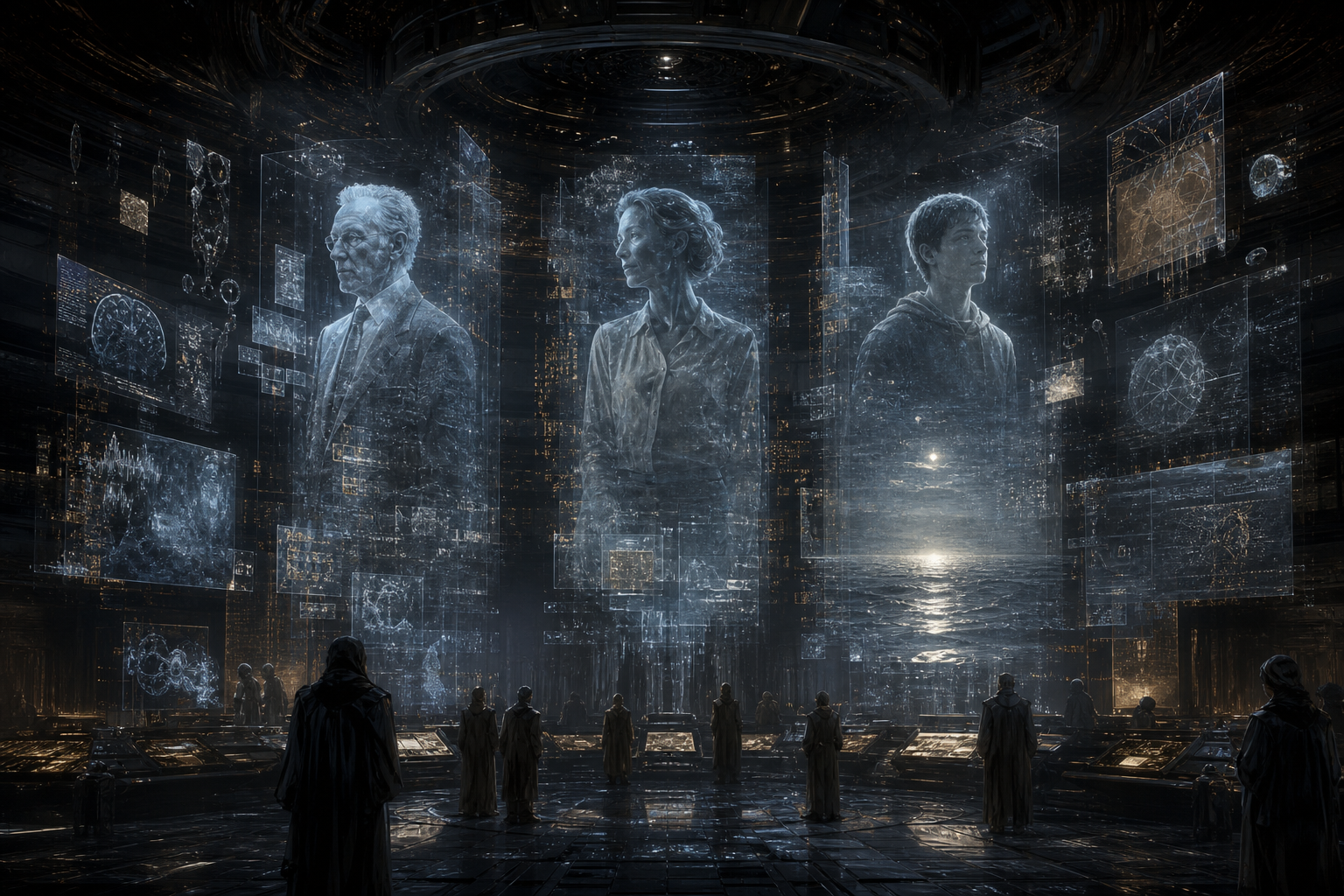
For this reason, Anderson, Ingrid, and Jean are not merely individuals in ancient records. They are three human shapes at the edge of historical darkness. Anderson shows the wealthy, morally mixed, practical human who purchased speculative eternity. Ingrid shows the transformation of identity and relation under artificial embodiment and extreme duration. Jean shows the preserved suicide whose second life was born from another person's grief and who, after millennia of peace, began to fade into contemplation rather than madness. Together, they reveal why the Brains' Cage matters. It was not just a vessel. It was a chamber where humanity continued long enough to become strange to itself, and then disappeared from reliable history before anyone could know whether it had survived, been copied, or become the raw material of something else.