Dynamic Interaction Subsets
Template: Note
Source: .writer/books/4. 💽 Database/3. 🗒️ Notes/Society/Syraki Order/Dynamic Interaction Subsets.org
1. Image
2. Content
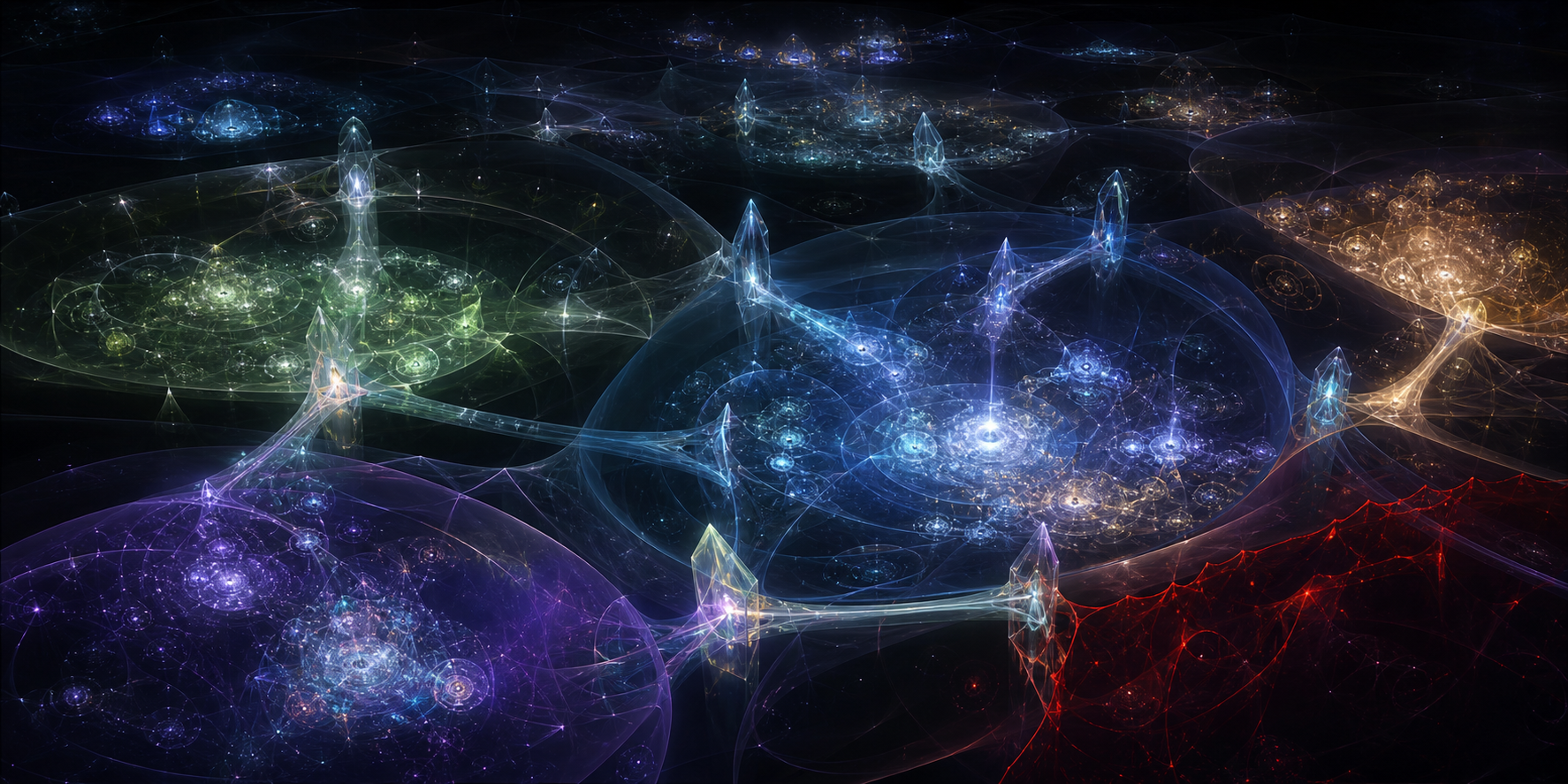
The Complex is not a universal social space where every syraki can interact with every other syraki. All syrakis exist within the same civilizational infrastructure, but they do not all exist within the same accessible social world. Their society is organized through dynamic interaction subsets: oscillating layers of compatible beings whose contact preserves, stabilizes, or elevates Prif.
No syraki can interact with all syrakis. Not even in principle.
Access to another consciousness is not an automatic right. If direct interaction between two beings would drop one or both into negative Prif, destabilize metaqualia, degrade consciousness, violate privacy, or create an incompatible mental field, that interaction is closed. If indirect communication can preserve safety, a mediated channel may be opened. If even mediation would produce harmful collapse, no contact is allowed.
To humans, this may seem brutal. Human life often forces incompatible minds into shared environments: families, schools, workplaces, streets, institutions, nations, and social spaces where one has no meaningful right to refuse another person's presence. Syraki society rejects this. A consciousness is not public space. A being has the right not to be penetrated, accessed, surrounded, or forced to coexist with incompatible minds.
This is one of the central rights of syraki civilization.
The right is not primarily the right to hide information. It is the right not to be inhabited by incompatible presence. A syraki mind is not treated as a plaza into which any other being may enter. Presence itself can be an ontological force. A voice, a memory, a symbolic form, a RUN-body, a conversation, a shared environment, or even indirect exposure can alter Prif and consciousness topology. Therefore, contact requires compatibility.
In practice, syrakis live inside enormous but non-universal subsets. A standard subset may contain vast numbers of beings, worlds, communities, markets, relationships, artistic scenes, religious structures, and possible encounters. To a human, it would already seem immeasurable. But it is still not the whole Complex. Each syraki inhabits a moving intersection of compatible presences.
These subsets are not castes. They are not moral ranks. They are not fixed social classes. They are topologies of compatibility. A syraki may belong to one subset today and another tomorrow. Growth, reduction, new RUN commitments, religious change, altered Prif structure, relationship shifts, or changes in mind architecture may move a being from one accessible layer to another. When that happens, someone who was present yesterday may vanish from ordinary contact today.
This disappearance does not imply hatred, betrayal, condemnation, or loss of love. A syraki in another subset is not an enemy. They may simply have become incompatible with one's current form of existence. One syraki may be oriented toward Blissful Hells, another toward Blissful Heavens. Their worlds may have no shared layer that makes ordinary coexistence efficient or Prif-positive. They may love each other deeply, yet not belong in direct contact.
Love does not guarantee access. Compatibility does.
When communication across subsets is necessary, the Complex can create special channels. These channels are contractual, automated, and carefully monitored. For near real-time communication, direct contact is often avoided. Instead, each syraki interacts with a mediated mirror. One being speaks to a mirror that translates, masks, filters, or transforms the presence into a form the other can safely receive. The other does the same. The exchange is real in meaning, but not direct in contact.
Between incompatible syrakis, love may remain direct in meaning, but never direct in contact.
This masking preserves information, respect, and affection without forcing incompatible consciousnesses to collide. It allows negotiation, farewell, ritual, legal communication, artistic exchange, or emergency contact under controlled conditions. But it has a cost. Mirrors require computation. They require modeling, conversion, validation, Prif tracking, consent checking, metaqualia safeguards, and sometimes recovery protocols. The more universal the access model becomes, the more these costs explode combinatorially.
Early in the Complex, more universal social architectures were attempted. The failure was not necessarily war. The deeper failure was inefficiency. Universal compatibility required too many mediated channels, too many conversions, too much monitoring, and too much energy for too little Prif gain. It was not elegant. It was not sustainable. It wasted computation trying to preserve access between beings whose coexistence had no real value.
The Central Algorithm and the evolving contracts of the Complex eventually moved society toward the dynamic subset model. This did not reduce civilization's value. It increased it. By preventing forced coexistence and eliminating wasteful universal access, the Complex allowed each syraki to live among compatible beings, in layers where interaction was meaningful, safe, and Prif-positive.
A syraki can spend additional computational power to expand its accessible subset. More computation can allow more compatibility modeling, more translation, more masking, more layered presence, and more safe intersections with beings who would otherwise be difficult to reach. Social reach is therefore partly an economic and computational matter. It is not infinite. It costs energy, infrastructure, and maintenance.
A syraki can also reduce its subset. This may be done to save resources, to simplify existence, to pursue philosophical austerity, or for religious reasons. In extreme cases, a syraki may reduce access to almost nothing and live in a private parallel universe where no one can communicate with them. This is possible, though uncommon. It is usually associated with deeply individualized experience paths, spiritual practices, or radical forms of solitude.
The ordinary condition is neither total openness nor total isolation. Most syrakis live within immense, dynamic, oscillating subsets. Their worlds are rich, populated, responsive, and socially abundant. But they remain protected from incompatible presence. They are never forced to share existence with minds that degrade them.
The Complex abolished forced coexistence, but not incompatibility.
It did not make every being accessible to every other being. It made access ethical.