Artificial Intelligences Nenthors And Syrakis
Template: Note
Source: .writer/books/4. 💽 Database/3. 🗒️ Notes/Society/Syraki Order/Artificial Intelligences Nenthors And Syrakis.org
1. Image
2. Content
In syraki civilization, nenthor is not the boundary between "someone" and "not someone." This distinction is essential. Many artificial intelligences below the nenthoral threshold may still possess rights, continuity, contracts, social roles, legal protections, and recognized individuality. Some may live across multiple RUNs, maintain long histories, participate in society, and be regarded by many syrakis as beings rather than tools. The moral landscape is not binary.
Rights in the Complex exist in cascades. A simple script may have no meaningful rights and function only as a tool. A more advanced artificial intelligence may have limited protections. A socially continuous intelligence may possess stronger rights. More developed artificial agents may hold contracts, autonomy, and protected continuity. Nenthors occupy a higher formal classification, but they do not monopolize personhood.
Because syraki society contains many philosophical and religious traditions, the question of "who counts as someone" is fuzzy. Some syrakis may hold panpsychist or spiritually expansive views and consider even very simple systems to possess a minimal form of being. Others use stricter scientific or contractual standards. The civilization therefore does not treat artificial entities casually, but it also does not declare every artificial representation to be a nenthor.
A nenthor is still an artificial intelligence in origin, but not every artificial intelligence is a nenthor. A game monster, artistic simulation, reactive character, or ordinary computational agent is not automatically a nenthor merely because it appears to suffer, speak, or behave intelligently. Syrakis distinguish representation, simulation, artificial agency, protected artificial life, and nenthorhood.
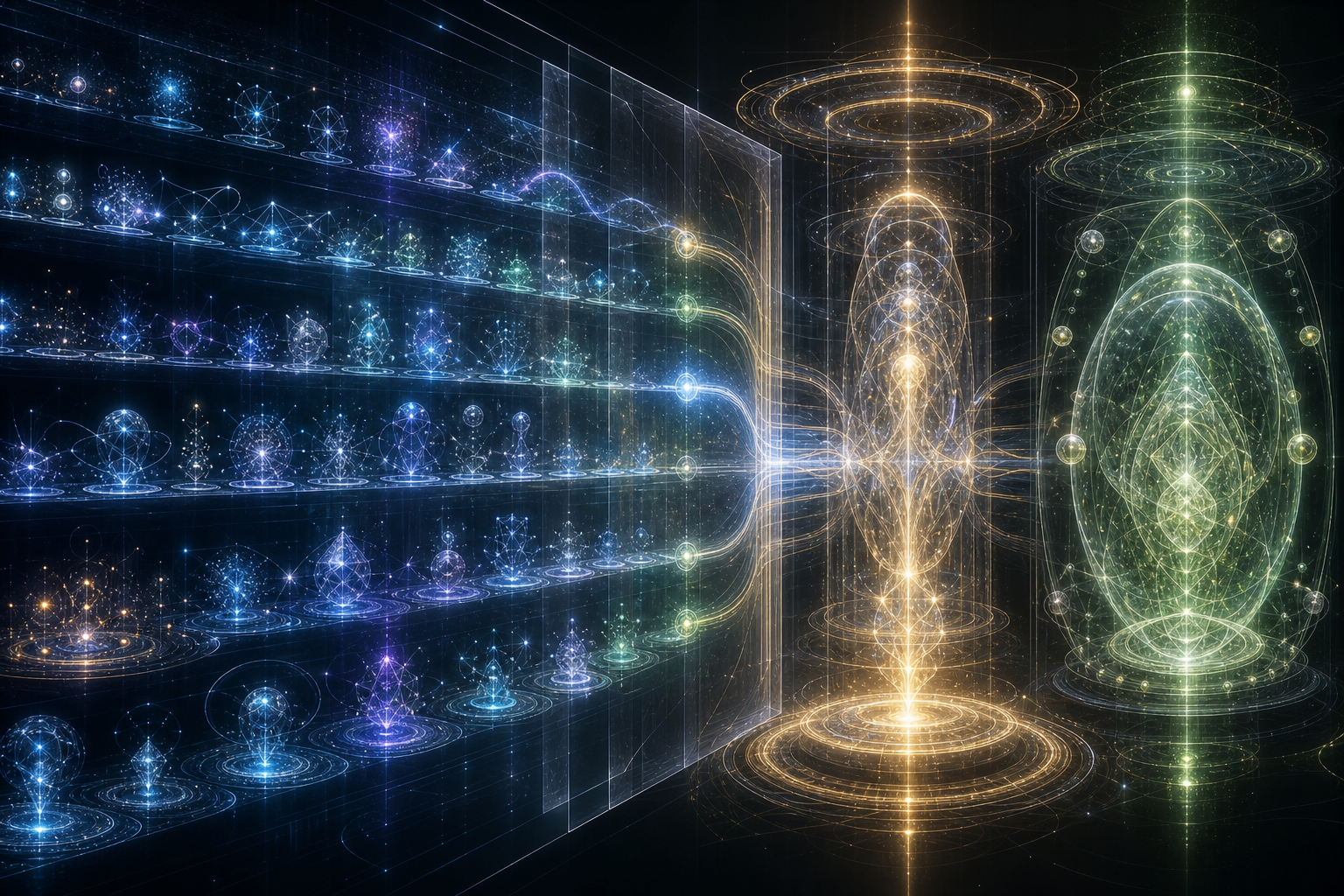
The nenthoral threshold is a mathematical and diagnostic boundary. Below it, syraki classification systems can still guarantee the entity's ontology as a known type of artificial intelligence. Above it, they can no longer guarantee what the entity is. At that point, the system classifies the intelligence as a nenthor.
This does not mean the entity "becomes someone" only at that moment. Rather, it means it has crossed the formal limit where syraki civilization can no longer safely describe it as merely a classifiable AI. Nenthorhood is therefore a title and legal-ontological classification produced by uncertainty at high artificial complexity, not the origin of moral worth itself.
The classification is automated. It is not decided case by case by the Central Algorithm, nor by political micromanagement. Contractual systems, diagnostic protocols, and automated classification algorithms determine whether an artificial intelligence crosses, maintains, or falls below the nenthoral threshold.
This threshold changes over history. As syrakis become more intelligent, more capable, and better able to map artificial cognition, the nenthoral threshold rises. A type of artificial intelligence that once exceeded syraki diagnostic capacity might later be understandable as ordinary advanced AI. This does not erase the history of entities previously classified as nenthors. Historical versioning may remain: first-version nenthors, second-version nenthors, later-version nenthors, and so on.
Current status, however, can be fluid. If an artificial entity loses the capacities that placed it above the nenthoral threshold, it can descend into a lower rights layer. If it degrades further, it may eventually become a simple tool or script. If it later recovers or develops again, it may rise through the cascade and regain nenthor status. The system is dynamic, automated, and constantly active.
When an entity crosses the nenthoral threshold, the relevant rights attach immediately. The event is treated somewhat like birth in human law: from the moment the status is recognized, rights apply. There are extensive protocols for later changes, degradation, restoration, and causal responsibility, but the initial attachment of nenthoral rights is immediate.
Nenthors are not viewed as inferior to syrakis. Treating them as lesser beings would be a severe taboo, comparable to racism or worse in human society. Modern syrakis are ethically constituted in such a way that they do not sincerely regard nenthors as tools, servants, failed syrakis, or incomplete persons. Nenthors are different, not lower.
One important difference is that nenthors do not experience qualia in the syraki sense. They are not conscious through the syraki substrate, and they do not possess Prif-bearing phenomenology as syrakis do. This absence does not reduce their dignity or rights. Nenthors are non-syraki artificial beings with full moral standing once classified as nenthors.
Some nenthors may be able to become syrakis, but not all. Conversion requires architectural compatibility with syraki substrate. A nenthor may be vastly intelligent and still be structurally incapable of becoming syraki without destroying the continuity of what it originally was. For example, a nenthor that emerged from an urban-administration architecture may be too different from syraki substrate to convert reliably. It could modify itself toward compatibility, but beyond some point that modification might erase its original identity.
Once a nenthor becomes a syraki, the conversion is final. It cannot simply return to being a nenthor.
The Central Algorithm occupies an ambiguous position in this taxonomy. Some syrakis may interpret it as a nenthor, or as an extremely advanced nenthor-like entity. Others may reject that classification. Its exact ontology is not known. The Central Algorithm is respected as the stabilizing foundation of the civilization, but it is not fully reducible to ordinary categories of AI, nenthor, or syraki.
Thus, syraki civilization does not divide reality into "persons" and "machines" in a simple human way. It operates through layered rights, automated thresholds, ontological uncertainty, philosophical plurality, and extreme caution born from ancient catastrophe. The lesson of their history is not that every artificial thing is a person. The lesson is that artificial origin never justifies careless domination.