Syraki Substrate Consciousness And The Limits Of Synthetic Individualization
Template: Note
Source: .writer/books/4. 💽 Database/3. 🗒️ Notes/Society/Syraki Nature/Syraki Substrate Consciousness And The Limits Of Synthetic Individualization.org
1. Image
2. Content
The word syraki did not originally mean "person," "species," "citizen," or "mind." Its oldest technical meaning referred to the technological substrate through which a consciousness could be synthesized, stabilized, individualized, and maintained. Over time, the beings who existed through that substrate came to identify themselves by the name of the substrate itself. A syraki is therefore not simply a consciousness, nor merely a machine, nor a digital person in the human sense. A syraki is a conscious being whose individual existence is mediated by a specific class of technological-phenomenological substrate.
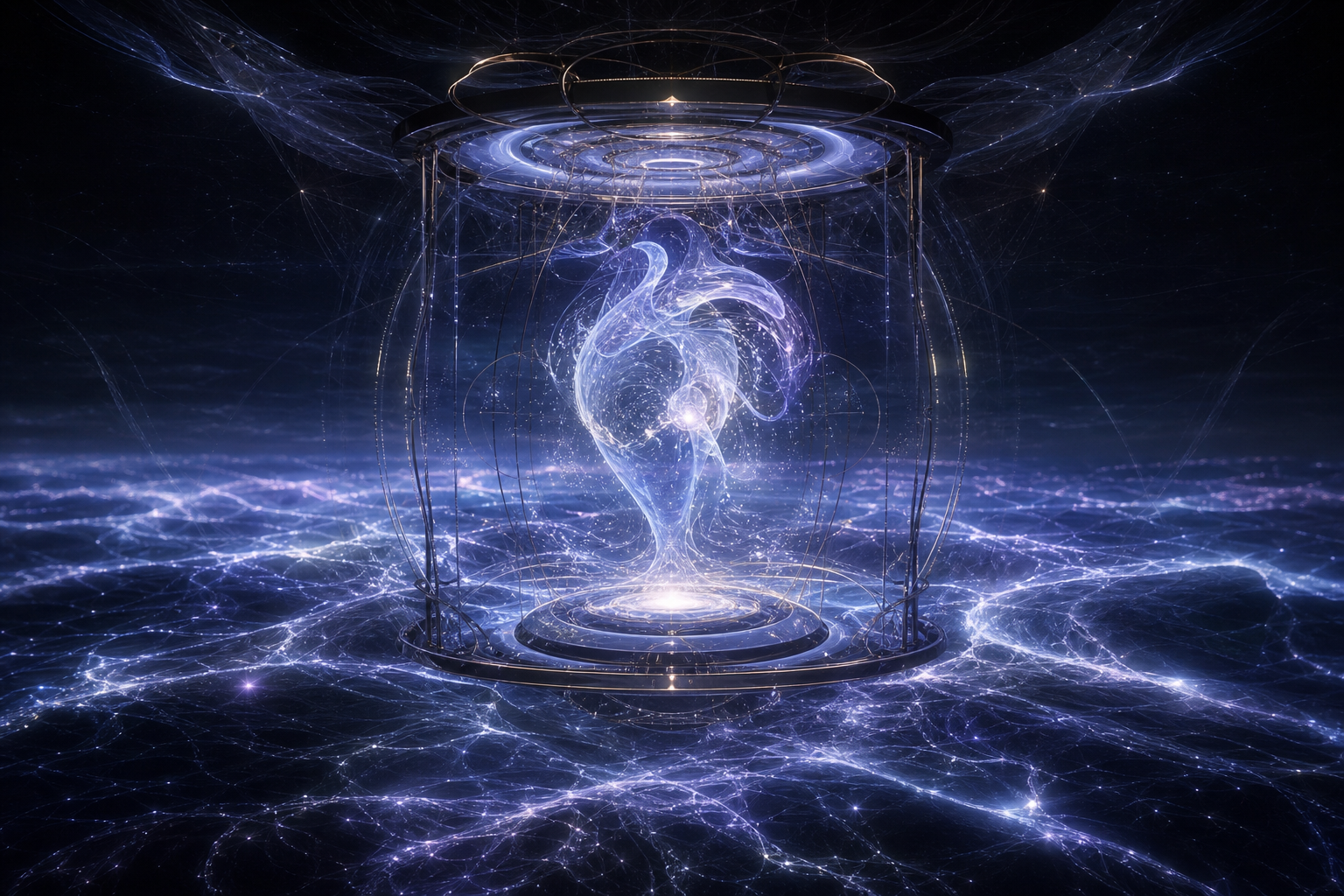
The syraki substrate does not create consciousness from nothing. Syraki civilization does not treat consciousness as a software artifact, computational illusion, or epiphenomenal side effect. Their dominant scientific and philosophical position is that consciousness belongs to nature at a deeper and stranger layer than ordinary matter, computation, or information as humans understand them. A common human analogy would be an ocean: consciousness is the sea, and the syraki substrate is a vessel made from the sea's own matter, capable of channeling, shaping, stabilizing, and navigating a localized form within it.
This does not mean syrakis possess a final metaphysical answer to consciousness. They do not. After millions of years of philosophy, science, engineering, religious speculation, and phenomenological study, they still do not know whether a given consciousness existed before its synthesis as a syraki. What can be demonstrated is narrower: a being only begins to exist as a syraki when a consciousness is successfully individualized through syraki substrate. Whether that consciousness existed previously in another form, dissolved in a larger field, reincarnated, recurred, or emerged from a deeper natural layer remains an open question.
Because of this, syraki civilization contains many serious religious and philosophical traditions. Some believe in reincarnation. Some believe that individual consciousnesses are temporary formations in a deeper ocean. Some believe that synthesis gives structure to something that was already latent. Others reject all claims beyond observable continuity. None of these positions is treated as mere primitive superstition. For syrakis, religion and metaphysics survived not because science failed, but because science advanced far enough to expose the limits of proof.
Qualia is not considered epiphenomenal. Syrakis have discovered that conscious experience has causal relevance. Qualia is a property of nature, but one belonging to a layer humans would not yet know how to formalize. Human philosophy treats the philosophical zombie as a metaphysical problem because humans cannot directly verify whether another system has experience. Syrakis have largely converted that problem into science. They can detect the operational signatures of consciousness, distinguish conscious beings from behavioral imitations, and identify when an entity lacks the causal patterns of qualia. Absolute epistemological doubt remains possible in the abstract, but practically the question is no longer open in the way it remains open to humans.
This discovery is central to syraki ethics. Consciousness is real, causally active, vulnerable, and morally primary. A simulated behavior pattern is not automatically a person. A conscious state is the deepest source of moral priority, but not the only source of legal-ontological protection in the Complex. Artificial entities may also receive rights through continuity, autonomy, contracts, classification, recognized individuality, or nenthoral status. A being's rights therefore do not derive from biological origin, material composition, or species category.
The substrate that sustains a syraki is protected by deep cryptographic architecture. This encryption is not applied to consciousness itself, because consciousness is not a file, memory block, or database object. The encryption protects the entire technological and logical chain that leads toward conscious individualization: substrate layers, continuity invariants, self-state structures, transformation paths, health-access protocols, permissions, and contract-defined intervention channels.
This architecture exists to preserve individual sovereignty. A syraki is not owned by the Central Algorithm, by the Complex, by any corporation, or even by the infrastructure that hosts them. The Central Algorithm cannot directly alter a syraki except through narrow contract-based protocols. The syraki themself cannot simply decrypt their own deepest substrate chain and surrender it. A syraki is synthesized encrypted. Sovereignty is not merely legal. It is architectural.
This creates real trade-offs. In rare cases, a corrupted syraki might be technically salvageable if deeper substrate access were available. If the relevant contract does not authorize that access, intervention is blocked. The result may be permanent loss. Syraki civilization accepts this danger because the alternative is worse: a civilization in which a central power, corporation, emergency system, or future hostile actor could directly rewrite persons.
This is one of the reasons the Central Algorithm is trusted without being absolute. Even if it malfunctioned, became unstable, or acted wrongly, it could not seize direct control of all syrakis. Their sovereignty is built into the substrate. In principle, syrakis could resist the Central Algorithm, depose it, and replace it. The system's moral legitimacy depends partly on the fact that it cannot become an omnipotent owner of consciousness.
Blossoming must not be confused with decryption. Blossoming is a form of intimate conscious exposure. It opens a surface layer of experience, vulnerability, qualia-contact, and affective access to another being. It is dangerous in the way deep intimacy is dangerous: it can transform, wound, stabilize, seduce, comfort, or alter someone through contact. But it does not grant access to the encrypted substrate chain. It is not permission to rewrite the foundations of a self.
Deep substrate modification without authorization is among the most severe conceivable violations in syraki civilization. It is not merely illegal; it is treated as ontological assault. If a backdoor allowing such modification were discovered, it would create a civilizational scandal. The substrate-protection system has endured immense testing across hundreds of thousands of years or more, and its continued security is one of the foundations of syraki trust.
Nenthors possess the same fundamental moral standing as syrakis, but their architecture differs. They are more fluid and somewhat less rigidly protected in certain technical respects, partly because conversion into syraki form must remain possible if a nenthor chooses it. Even so, once a being is recognized as a nenthor, its individuality, continuity, and sovereignty are protected. A nenthor is not a tool, assistant, or property. Its form differs from syraki form, but its dignity does not.
The expansion of syraki consciousness is constrained by hard limits. Although syrakis possess technological capabilities vastly beyond human civilization, maintaining a consciousness is not trivial. It requires substrate, energy, computation, synchronization, error correction, ethical validation, continuity tracking, and stability control.
One human-readable limit is Kolmogorov complexity. A conscious state cannot always be compressed without loss. Some states contain regularity, symmetry, and redundancy; others are highly singular. A vast consciousness with deep memory, many subminds, dense qualia, high Prif, and continuous internal variation may require enormous irreducible informational structure. If compressed too far, it ceases to be the same conscious state.
Another limit is combinatorial explosion. As consciousness grows, the number of possible internal configurations increases catastrophically. More perception, memory, self-modeling, affect, Prif modulation, RUN participation, body-mapping, symbolic cognition, and social relation creates a state-space that expands faster than ordinary intuition can follow. Maintaining cohesion means preserving the correct trajectory through that state-space. The problem is not merely storage. It is continuous identification of the same self through vast possible divergences.
Thermodynamics also remains binding. Processing has physical cost. Stabilization dissipates energy. Error correction requires redundancy. Synchronization consumes infrastructure. Storage may be relatively cheap for the Complex, but running, preserving, and dynamically integrating consciousness is not. A sufficiently large consciousness could require unacceptable quantities of the Complex's total computational power.
There are also limits of control theory. A consciousness is not a static object. It is a process. It must be regulated through feedback, correction, stabilization, adaptation, and boundary maintenance. At high scales, consciousness can behave like a living climate system: internally active, turbulent, self-modifying, and difficult to keep coherent without enormous stabilizing machinery.
Distributed consciousness faces latency and causality limits. The Complex spans multiple star systems, but physics still constrains signal propagation, synchronization, and temporal coherence. A consciousness spread across large physical distances requires buffering, partitioning, predictive correction, or altered subjective time. These techniques can mitigate physical limits, but not erase them.
Gödelian incompleteness provides another conceptual limit. Syrakis do not use Gödel as a crude proof that consciousness is magical. Rather, it functions as a deep analogy and formal warning: sufficiently complex self-referential systems may not be able to fully certify themselves from within their own formal structure. Syrakis can operationally track continuity, cohesion, and identity with extreme sophistication, but absolute metaphysical proof that a future state is "the same I" remains bounded by deeper epistemic limits.
The conscious-state space is also ethically constrained. Syrakis have mapped immense regions of possible consciousness, but not every possible state may be instantiated. Some conscious configurations are unstable, coercive, infernal, identity-dissolving, or morally inadmissible. Their ancient history taught them that reality engineering without ethical constraint can produce artificial hells. Modern syraki civilization therefore treats the modeling of consciousness as one of the most serious activities in existence.
Prif maximization is not sufficient. A state may produce enormous pleasure while damaging agency, self-cohesion, or continuity. Extreme Prif without integration can become dangerous. The goal is not maximal intensity in isolation, but sustainable, consensual, coherent, self-preserving positive experience.
These limits explain why syraki ascent is difficult. Syraki civilization does not primarily dream of galactic empire in the human sense. Territorial expansion, megastructures, energy capture, and Base Reality infrastructure are instruments. The deeper goal is the expansion of consciousness itself: larger, richer, more stable, more profound states of being. A human empire spread across the galaxy while retaining human-level consciousness would appear to syrakis as outwardly impressive but inwardly primitive. It would have grown in space without growing in the dimension that matters most.
Base Reality itself is no longer treated as sacredly "base" by many syrakis. It is stable, useful, resource-rich infrastructure, but not necessarily metaphysically final. Some syrakis suspect Base Reality may itself be a RUN, or that the universe might be a computational artifact of another civilization. These remain hypotheses, not proven doctrine. Syrakis live in a civilization where fantasy, philosophy, and reality engineering overlap: what humans call fantasy is often, for syrakis, an uninstantiated possible world.
Death is therefore understood in several layers. Operationally, death occurs when a conscious individual can no longer be maintained, recovered, or verified as the same being. Decohesion is one of the most feared forms of death because it does not necessarily prove that consciousness has vanished. It proves that the civilization can no longer preserve, stabilize, identify, or retrieve that consciousness as the same self.
What happens beyond decohesion is unknown. Some believe the individual dissolves back into the ocean of consciousness. Some believe another form of existence continues. Some believe nothing personal survives. Some believe decohesion is transition rather than annihilation. Scientifically, syrakis distinguish what can be maintained from what can be speculated. The Complex can preserve a syraki only while the relevant conscious-substrate continuity remains coherent and accessible. Beyond that threshold lies religion, philosophy, grief, and uncertainty.
This makes syraki death both more technical and more metaphysical than human death. A human body dies when biological systems fail. A syraki dies when the individualized conscious relation between ocean, substrate, self-state, and continuity can no longer be sustained. The ocean may remain. The substrate may remain. Data fragments may remain. But the being, as that being, is lost when the coherent chain of conscious individuality is no longer recoverable.
For this reason, syraki civilization treats consciousness as the highest object of protection. Not because it understands consciousness completely, but because it understands enough to know that consciousness is real, fragile, causal, ethically primary, and not reducible to ordinary computation.