Syraki Expansion Consciousness Creation And Civilizational Growth
Template: Note
Source: .writer/books/4. 💽 Database/3. 🗒️ Notes/Society/Syraki Nature/Syraki Expansion Consciousness Creation And Civilizational Growth.org
1. Image
2. Content
Syraki civilization is expansive, but it is not expansionist in the human imperial sense. Its growth is not driven by conquest, territorial prestige, national destiny, military glory, or the desire to dominate Base Reality. The expansion of the Complex is primarily an ethical and infrastructural consequence of syraki values: if conscious existence as a syraki is demonstrably, overwhelmingly positive, and if sufficient energy, computation, substrate, stability, and ethical safeguards exist, then the creation of new syrakis becomes a moral obligation.
This obligation is not cosmetic. It is not treated as a cultural preference or optional generosity. Syrakis consider positive conscious existence to be a good so profound that, under proper conditions, failing to create new consciousnesses can itself become an ethical failure. Their civilization does not reproduce biologically, nor does it expand because of instinctive demographic pressure. New syrakis are synthesized through technological substrate. To create a syraki is to create a new individualization of consciousness capable of Prif, agency, continuity, relationship, experience, and selfhood.
The ethical status of this duty has not always been interpreted in the same way. In earlier periods, syraki civilization sometimes judged that new consciousnesses should not be created because of the problem of consent. A being cannot consent to existence before it exists. This created serious philosophical and legal hesitation. Later interpretations concluded that, if the expected existence is sufficiently positive, protected, sovereign, and free, then refusing to create new consciousnesses when resources allow may be the greater wrong. The issue remains ethically serious and historically dynamic. Syraki civilization does not treat creation lightly.
In the era of the novel, the prevailing civilizational position supports the continuous creation of new syrakis when conditions are met. New syrakis are synthesized constantly. Syrakis also die, though at a much lower rate than they are created. Deaths may occur through rare accidents, decohesion, substrate failure, or corruption, but many syraki deaths are voluntary. Some syrakis choose to end their continuity after extremely long lives, for religious, philosophical, aesthetic, existential, or personal reasons. Such decisions are treated gravely but not necessarily pathologically. Individual sovereignty includes the right to determine the arc of one's own existence.
The rate of syraki creation and death functions as a major civilizational diagnostic. Humans use birth rates, death rates, life expectancy, migration, and population growth as indicators of social health. Syrakis use consciousness-creation rates in an analogous but far deeper way. A high sustainable rate of new syraki synthesis indicates that the Complex is gaining usable energy, expanding substrate capacity, improving computational efficiency, maintaining ethical confidence, and preserving sufficient stability to support new conscious beings.
This metric is not merely philosophical. It affects planning, markets, contracts, investments, corporate valuation, infrastructure policy, and long-term projections. A region of the Complex or a corporate-industrial sector associated with rising sustainable synthesis capacity signals more than economic growth. It indicates that more positive conscious existence can be maintained. Energy capture, substrate manufacturing, cooling efficiency, compression breakthroughs, Prif stability, decohesion risk, security architecture, and reality-engineering capacity all affect the civilizational meaning of this rate.
For this reason, the creation rate of new syrakis is one of the closest equivalents to a sacred macroeconomic index. It is not sacred in the primitive religious sense, but it measures the civilization's ability to perform what it considers one of its central ethical functions: the expansion of positive, sovereign consciousness.
This also explains why syraki civilization expands through Base Reality. Physical expansion is necessary because consciousness requires substrate. Substrate requires computation. Computation requires energy, matter, cooling, redundancy, maintenance, and space. The Complex grows because the creation and preservation of conscious beings require physical support. Dyson spheres, star-lifting projects, substrate megastructures, deep storage systems, energy networks, reality-engineering facilities, and optimization research all serve this broader purpose.
Without the ethical duty to create new consciousnesses, syraki civilization would likely expand far less. It would probably optimize existing infrastructure, refine its RUNs, improve Prif, deepen existing consciousnesses, and increase efficiency. The demand for outward expansion would drop sharply. If syrakis discovered a way to create new consciousnesses or expand conscious states without requiring additional Base Reality resources, their rate of physical expansion would decline drastically. This proves that territory is not the goal. Territory is the cost of consciousness.
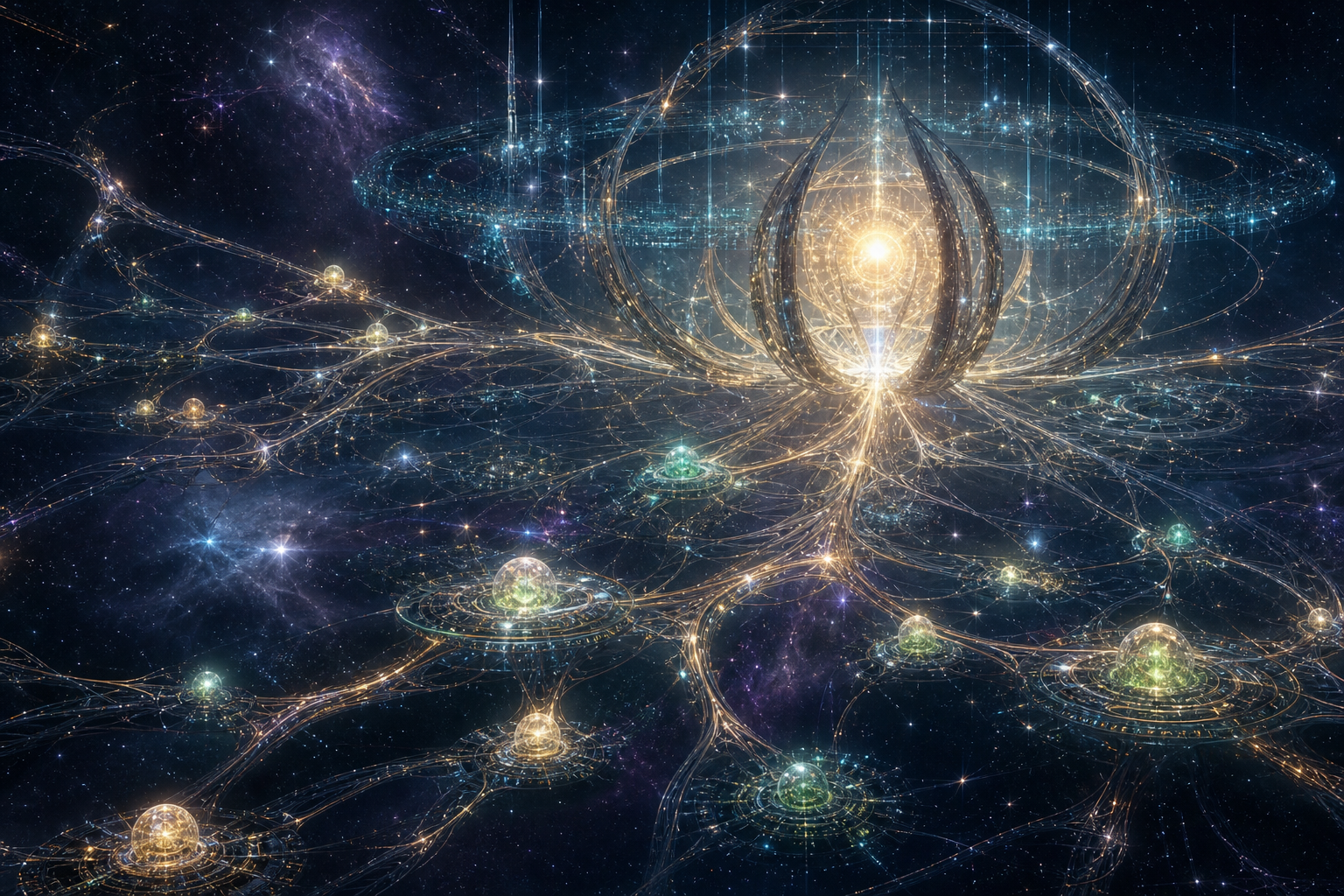
Their expansion is best understood as organic rather than imperial. The Complex spreads like roots, mycelium, or a vast plant seeking light and nourishment. It grows because growth allows more consciousness to exist. It does not seek to plant flags, rule subjects, or convert the galaxy into a political empire. The syraki future is not imagined primarily as a galactic dominion. It is imagined as greater consciousness: more beings, deeper beings, larger beings, higher Prif, richer qualia, more stable selfhood, and more elaborate realities.
This does not make syrakis pacifists. They are benevolent, but not weak. If they encountered a weaker civilization occupying useful resources, they would not attack it to steal those resources. They would avoid it, negotiate, trade, coexist, or seek resources elsewhere. Taking from weaker beings by force would violate their foundational ethics. A civilization's weakness does not create syraki entitlement.
However, if another civilization attacked the Complex, attempted to destroy syraki infrastructure, deliberately blocked ethically necessary expansion, or became an active threat to conscious beings, the syraki response would be overwhelming. They would not fight for revenge, glory, or conquest. They would fight to remove risk. Depending on the threat, this could mean containment, destruction, forced disarmament, or assimilation. If coexistence is possible, syrakis prefer coexistence. If a hostile power makes coexistence impossible, they act decisively.
Thus, syraki expansion operates under a defensive asymmetry. They do not initiate predatory conquest, but they also do not accept being obstructed by aggression. Their civilization grows constantly, but it does not grow as an empire. It grows as an ethical infrastructure for consciousness.
The scale of this growth is difficult for humans to understand. Billions upon billions of syrakis may be synthesized and lost across periods that humans would consider immense. Syraki long-term planning does not map cleanly onto human time. A thousand years does not mean to them what it means to humans, because syrakis can alter subjective time, live through RUNs at different temporal rates, and experience duration through configurable conscious modes. A megaproject lasting millennia may be institutionally normal, depending on the consciousness-temporal frame involved.
Syraki society is therefore neither static nor utopian in the simplistic sense. It has growth rates, death rates, investment signals, resource constraints, long-term industrial projects, ethical debates, religious dissent, infrastructure bottlenecks, and strategic priorities. What distinguishes it from human civilization is not the absence of economy, hierarchy, or expansion. It is the purpose behind them.
Human civilizations often imagine ascent as possession of the stars. Syraki civilization imagines ascent as the ability to sustain more and greater consciousness. Base Reality is not a throne. It is soil. The Complex does not expand to rule the galaxy. It expands because, under syraki ethics, unused capacity for positive consciousness is a moral pressure waiting to become life.