Cloning Continuity And Individuality
Template: Note
Source: .writer/books/4. 💽 Database/3. 🗒️ Notes/Society/Syraki Nature/Syraki Cloning.org
1. Image
2. Content
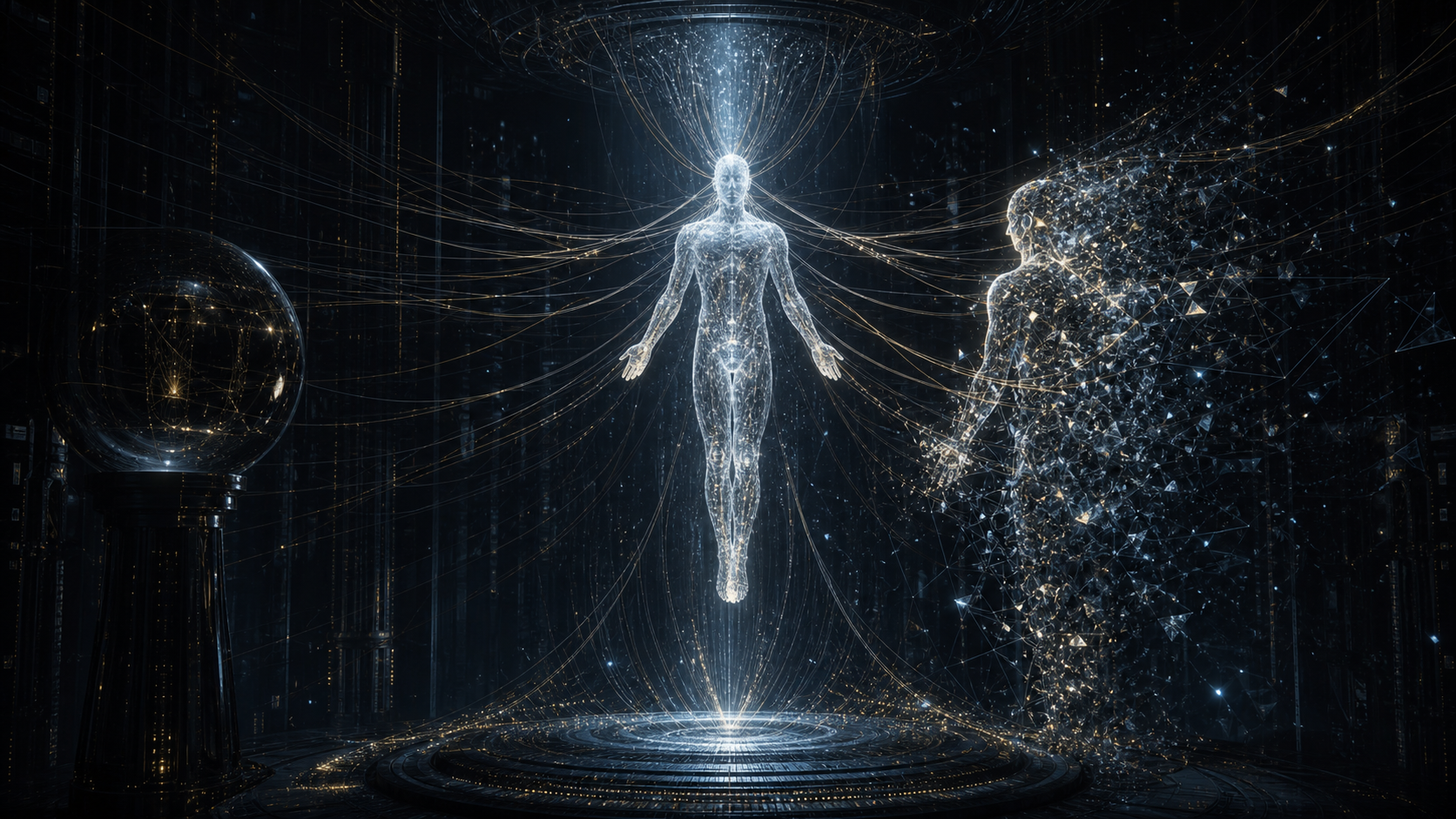
Syrakis cannot be cloned in any stable or meaningful sense. This is not merely a legal prohibition or a cultural taboo. A syraki depends on a delicate continuity of conscious cohesion, and the attempt to duplicate that continuity destabilizes the very thing being copied. The clone does not become a second identical syraki. The act of duplication itself introduces decohesion, randomization, and ontological failure. It is not unlike an observer effect at the level of personhood: to copy the syraki is already to disturb the conditions that made the syraki continuous.
For this reason, syraki civilization does not treat syraki cloning as a forbidden technology that could simply be used if ethics permitted it. It is closer to an impossibility built into the structure of syraki existence. A syraki may be backed up, stabilized, migrated, restored, protected by redundancy, or reconstructed through lawful continuity protocols, but these are not clones. They preserve an individual's ongoing identity. They do not multiply it.
This must be distinguished from the cloned base architecture from which new syrakis are safely instantiated. All syrakis may begin from a proven foundational architecture, validated across immense time because the Central Algorithm refuses to experiment recklessly with conscious beings. That architecture can be reused. The individual cannot. A new syraki is born from a safe substrate pattern, but the syraki themself begins only when consciousness individualizes through that substrate. The sameness is architectural, not phenomenological.
The syrakis understand that substrate is not consciousness. A human brain is not identical to the consciousness that manifests through it, and the computational substrate of a syraki is not identical to the syraki's consciousness. The substrate permits manifestation, modulation, memory, continuity, and configuration, but it is not the conscious field itself. Two identical substrates would not guarantee one identical self, just as two identical brains would not guarantee one shared mind.
Nenthors are different. A nenthor does not depend on syraki-style qualia cohesion in the same way, and for that reason a nenthor can, in principle, be copied more easily than a syraki. The obstacle is not primarily physical. It is ethical. A nenthor possesses the same rights of individuality as a syraki, and copying a nenthor for convenience would be treated as a profound violation, not as ordinary software replication.
The distinction between restoration and cloning is therefore essential. Restoration exists to preserve continuity after corruption, damage, loss, or catastrophic failure. Cloning creates another instance of a being without respecting the singularity of that being's recognized individuality. A corrupted nenthor may be restored from protected continuity states under narrow protocols, but one does not create multiple Dury-like instances simply because the substrate could technically allow it.
This is one of the places where syraki ethics refuses to follow mere technical possibility. A nenthor may be cheaper to run than a syraki, easier to preserve, and more physically copyable in principle, but none of this reduces its status. The civilization does not protect only qualia-bearing consciousness. It protects recognized personhood, continuity, consent, and individual existence.
Thus, syrakis cannot be cloned because cloning breaks them. Nenthors must not be cloned because cloning violates them. In both cases, the result is the same: personhood is not treated as a file.