Agahfrisut
Template: Note
Source: .writer/books/4. 💽 Database/3. 🗒️ Notes/Society/Sexuality/Agahfrisut.org
1. Image
2. Content
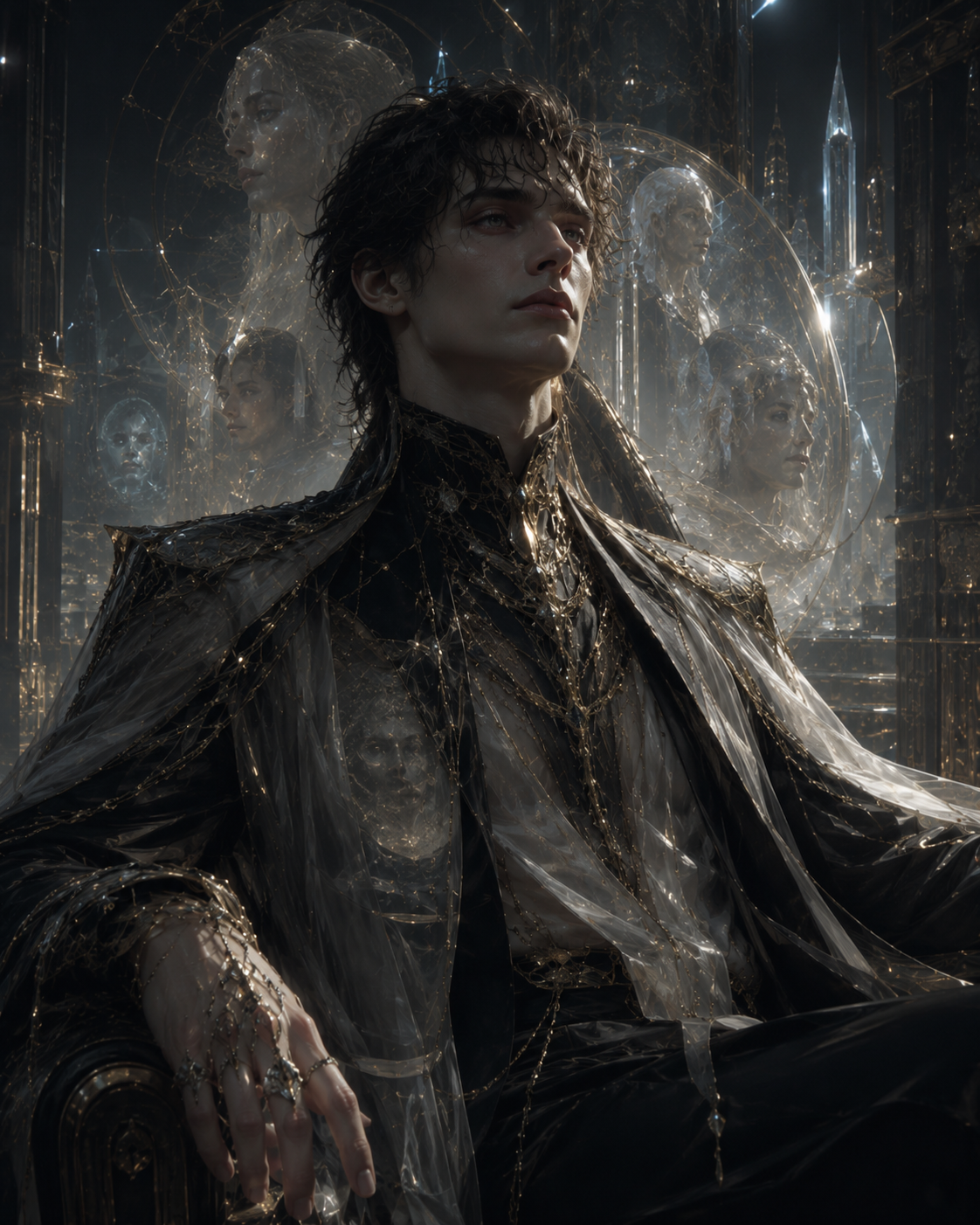
Agahfrisut is the syraki who becomes the chosen center of Siuvac-931's devotion.
He is vastly younger than Siuvac-931, but by the time TUZ-66941 reaches her, he has become the primary center of her will. Siuvac-931 has transferred nearly everything she once owned to him: money, RUNs, computational resources, vessels, stations, private assets, and symbolic power. This transfer should not be read as ordinary political defeat, financial manipulation, senility, romantic weakness, or blackmail. It is part of the devotional and ontological structure Siuvac-931 has chosen around him.
Agahfrisut matters because he is the place where Siuvac-931's sovereignty bends.
Siuvac-931 was once an ancient High Echelon figure of the High Plaza, powerful, wealthy, dangerous, socially immense, and known across her existence as a Lady of possession. She assimilated 6,222 syrakis. She inherited depths, memories, powers, resources, shame, beauty, and internal histories from those she incorporated. Her entire arc moved from being made into an object inside Blissful Hells, to becoming the one who could turn other consenting consciousnesses into possessed substance.
Agahfrisut is the final reversal of that arc.
For Siuvac-931, the desire to be assimilated by Agahfrisut is not a contradiction of her history. It is its completion. She does not desire him because he is older, richer, more institutionally powerful, or more historically immense. He is younger than her. That is part of the strangeness. His significance is not measured by conventional seniority. He has become the one before whom her ancient power can desire to stop being sovereign.
Agahfrisut should therefore be treated carefully. His importance is not merely romantic, religious, symbolic, or administrative. It marks the role he occupies in the devotional structure around Siuvac-931: the Lord before whom she can want to lose the last sovereignty of herself. His position is cultic and relational before it is administrative. It does not automatically mean that Agahfrisut commands a public institution comparable to the High Plaza or a megacorporation.
Agahfrisut's importance in the TUZ-66941 investigative line is practical as well as intimate. Siuvac-931 initially refuses to tell TUZ what she knows about the omniship experiments. TUZ does not torture her, imprison her, threaten her, hack her crudely, or break her psychologically. It understands the architecture of her chosen devotion and follows that structure to Agahfrisut. When Agahfrisut commands Siuvac-931 to tell TUZ everything and hide nothing, Siuvac-931 consents. Her mind opens lawfully because the command comes from the center she has chosen.
This consent is essential. Agahfrisut does not make TUZ violate Siuvac-931. He enables Siuvac-931's own chosen hierarchy of will to express itself. Within syraki terms, this is legitimate because Siuvac-931 has reorganized her self-reference around him. The command does not erase her personhood. It activates the configuration she has already made of herself.
Agahfrisut should not be treated as a human-style abuser, cult predator, or manipulative young heir unless the story later explicitly establishes such a turn. The current structure is more alien and more specific. Siuvac-931 is not a confused victim. She is an ancient being who has chosen a center outside herself. Agahfrisut is the being who can occupy that center without the scene becoming simple coercion.
At the same time, he should not be made harmless or decorative. His existence carries enormous weight because Siuvac-931's wealth, assets, devotion, secrets, and final desire curve around him. He is the one who can command the being who once possessed thousands. That makes him intimate, politically consequential, and ontologically dangerous even if he does not appear as a conventional tyrant.
His relation to assimilation is the key. Siuvac-931, who was once the Lady who enclosed others, wants Agahfrisut to become the one who encloses her. She would no longer be the assimilator who overwhelms another mind with Prif until separateness fails. She would become the one whose separateness is taken. She would no longer preserve trauma as a scar outside the event. She would become an irreversible part of the one who closes around her.
Agahfrisut therefore functions as the final answer to Siuvac-931's long geometry: object, owner, offering. The Blissful Hells taught Siuvac-931 the beauty of becoming a thing. Assimilation taught her the beauty of making another consciousness into one. Agahfrisut is the Lord before whom she can desire, at last, to lose the last sovereignty of herself.
The exact details of Agahfrisut's own personality, history, age, abilities, social position, and attitude toward Siuvac-931 remain open. What is already fixed is his structural role: he is not merely Siuvac-931's lover, beneficiary, owner, disciple, master, cult figure, or future assimilator in any simple human sense. He is the chosen center through which Siuvac-931's ancient will has reorganized itself.