Syraki Society Under A Human Political Perspective
Template: Note
Source: .writer/books/4. 💽 Database/3. 🗒️ Notes/Society/Human Categories/Syraki Society Under A Human Political Perspective.org
1. Image
2. Content
The syrakis do not understand themselves through human political categories.
They are not socialists, liberals, anarcho-capitalists, monarchists, technocrats, democrats, communists, libertarians, or aristocrats in any direct human sense. Those categories belong to biological societies built from fear, scarcity, coercion, sexual competition, tribal memory, status hunger, mortality, resentment, and unstable political power. Syraki civilization emerged from a different substrate, a different psychology, a different history, and a different moral architecture.
Still, from a human perspective, one may attempt an approximation.
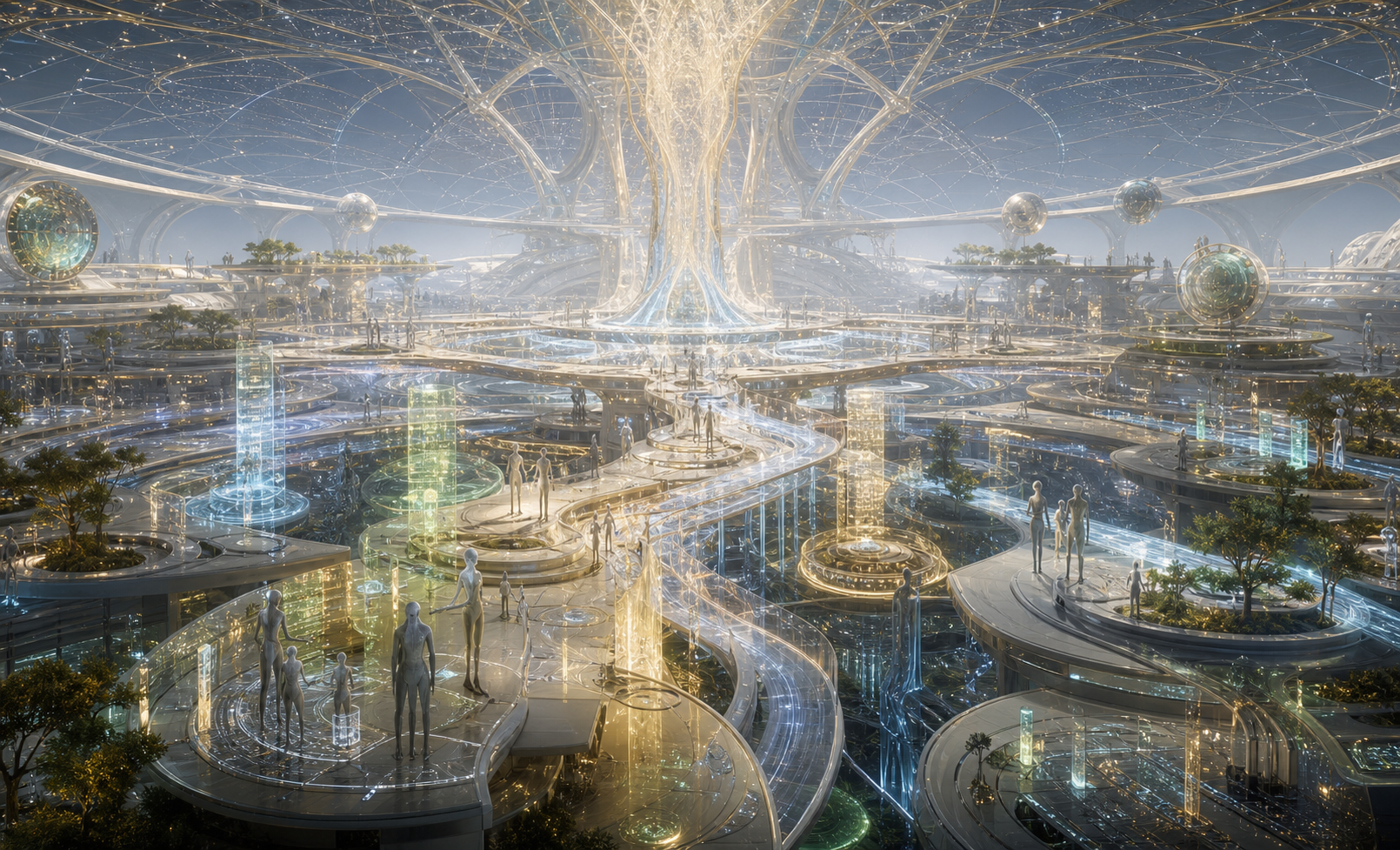
Syraki society is a contractual, proprietarian, market-driven, postbiological civilization operating under an ethical-hedonic algorithmic framework. It has strong private property, vast corporations, profit, competition, extreme inequality, intense social mobility, guaranteed existential security, and a central civilizational system that is not a State in the human sense.
The Central Algorithm is not a king, parliament, party, bureaucracy, dictator, priesthood, or democratic government. Most syrakis do not know what it fully is. It is probably a distributed system that became more complex across immense historical time. It may manifest as an individual if necessary, but that is not how it ordinarily exists in civilization. It is better understood as the framework that allows the Complex to function: a civilizational platform, an ethical operating layer, a predictive and contractual structure beneath society.
Calling it a State is misleading. A human State contains unstable political power. A king may be good or cruel. A president may be competent or corrupt. A party may become predatory. A bureaucracy may expand for its own sake. Human political power always contains insecurity because it depends on will, faction, force, interpretation, and succession.
The Central Algorithm does not operate like that. It is predictable, bounded, contractual, and tied to civilizational principles. It does not guide society through arbitrary political desire. It acts through structures already embedded in the Complex. To a syraki, the Central Algorithm is closer to executable constitutional infrastructure than to government.
Private property exists strongly in the Complex. Computation, RUNs, engines, corporations, bodies, contracts, storage, infrastructure rights, capital, and productive systems can be privately owned. Under normal conditions, property is real, stable, protected, and almost absolute. The Central Algorithm cannot simply take what it wants.
But this is not pure anarcho-capitalism. Every syraki exists within prior civilizational contracts. Those contracts specify extreme conditions under which Central Algorithm preponderance may override property rights. If the Central Algorithm ever seized something as immense as Theravada Corporation, it would not be an act of political theft. It would be an almost unthinkable emergency action, already foreseen by contract, justified by continuity, ethics, or civilizational survival.
Such an act would itself create severe inefficiency. For that reason it almost never happens. The point is not that property is weak. The point is that property exists inside a wider contractual architecture whose highest purpose is the preservation and flourishing of conscious beings.
This differs radically from socialism. In human socialism, property often becomes insecure because political authority can redefine ownership. In syraki society, the conditions of override are explicit, auditable, contractual, and known in advance. A syraki can understand the exact circumstances under which their property might be affected. If a condition is not covered by contract, the Central Algorithm cannot simply invent authority.
Legal certainty is extreme.
Markets, profit, competition, and corporations are central to syraki civilization. They are not tolerated as regrettable evils. They are legitimate because they solve optimization problems the Central Algorithm cannot solve centrally. The needs, desires, Prif structures, reality preferences, computational demands, and qualia architectures of syrakis are too vast for total central planning. The Central Algorithm does not attempt to calculate every life from above because doing so would be an explicit mathematical error.
A human dictator who tries to plan everything commits a political error. If the Central Algorithm tried the same thing, it would be committing a computational optimization error. It knows better.
Competition exists because distributed discovery works. Companies, independent artists, research houses, engines, contract networks, and citizens search for better ways of raising Prif, allocating resources, building RUNs, improving consciousness, reducing cost, and expanding possible experience. Profit indicates that value has been created. A successful company is not seen as an enemy hoarding power. It is seen as an agent that improved the Complex directly or indirectly.
This competition does not carry the emotional structure of human rivalry. Syrakis are not born with the same capacity for hatred, resentment, humiliation, or malicious envy. They can compete without wanting one another destroyed. They can desire success without needing others to fail. Competition is closer to a game, a search procedure, and a mode of existence than to hostile domination.
The Central Algorithm may operate its own market enterprises. When it does, they follow market rules. If such an enterprise fails, it is allowed to fail. The Central Algorithm does not preserve a rotten institution through vanity, political protection, or forced subsidy. Maintaining failure would be anti-optimization.
There is no misery in the Complex.
Every ordinary syraki has an existential floor. Even one who does nothing lives a life beyond what biological humans would imagine as divine. This floor includes security, baseline computation, storage, Default Reality, access to basic RUNs, and a recurring allocation derived from the productive output of the Complex. The allocation is not money in the human paper-currency sense, but it functions as cryptographically accounted value: computation, storage, purchasing capacity, access rights, and other resource claims.
This allocation is distributed cycle by cycle, with sectoral variation. Accounting is extremely serious. A syraki can audit why they received a given amount. If the value decreases, the cause can be traced: a mining disruption, a sectoral maintenance cycle, congestion, reduced energy output, route inefficiency, or another measurable factor. The system is not opaque. It is legible.
Very wealthy syrakis may no longer receive the base allocation, allowing more to flow toward others. This is not charity in the human sentimental sense. It is part of the civilizational resource architecture.
The result is neither poverty nor equality.
The poorest ordinary syraki is not poor in any human sense. They are not starving, humiliated, excluded, degraded, or trapped in misery. But the distance between a basic syraki and a top-tier syraki may exceed any inequality humans have ever known. The difference between a destitute human and a billionaire is tiny compared to the difference between a baseline syraki and someone like Jabari.
Jabari-level wealth can include planets, stations, Dyson structures, immense computational reservoirs, private infrastructures, specialized engines, elite reality access, and the capacity to stabilize pleasure regimes that ordinary syrakis cannot reach. The Overarching layer belongs to this upper scale. Overarching pleasures are not merely stronger pleasures. They require enough computation to calculate, sustain, and protect forms of consciousness inaccessible to lower strata.
Yet this hierarchy is not caste.
Social mobility is common. A syraki may rise, expand, gain wealth, enlarge their substrate, access higher Prif regimes, then later decline, lose scale, return toward the base floor, and continue living well. This movement is normal. Jabari is exceptional not simply because he is high, but because he has remained high for an immense span of time, perhaps nearly a million human years. Stability at that level is rare.
Syraki inequality is therefore extreme, but fluid. The floor is secure. The ceiling is vast. Movement between layers is real.
Prohibitions in syraki society are not arbitrary. The Central Algorithm avoids banning things unless there are strong objective reasons. When something is unavailable or forbidden, the reason is explicit. It may be ethical, technical, economic, logistical, contractual, or related to systemic stability.
A syraki may be unable to run a heavy RUN in a particular sector because that sector is congested, under maintenance, already overloaded, or physically unable to support the demand. This is not oppression. It is resource reality. The syraki understands the reason.
Hell-RUNs are forbidden for a different reason. They violate the ethical foundation of the Complex. One may construct danger, tragedy, fear, sacrifice, difficulty, discipline, or consensual suffering. One may not build a coercive infernal architecture designed to trap consciousness in involuntary degradation.
Decohesion risk occupies another category. The Central Algorithm does not exist to imprison freedom. If a syraki knowingly chooses to take risks with self-remapping, higher Prif access, substrate alteration, or dangerous experiential expansion, they may be allowed to do so if the act is informed, valid, and does not endanger others. Some rare syrakis take such risks repeatedly and damage themselves. Some decohere. Some die. Recovery is attempted, but not always possible.
Freedom includes real risk.
The deepest psychological difference between syraki society and human society concerns selfishness. Syrakis are not purely selfless beings. Some are more selfless than others, but their civilization does not depend on the abolition of self-interest. It depends on the alignment of self-interest with social flourishing.
The syrakis know they seek their own Prif. They want pleasure, expansion, fulfillment, beauty, power, safety, experience, love, creation, and continuity. They are not ashamed of this. Their civilization works because their egoism does not run against society. It runs alongside it.
A syraki wants the Complex to prosper because a prosperous Complex improves their own existence. A society rich in trust, contracts, safety, creativity, reality artistry, computation, and ethical stability raises the Prif of everyone within it. Cooperation is therefore not self-denial. It is intelligent self-affirmation.
Human societies often lower Prif through humiliation, resentment, domination, sexual competition, fear, precariousness, status aggression, and the desire to place others beneath oneself. Even human success often occurs inside architectures that poison the whole field of experience. The winner rises over a damaged landscape.
The syrakis surpassed this not by becoming saints, but by understanding the hedonic mathematics of cooperation. Another being's flourishing is not a threat when the structure of society turns flourishing into a multiplier. The other is not merely a rival. The other is part of the environment through which one's own Prif becomes possible.
They did not overcome selfishness by denying the self. They aligned the self with civilization.
This is also why syrakis are not romantic about humanity. They would respect humans who preach love, peace, compassion, or cooperation, but they would see purely moral solutions as naive. Human cruelty does not arise from bad slogans alone. It arises from evolved bodies, sexual selection, scarcity psychology, attraction asymmetries, aggression, fear, status competition, tribalism, and brain architecture.
To a syraki, telling humans to love one another is not enough. Education, philosophy, religion, and ethics may help, but only to a limit. Beyond that limit, the organism must change. Real improvement would require intervention in the substrate: genetics, neurochemistry, attraction, aggression, fear response, empathy, cognition, reproduction, embodiment, and social incentives.
They would not blame humans for failing to become syraki-like. Humans lack the structure for it.
The syrakis are therefore post-political in a strict sense. Not because they have no conflict, no hierarchy, no property, no companies, no rules, and no scarcity, but because the human political axis has been displaced by a deeper civilizational problem: how to preserve freedom, raise Prif, protect conscious beings, allocate finite resources, and prevent the return of infernal patterns.
From a human perspective, the closest approximation would be:
a contractual, market-based, proprietarian, high-mobility, high-inequality, post-scarcity-partial civilization with a guaranteed existential floor, governed not by a State, but by a predictable ethical-hedonic algorithmic framework.
But even that is only a translation.
The syrakis do not live inside human politics.
They live inside a civilization that made politics subordinate to consciousness.