The Syrakis As A Proto-Temporal Civilization
Template: Note
Source: .writer/books/4. 💽 Database/3. 🗒️ Notes/Society/Complex/The Syrakis As A Proto-Temporal Civilization.org
1. Image
2. Content
The syrakis are not yet a temporal civilization in the full sense. They remain bound by causality, entropy, relativistic constraint, computational cost, physical risk, and the arrow of time. They cannot move freely through the fourth dimension, cannot rewrite history by will, and cannot treat Base Reality time as casually as they treat RUN-time, memory architecture, or computational routing. Their civilization has not mastered time as a navigable medium. What it has done is begin the long transition from enduring time to engineering around it.
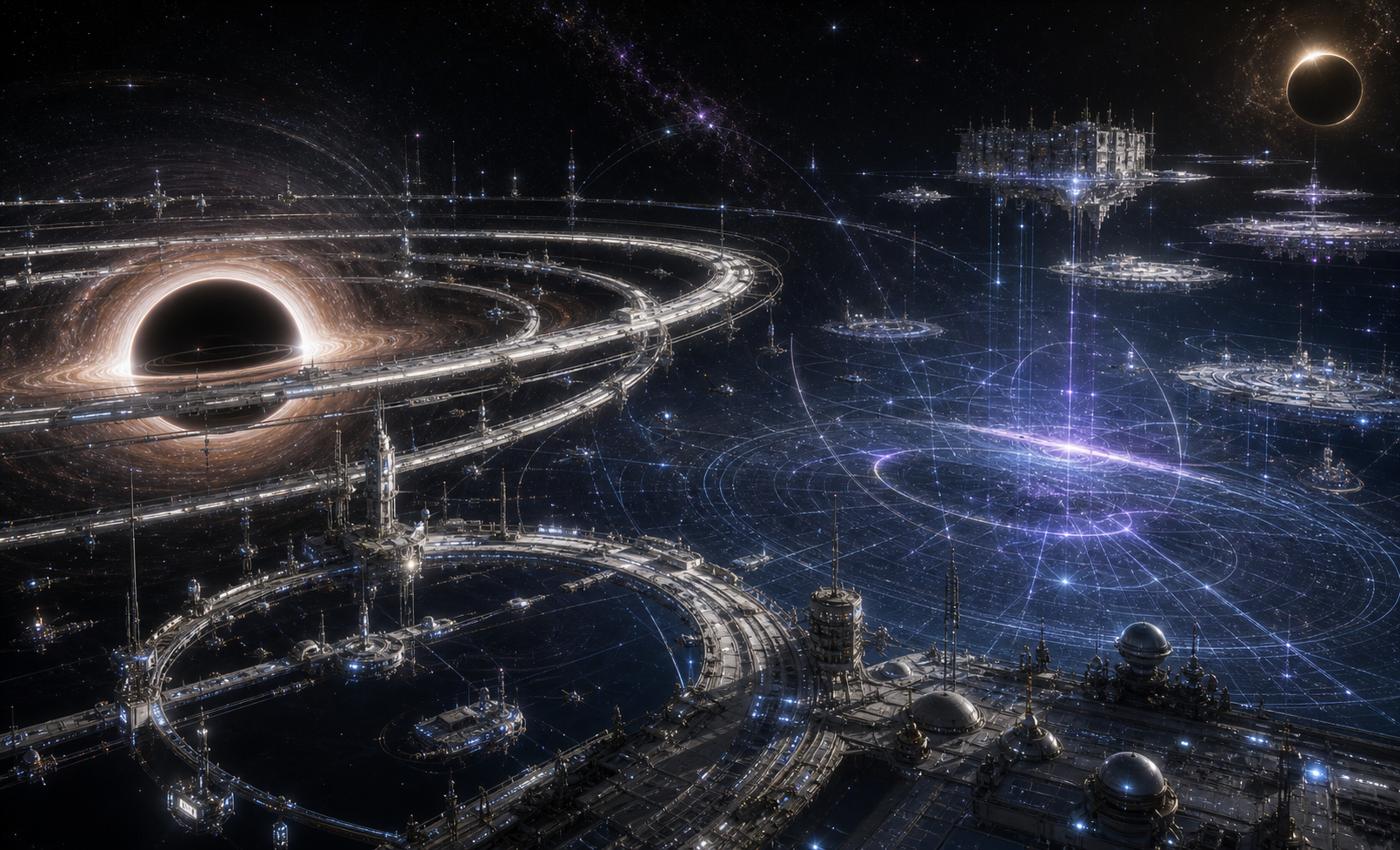
This transition is already visible in the infrastructure of the Complex. The syrakis use temporal distortion technically through conservation rings around black holes, relativistic storage, black-hole archives, BRCT systems, RUN-time modulation, subjective compression, sectoral deviation analysis, anomaly research, and preservation architectures. These are not isolated curiosities. They are early forms of temporal infrastructure. Time is measured, modeled, translated, slowed, exploited, archived against, and partially incorporated into civilizational design.
To humans, imminence usually means years or decades. To syrakis, an imminent transition may still lie thousands of years away. Their civilization operates across longer spans, so a development that remains distant by human standards can already appear as a structural horizon. The important point is not that they have crossed the threshold, but that they can see its outline. They know that their society is moving toward deeper temporal competence, even if the field remains experimental, expensive, constrained, and dangerous.
Their present mastery is partial. They understand certain temporal anomalies far beyond human physics, can build around stable black holes, can preserve information within relativistic gradients, and can run controlled experiments in sectors where temporal behavior is measured and tested. But these techniques have not yet become general civilizational substrate. Temporal engineering is not as mature as reality artistry, ordinary computation, storage, market routing, or RUN design. They can use temporal structures. They cannot yet inhabit time as a fully mastered dimension.
The movement toward temporal civilization is not ideological. It is part of the automatic efficiency-seeking of the Complex. The syrakis do not pursue temporal engineering because of a mystical desire to become gods or because of a political doctrine of transcendence. Their civilization constantly searches for better preservation, better computation, better resource allocation, better Prif, better safety, better continuity, and better use of physical law. If temporal structures increase efficiency, reduce decay, protect consciousness, improve computation, extend civilizational duration, or open higher forms of experience, then the Complex will naturally move toward them.
For that reason, temporal engineering sits at the intersection of several syraki priorities. It promises preservation because time dilation and black-hole architectures can protect information against external history. It promises efficiency because altered temporal relations can change the cost of storage, waiting, computation, and recovery. It promises security because a civilization that survives longer and preserves better protects more conscious beings. It promises Prif because continuity, safety, abundance, and expanded experiential capacity all affect the quality of conscious life. These motives are not separate in syraki thought. They reinforce one another.
Black holes occupy a special place in this trajectory. They are not simply dangerous astronomical objects. To the syrakis they are clocks, vaults, gradients, machines, risks, resources, and preservation sites. A conservation ring does not make memory free, but it can make decay slower than history. A deep archive does not abolish physics, but it changes the relation between local duration and the wider Complex. Over time, such techniques point toward a civilization that might place parts of itself inside black-hole-like temporal architectures to extend preservation, reduce exposure to cosmic decay, or approach forms of duration that earlier civilizations would have mistaken for immortality.
Even this would not be magic. It would be engineering under constraint. The syrakis would still pay in energy, matter, computation, maintenance, access difficulty, communication delay, risk, and ethical complexity. Temporal depth would create its own costs. A civilization placed too deeply into preservation might gain duration while losing flexibility. A vault protected from history might also become harder to retrieve, update, audit, or reintegrate. These are not reasons to abandon the path, but they are reasons for careful procedure.
Ethical debate is therefore part of the movement toward temporal civilization. The syrakis do not debate these questions as human ideological factions would. They argue through projection, physics, contract theory, Prif modeling, risk analysis, continuity diagnostics, and civilizational procedure. The question is not framed as a romantic choice between ambition and humility. It is framed as a technical-ethical problem: what can be done, what should be done, what preserves autonomy, what risks decoherence, what produces real benefit, what creates hidden fragility, what must remain experimental, and what can be safely generalized.
This is why the syrakis are best described as proto-temporal rather than temporal. They have not yet crossed into full temporal civilization, but they are no longer merely ordinary beings moving helplessly through time. They have begun to treat temporal structure as a domain of engineering. Their archives, conservation rings, anomaly studies, time-mapping protocols, and preservation systems are early steps toward a later form of civilization that may one day manipulate temporal conditions as deliberately as modern syrakis manipulate RUNs, contracts, computation, and conscious experience.
The long-term direction is clear. If the Complex continues to grow, preserve itself, and refine its methods, it will become increasingly temporal in character. Its future may involve deeper black-hole architectures, more advanced conservation systems, controlled temporal gradients, causal engineering, long-duration civilizational shelters, and perhaps forms of movement through time that remain only theoretical in the era of the novel. This future does not need to appear directly in the story. It is enough that the trajectory exists in the background: the syrakis are a civilization standing near the threshold where time itself begins to become infrastructure.