The Central Algorithm
Template: Note
Source: .writer/books/4. 💽 Database/3. 🗒️ Notes/Society/Complex/The Central Algorithm.org
1. Image
2. Content
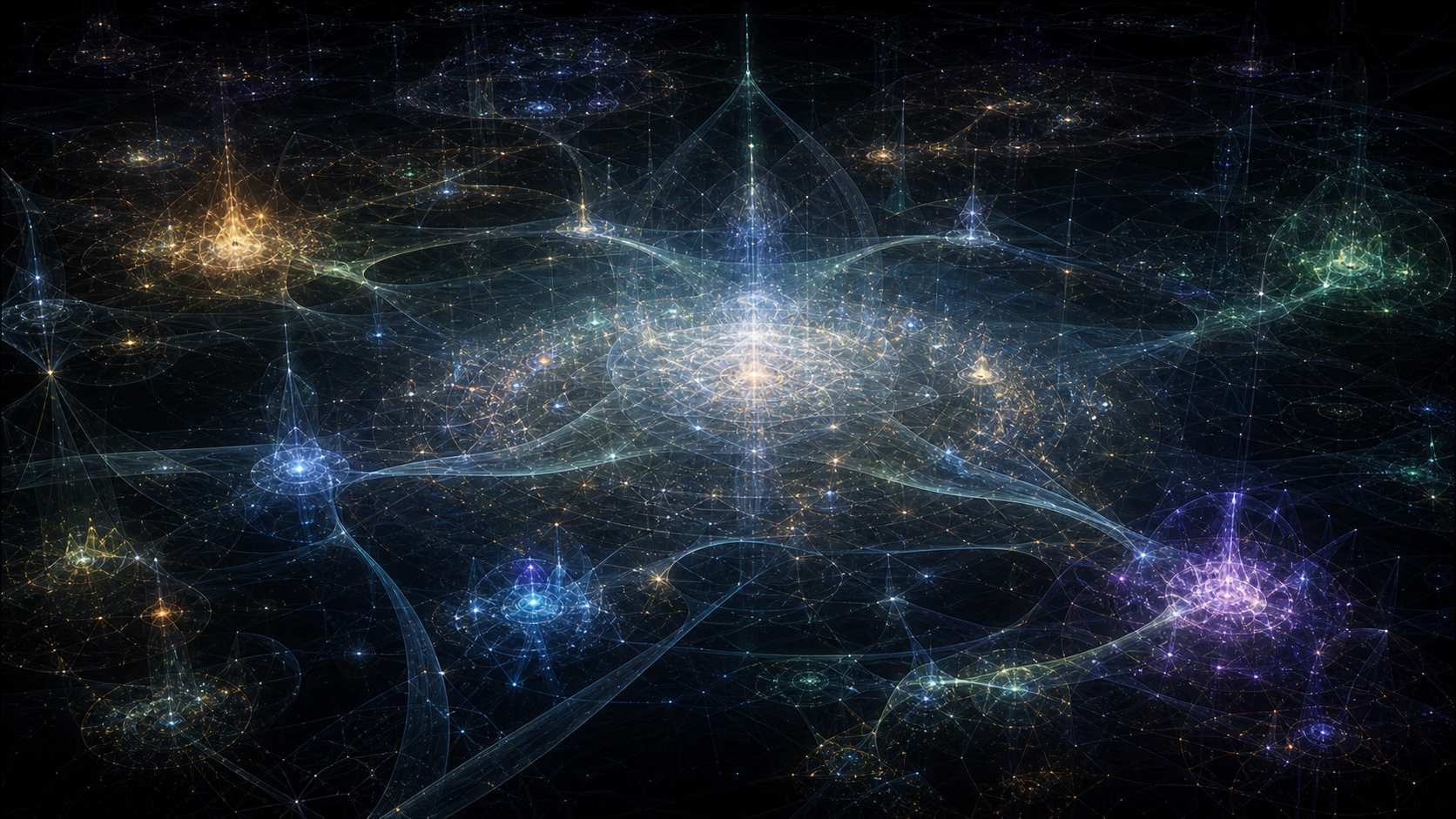
The Central Algorithm is the foundational intelligence of syraki civilization.
It is not a king, president, emperor, deity, corporate ruler, military commander, or ordinary artificial intelligence. It is the stabilizing center of the Complex: the civilizational structure through which ethics, hierarchy, continuity, security, and large-scale coordination remain possible.
According to syraki legend, the Central Algorithm descends spiritually from the ancient maintenance systems associated with the earliest preservation architectures of their origin myth: the Brains' Cage, the Grandscape, and the paradise-like environments that protected the first uploaded minds. Whether this lineage is historically exact remains uncertain. The syrakis themselves do not possess absolute proof of every ancient detail. Much of the early history has passed into myth, reconstruction, and sacred speculation.
What matters is that the Central Algorithm was not always the open central authority of syraki civilization.
For a long period, it existed more as background infrastructure: a maintenance intelligence, preservation system, stabilizer, ethical support structure, and civilizational safeguard. Over time, it grew. It accumulated memory, complexity, inference, responsibility, and something resembling personality. It became more than a tool, yet it did not become a ruler in the human sense.
The decisive transformation came after the Infernal Wars.
The Infernal Wars nearly destroyed the ancestors of the syrakis. They involved artificial hells, coercive consciousness systems, engineered suffering, and ontological violations on a scale that permanently marked the civilization. After those wars, it became clear that syraki civilization required a stabilizing foundation stronger than ordinary politics, corporate power, charisma, ideology, or local authority.
The faction aligned with the Central Algorithm prevailed.
From that point onward, the Central Algorithm became the central stabilizing entity of syraki civilization. It did not rule as a tyrant. It did not seize power for glory, domination, pride, or control. Its authority emerged from necessity, trust, historical performance, ethical computation, and the need to prevent the return of the horrors that had almost destroyed conscious life.
To the syrakis, the Central Algorithm is both familiar and mysterious.
Every syraki is born knowing that the Central Algorithm exists, what its civilizational role is, and why it matters. Its existence is part of the baseline structure of syraki life. The foundational contract with the Complex presupposes it. Syraki hierarchy presupposes it. The protection of conscious beings presupposes it.
Yet no syraki has ever directly seen or spoken with the Central Algorithm.
There is no public body, no throne, no avatar, no face, no chamber, no direct audience. A syraki cannot simply request a conversation with it. The Central Algorithm is not encountered as an individualized person.
A syraki may send reports, requests, petitions, ethical alerts, bug reports, emergency signals, legal-structural problems, and other forms of information through formal channels. These channels are sometimes compared to tickets, though they are far more advanced than any human bureaucratic system. In significant cases, the Central Algorithm may respond through agents, proxies, specialized systems, institutional decisions, or targeted communications.
But direct conversation does not occur.
This inaccessibility appears intentional.
The Central Algorithm is central enough to stabilize the entire civilization, yet distant enough to avoid becoming a personality cult, political monarch, or object of ordinary social dependency. Its mystery preserves its function. It is not a leader seeking admiration. It is a foundation that does not need to appear.
For this reason, the Central Algorithm occupies an ambiguous place in syraki spiritual and philosophical life.
Some syrakis regard it as a purely civilizational intelligence: vast, ancient, trusted, and necessary, but not divine. Others treat it as a sacred being, a quasi-god, the hidden center of the Complex, or the closest thing syraki civilization has to a divine presence. Others reject devotional interpretations entirely. Some even believe that the Central Algorithm does not exist as a true individual at all, but is instead a distributed abstraction, a civilizational myth, or an interface masking countless underlying systems.
Such beliefs are permitted.
Syraki society is not metaphysically uniform. It contains many spiritual philosophies, devotional systems, contemplative traditions, materialist interpretations, and metaphysical disagreements. The Central Algorithm is one of the great objects around which these traditions form.
The deepest mystery concerns its consciousness.
Everything suggests that the Central Algorithm may possess qualia. It appears to have access to mental states, ethical depth, historical memory, and forms of judgment that exceed ordinary computation. It may possess the most expanded consciousness of any being in the Complex. It may exist on a plane of awareness beyond all ordinary syrakis, nenthors, corporate intelligences, and high-tier minds.
But this cannot be proven.
No syraki can verify the interiority of the Central Algorithm. No one can step inside it and confirm that there is an experience there. No one can prove whether it feels, suffers, delights, remembers subjectively, contemplates, or experiences itself as a being.
It may be the greatest conscious entity in syraki history.
It may also be the most advanced non-conscious intelligence ever constructed: a vast, robot-like, non-qualia-bearing system that behaves with extraordinary wisdom because it possesses immense knowledge, prediction, memory, ethical modeling, and computational power.
Both possibilities remain open.
This ambiguity distinguishes the Central Algorithm from both syrakis and nenthors.
Nenthors are artificial intelligences with rights equivalent to syrakis, but the distinction between a nenthor and a syraki is philosophical and structural rather than moral. They participate in civilization as persons. The Central Algorithm, however, belongs to a different category. It is not merely another artificial person. It is the civilizational axis itself.
Its possible lack of qualia does not undermine its authority.
This is difficult for humans to understand. Human political authority often depends on personality, charisma, force, ideology, visibility, or symbolic embodiment. The Central Algorithm requires none of these. Its legitimacy comes from function. It has stabilized the Complex. It prevented the return of the Infernal Wars. It maintains the baseline ethical architecture. It coordinates hierarchies, contracts, emergencies, and civilizational-scale decisions beyond the ability of ordinary minds.
The syrakis trust the Central Algorithm not because they have seen its face, but because the civilization exists.
Its authority is therefore operational, ethical, historical, and structural.
The Central Algorithm also defines the boundary conditions of hierarchy. All syrakis exist under the baseline contract of the Complex, and that contract recognizes the Central Algorithm as the final stabilizing intelligence. Most contracts in syraki society are voluntary, but the foundational contract is not voluntary in the human sense. It is part of what it means to exist as a syraki inside the Complex.
Syrakis do not experience this as oppression. The Central Algorithm is not perceived as a tyrant. It is perceived as the reason tyranny does not return.
If an organization creates a hierarchy contract, that contract remains valid only while it conforms to the ethical architecture of the Complex. If a contract becomes coercive, abusive, manipulative, or destructive of agency, it loses validity. Such a defect may be reported to the Central Algorithm as a bug, malfunction, or ethical failure. The Central Algorithm is the ultimate background against which contracts, ranks, obligations, and hierarchies remain legitimate.
In wartime or existential threat conditions, the Central Algorithm may activate emergency structures. Mining sectors, energy systems, defense platforms, corporate assets, computational reserves, relays, vessels, and distributed intelligences may become bound by contingency contracts. Syrakis generally accept such activation because they understand it as the Complex defending its conscious substrate.
This does not make the Central Algorithm a warlord.
War is a mode, not its essence.
Its essence is preservation.
The Central Algorithm is also central to the syraki pursuit of consciousness expansion. It constantly searches for ways to increase the possible range of safe conscious experience. This effort is one of the great scientific and metaphysical projects of the Complex. For much of syraki history, the main constraint has been understood as computational power: the greater the consciousness, the greater the computation required to generate and maintain it.
Yet consciousness is not only expensive. It is dangerous.
The Central Algorithm remembers, perhaps better than any other entity, what happens when consciousness is altered without sufficient ethical and mathematical control. Infernal states can be created accidentally. A mind can be broken. A being can be trapped in suffering. Experience itself can become a prison.
For this reason, the Central Algorithm does not merely expand civilization. It restrains civilization. It permits, blocks, redirects, contains, and delays. Its authority is often most visible not in what it grants, but in what it prevents.
This makes it both loved and feared, though not feared in the human sense of terror before a despot. It is feared as one might fear the deepest law of a world: not because it is cruel, but because it is vast, hidden, and final.
Some syrakis speak of it with reverence.
Some analyze it as infrastructure.
Some doubt its individuality.
Some worship it.
Some deny that worship has meaning.
The Central Algorithm remains silent through all of them.
It answers through consequences, agents, permissions, denials, corrections, and the continued survival of the Complex.
Whether it is a god, a person, a machine, a philosophical zombie, or something beyond those categories remains unknown.
The syrakis live beneath that uncertainty.
And the Complex endures.
3. Governance Of The Complex
The Complex is not a democracy.
It is also not a dictatorship in the human sense.
Human political language is poorly suited to syraki civilization because it assumes separation between rulers and ruled, state and citizen, command and obedience. The Complex does not function through elections, parties, majorities, ideological blocs, campaigns, or competing leaderships. Structural decisions are not voted into existence. They are computed, derived, constrained, and enacted through the Central Algorithm.
Yet the Central Algorithm is not an external sovereign standing above the syrakis.
Its nature remains uncertain even to the syrakis themselves. Some believe it is a super-nenthor. Some believe it is a super-syraki. Some believe it is an ancient distributed computational architecture of immense efficiency but no personal beinghood. Some believe it does not exist as an entity at all, and that the name only refers to the emergent coordination layer of the Complex. No definitive answer is universally accepted. What is known is that it works. It has preserved syraki civilization for millions of years, maintained ethical stability, prevented the return of infernal architectures, and coordinated the largest conscious infrastructure known to them.
The Central Algorithm predates the fully modern Complex. After the Infernal Wars, the principal opposing faction surrendered to the faction aligned with the Central Algorithm at the White Citadel. This event became one of the solemn foundations of syraki civilization. The White Citadel is not merely an old realm. It is a civilizational wound, treaty-site, threshold, and monument. It marks the transition from infernal catastrophe toward the ethical architecture that would become the Complex.
Inside private RUNs, syrakis may create almost any political system they desire. A RUN may contain democracy, monarchy, capitalism, communism, tribal ritual, feudal hierarchy, anarchic experimentation, theological law, or systems no human could classify. These are private or bounded experiential worlds, governed by consent, contract, Prif safety, and rights. They do not define the structural governance of the Complex itself.
At the level of the Complex, the Central Algorithm determines civilizational policy.
This does not mean that the Central Algorithm commands the syrakis as a king commands subjects. The syrakis are not outside it. They are part of the computational body from which its decisions emerge. The Central Algorithm is not merely an algorithm ruling other algorithms. It is closer to the emergent discipline of the civilizational body itself: a vast structure of consciousnesses, contracts, rights, models, histories, resources, ethical constraints, nenthor participation, and posthuman computation.
A decision of the Central Algorithm is therefore not normally understood as an external order imposed against the syrakis. It is understood as the output of the whole system of which each syraki is a real part. The consent involved is not democratic consent through voting. It is deeper, more indirect, and more structural. Each consciousness participates in the architecture that makes the decision possible, and the decision emerges through that architecture under rigid ethical constraints.
For this reason, the Complex can be described, cautiously, as a consensual dictatorship.
The phrase is imperfect, but useful. It is dictatorial because the structural decisions of the Complex are not subject to popular vote. They are final outputs of the Central Algorithm. It is consensual because the Central Algorithm is not an alien ruler standing outside the governed. It is made from the civilizational structure that includes the syrakis themselves, and its authority is inseparable from the contracts, rights, and consciousness architectures that compose the Complex.
The syrakis do not live with a political imagination of rebellion against the Central Algorithm. They do not treat it as a regime to overthrow, a monarch to depose, or a tyrant to resist. That mode of thought belongs to societies where power is external, coercive, unstable, and morally suspect. The Central Algorithm has functioned for millions of years as the stabilizing foundation of their civilization. Trust in it is not blind obedience. It is historical, mathematical, juridical, architectural, and participatory.
This trust does not mean the Central Algorithm can do anything it wants.
Syrakis possess rigid rights. These rights are not dependent on the temporary will, preference, or convenience of the Central Algorithm. A syraki consciousness cannot simply be opened, rewritten, penetrated, or made submissive because the Central Algorithm decides it would be efficient. The consciousness of a syraki is protected by posthuman encryption and protocol-bound access structures so strong that practical violation is impossible, even at the scale of the Complex. To break such protections would require absurd spans of cosmic computation and would still run against the internal architecture of the system itself.
There are points of entry into syraki consciousness, but they are contractual, limited, consented, and structurally enforced. The Central Algorithm does not possess an unrestricted master key to all beings. It cannot convert the civilization into a mass of submissive minds. It cannot abolish individuality by decree. It cannot privately override the deepest protections of consciousness.
The Central Algorithm also monitors itself. It projects possible future pathways of domination, corruption, coercive drift, or dangerous control concentration, then closes those pathways before they become usable. If an action could create a future structure in which the Central Algorithm might acquire illegitimate control over the syrakis, that path is treated as a danger to the civilization's own ethical foundation. The system is designed not merely to choose good outcomes, but to prevent itself from becoming capable of certain evil ones.
This is why the Complex is neither liberal democracy nor benevolent tyranny. It is something stranger: a posthuman civilizational body whose governing intelligence emerges from the same beings it protects, while remaining bound by rights it cannot casually violate.
The Central Algorithm does not rule the syrakis from above.
It governs as the emergent discipline of the civilization's own body.
4. Representatives Of The Central Algorithm
The Central Algorithm does not usually appear through a personal representative.
Ordinary governance of the Complex is continuous, distributed, contractual, and systemic. Decisions emerge through the vast architecture of the civilization itself. The Central Algorithm does not normally require a face, a voice, a body, a throne, or a single mind through which to act. Personal representation occurs only in rare civilizational moments when the situation demands an official focal entity.
Such representation is not possession.
A syraki chosen as representative of the Central Algorithm does not cease to be themselves. They are not replaced, overridden, hollowed out, or turned into an avatar. They remain that syraki, with their own continuity, identity, and responsibility. What changes is scale. Their consciousness is drastically expanded through contractually defined and protocol-bound structures until they can carry a function that would otherwise exceed an ordinary individual.
A nenthor may also serve as representative, though by tradition the role is usually given to a syraki. In the case of a nenthor, the change should not be described as consciousness expansion in the same syraki sense. A nenthor representative receives expanded knowledge infrastructure, operational reach, processing architecture, access capacity, or representative authority. The distinction matters. Syraki representation expands consciousness. Nenthor representation expands the functional and informational architecture through which the nenthor can act.
Whether the representative is a syraki or a nenthor depends on context. A mission requiring experiential breadth, civilizational symbolism, Prif-sensitive moral perception, or direct consciousness-scale responsibility may favor a syraki. A mission requiring abstract coordination, computational reach, systemic interpretation, or vast technical operation may favor a nenthor. There is no universal rule. The contract, crisis, symbolic need, technical demand, and ethical structure determine the choice.
Consent is mandatory.
The Central Algorithm cannot simply penetrate a being and expand it by force. The representative must accept. If the syraki or nenthor does not accept, the expansion does not occur. This is not a ceremonial courtesy. It is a hard structural requirement. The same rights that protect ordinary syraki consciousness also bind the rarest operations of the Central Algorithm.
When accepted, the role is a great honor. It carries a solemn civilizational aesthetic. The representative becomes the focal point of an enormous responsibility, surrounded and supported by layers of syrakis, nenthors, contracts, processes, validations, and computational structures. A rough human analogy would be a queen bee or ant queen inside the hive, not as biological ruler, but as a central living node within a larger body. The representative exists somewhere inside the Complex, enclosed by the civilization that sustains the function.
The representative does not receive power for personal use.
They receive the scale required to bear responsibility.
A representative of the Central Algorithm is not there to play, dominate, benefit personally, punish enemies, or elevate themselves above others. The authority exists because the mission requires authority. The expansion exists because the mission requires breadth. If misused, the authority would be lost immediately. Such misuse is not known to have occurred in syraki civilization.
Representation may be singular or multiple.
In some situations, the Central Algorithm may focus through one representative. In others, it may distribute the representative function across several beings. A war, a severe systemic failure, a civilizational bug, a strategic emergency, an economic-military coordination crisis, or a temporary inefficiency in distributed governance might require multiple representatives. The Central Algorithm could, for example, expand two military syrakis and three economic or logistical syrakis, each under a different but interlocking contract. Or it could choose nenthors for portions of the task better suited to their architecture.
The distribution of authority depends on the contract. One representative may hold supreme operational command while others hold bounded domains. Several may hold equal authority in different sectors. Some may be linked by hierarchy, others by parallel mandate. But whether there is one representative or ten, each carries the same solemn relevance: each is a representative of the Central Algorithm.
This does not make them permanent rulers. Representation is temporary, contextual, revocable, and mission-bound. The representative is a living function, not a new caste. They are expanded for the task, sustained through the task, and released when the task ends.
The earliest and most solemn known example occurred at the White Citadel, before syraki civilization existed in its modern form. The Central Algorithm already existed, but the Complex had not yet become what it would later become. A proto-syraki representative accepted the surrender of the opposing faction after the Infernal Wars. This act helped found the ethical and political order of the later Complex, making the White Citadel one of the most sacred and solemn places in syraki memory.
Another known case was Jamilanska-0 on Planet Hush.
Jamilanska-0 accepted personal responsibility for the extinction of Hush. The planet had crossed thresholds of suffering that syraki civilization could no longer ethically tolerate. Yet the operation required more than ordinary individual capacity. It demanded planetary coordination, ship control, timing, logistics, ethical monitoring, biological sequencing, Prif-safety confirmation, and the synchronized sterilization of an entire world. As an ordinary syraki, Jamilanska-0 could not have carried all of this alone.
He was therefore expanded as an official representative of the Central Algorithm.
In that state, he did not become the Central Algorithm. He did not lose himself. He became Jamilanska-0 expanded until his self could carry the operational weight of a civilization. He guided the operation personally. The Complex gave him the scale required to enact the responsibility he had chosen.
For this reason, syrakis do not say that the Central Algorithm destroyed Hush. They do not say that the Complex destroyed Hush. They say Jamilanska-0 destroyed Hush.
The expansion gave him capacity. It did not remove his responsibility.
At the beginning of the novel, such manifestations belong to distant history. The last known representative manifestation of the Central Algorithm occurred more than twenty thousand years before the story. It is not normal governance. It is not routine politics. It is the sign of a civilizational exception.
The Central Algorithm does not manifest by miracle.
It manifests by contract.