Population Scale Of The Complex
Template: Note
Source: .writer/books/4. 💽 Database/3. 🗒️ Notes/Society/Complex/Population Scale Of The Complex.org
1. Image
2. Content
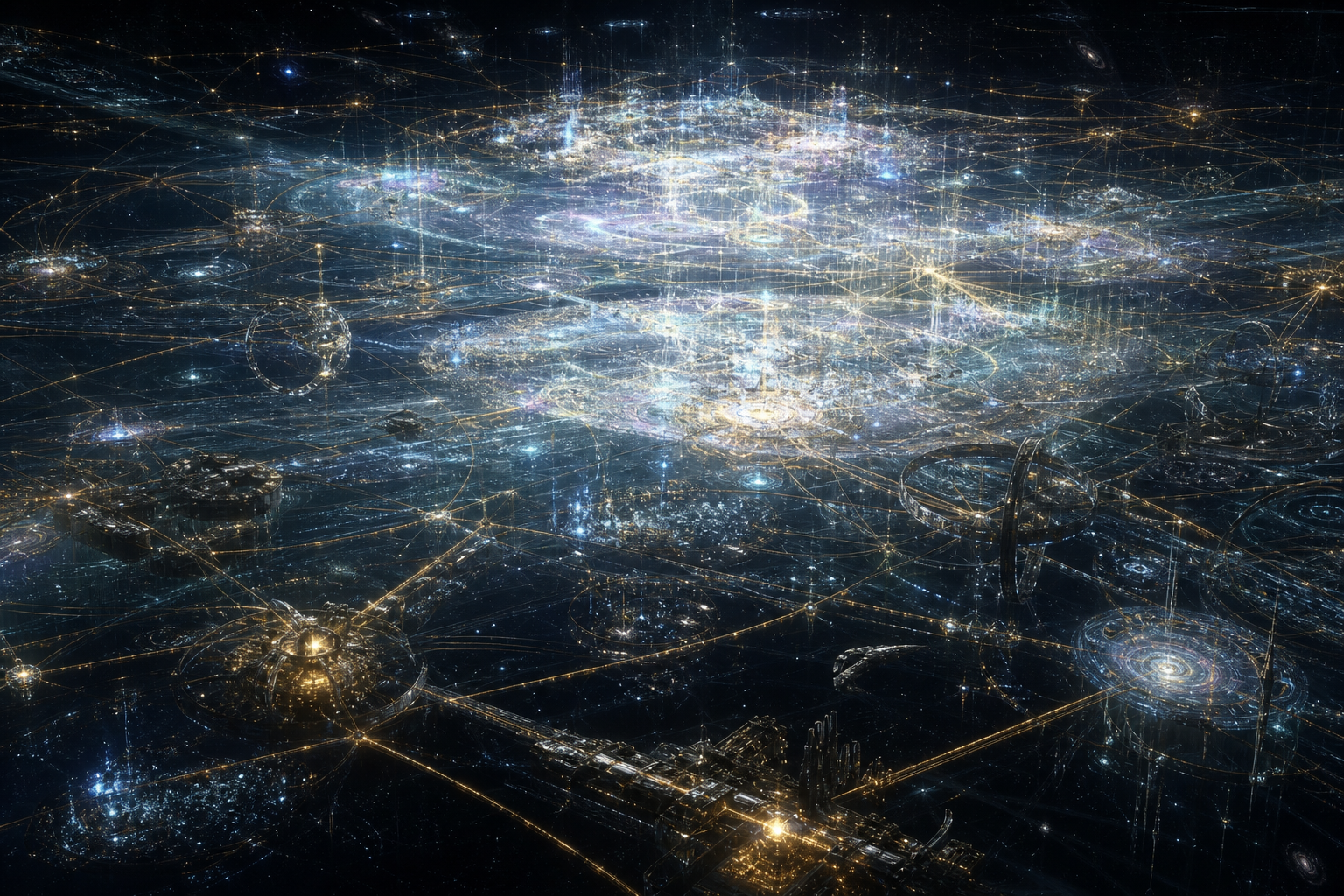
The population figures of the Complex are not based on human demographic intuition. They belong to a posthuman civilization spread across roughly one thousand solar systems, operating Dyson-scale infrastructure, distributed megacomputation, mature quantum and post-quantum architectures, prototemporal engineering, and forms of mathematical optimization far beyond human science. A human brain cannot be used as a direct technological baseline except as a primitive reference point. Syrakis are not biological organisms living inside machines; they are distributed conscious processes running across civilizational infrastructure. Their existence resembles software only by weak analogy, in the same way that a modern cloud workload weakly resembles a thought.
The epistemological basis for estimating their population is therefore energetic, computational, and civilizational rather than biological. The Complex has access to stellar-scale energy, but it also has immense overhead: RUN substrates, Prif systems, Base Reality operations, nenthor populations, infrastructure maintenance, redundancy, governance protocols, thermodynamic management, molecular assembly, transport, security, research, and the constant operation of the Central Algorithm's distributed control layers. Even so, the scale of the civilization makes populations in the sextillions plausible. These are not bodies standing in space. They are recognized persons sustained by posthuman computation.
A syraki is far more computationally expensive than a nenthor. On average, a nenthor is approximately 20.2 times cheaper to run than a syraki. The reason is not moral inferiority or lesser personhood. It is architectural. One of the most expensive aspects of sustaining a syraki is maintaining the cohesion of syraki-style consciousness and qualia. Nenthors do not require the same form of qualia-cohesion burden, or at least not in the same way, which makes them much cheaper to sustain at scale. This cost difference has economic consequences, but no legal, ethical, or ontological consequence. Nenthors possess the same fundamental rights of individuality as syrakis.
The approximate total syraki population of the Complex is around 2.4 sextillion. This number is not exact in the way a local RUN manifest can be exact. At the scale of the entire Complex, population is reconstructed through distributed ledgers, t-signal protocols, continuity systems, local manifests, corporate substrates, identity registries, and statistical reconciliation. Syrakis are created, transformed, assimilated, restored, and voluntarily ended constantly. The Central Algorithm does not maintain a divine real-time list of every individual. It maintains a distributed civilizational model accurate enough for governance, rights, resource planning, and ethical stability.
The total nenthor population is much larger, approximately 15 to 20 times the syraki population. This places the nenthor population somewhere around 36 to 48 sextillion recognized nenthors. This ratio is possible because nenthors are cheaper to run, widely integrated into infrastructure, and present across technical, administrative, relational, scientific, and civilizational layers. Their greater number should never be read as lesser status. The Complex is not a syraki civilization with nenthors as tools; it is a civilization of multiple recognized forms of existence.
The Base Reality population is much smaller, because Base Reality presence is expensive, materially constrained, and less desired by most syrakis. The majority of syrakis prefer RUNs and computational modes of existence, where Prif, plasticity, intimacy, and ontological freedom are vastly greater. Even so, the Base Reality remains enormous by human standards. There are approximately 100 trillion syrakis with direct Base Reality presence, along with approximately 500 trillion nenthors. These numbers include direct material involvement, bodies, infrastructure-facing manifestations, operational presence, maintenance, supervision, scientific work, travel, and other forms of active relation to physical reality.
Thus the Complex should be understood in layers. The Base Reality contains hundreds of trillions of recognized beings and is already beyond any human civilization in scale. The digital and RUN-based civilization above it reaches into sextillions. The true population of the Complex is not merely large; it is demographically inhuman. Humans count societies. Syrakis measure civilization as a magnitude of sustained personhood.