Navigation In The Complex
Template: Note
Source: .writer/books/4. 💽 Database/3. 🗒️ Notes/Society/Complex/Navigation In The Complex.org
1. Image
2. Content
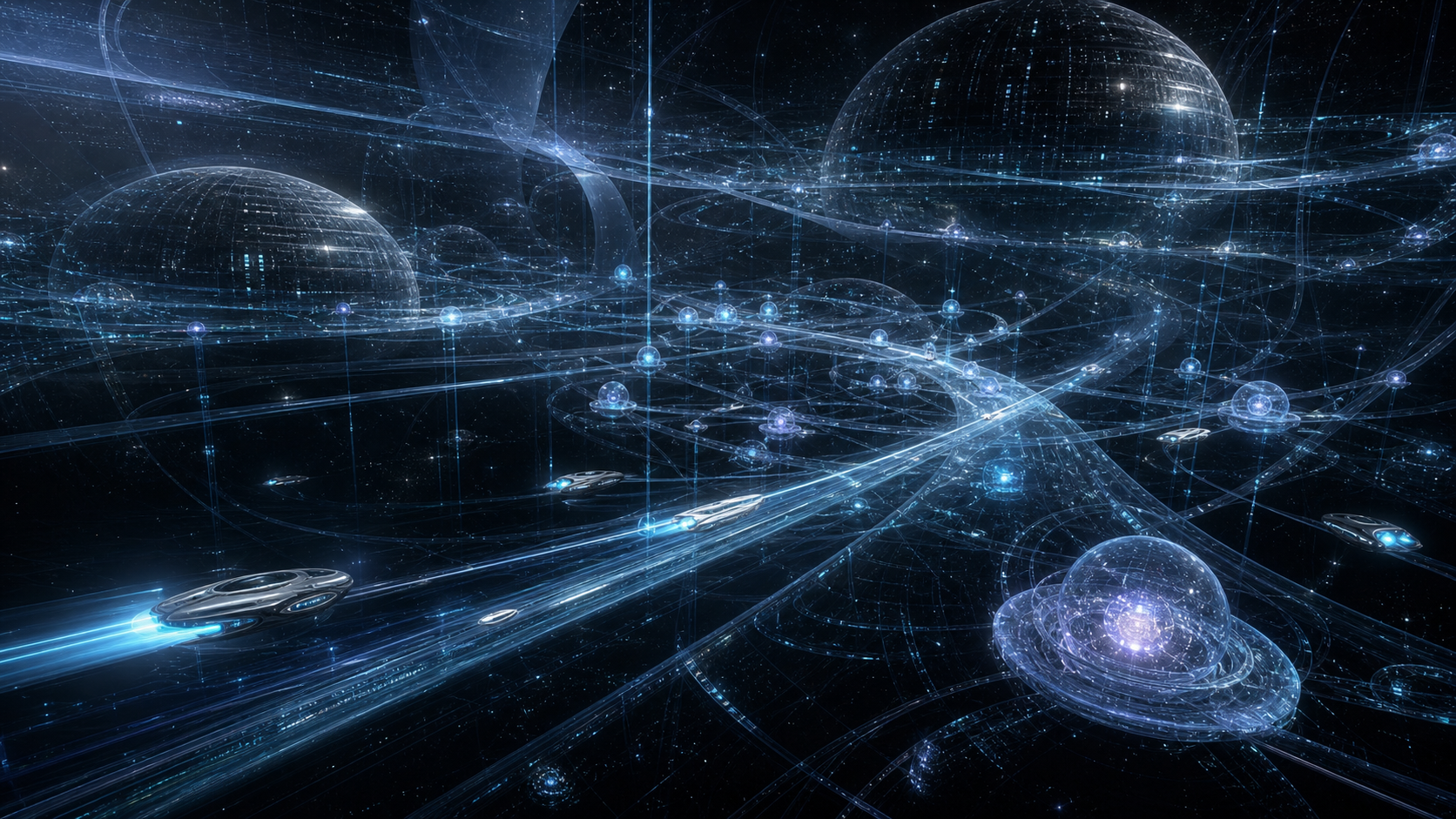
The Complex is not a flat ledger of servers. A syraki does not stand before an indexed list of machines and select a destination in the human sense. The Complex forms a mathematical hyperdimension: a navigable field of computation, encryption, contracts, permissions, hashes, routing costs, access gradients, stored realities, active worlds, dormant archives, bridges, queues, and physical substrates. Syrakis, nenthors, scripts, inquestors, and other artificial systems move through this field with an instinctive competence that has no true human equivalent. The closest human analogy is locomotion through space, but even that fails. Direction, as humans understand it, is not primary. Cost is primary. Access is primary. Computational pressure is primary. Cryptographic relation is primary.
A syraki moving through the Complex may know exactly what happens beneath the experience. It may know which computational bases carry it, which regions host its active processes, which fragments of itself are distributed, which physical systems support the route, which IG-Bridges stand in the path, which vessels or transfer shells may be used, which planets lie nearest to the relevant endpoints, and which other syrakis occupy nearby routing layers. Nothing about the machinery is hidden from it by default. Yet knowledge is not the same as attention. A syraki may possess complete access to the logistics of its motion and still choose to experience the passage as a game, a waiting-room, a dream, a private interstice, a social encounter, a blank transition, or nothing at all. To one syraki, the route may feel like crossing a luminous interior geometry of cost and permission. To another, it may feel like closing one RUN and opening another.
Movement through the Complex therefore has two faces. Phenomenologically, it may appear as a simple transition between realms. Operationally, it may involve data migration, state compression, contract validation, t-signal checks, queue negotiation, redundancy anchoring, physical transport, IG-Bridge access, docking, undocking, routing through congested regions, and reactivation at a cheaper or safer endpoint. A syraki can request a destination and allow the infrastructure to solve the path, or it can inspect every layer of the route. The everyday user rarely needs to perform that inspection. The capacity exists; the need usually does not.
This distinction makes movement economic rather than magical. The Complex has no free omnipresence. Every route has a price. Some prices arise in the hyperdimensional layer: computation, cryptography, verification, congestion, permissions, routing difficulty, maintenance windows, queue priority, and access rights. Other prices arise in Base Reality: vessel use, energy, endpoint occupation, docking capacity, physical transfer, IG-Bridge scheduling, infrastructure load, and risk. A syraki may wish to move from one region to another and discover that the direct route has become expensive because an intermediate sector received a vast influx of traffic. The route still exists, but its cost has risen. Under those conditions, a stranger path may become cheaper: connect to an automated vessel, wait for departure, travel through Base Reality, dock at a different node, cross an IG-Bridge, and enter the target region from a less congested side. To the syraki, the whole process may appear as a priced route option. In Base Reality, machines move.
This is common. The society has entire markets built around route optimization. A syraki can plan a route manually, reserve a future connection to a vessel, enter a queue, specify preferred infrastructure, select cost thresholds, accept delays, avoid regions, or pay for higher priority. But manual planning is technical and inefficient for ordinary life. Most syrakis outsource route calculation to paid route-mapping services. These services compete with one another by using immense computation, market-scale data, predictive congestion models, contract analysis, bridge availability, maintenance forecasts, endpoint pricing, vessel schedules, and near-optimal heuristics. An individual syraki can calculate a good route. A route-mapping service can calculate a better one because it sees the market, the queues, the hidden pressure, and the economies of scale.
The best route is rarely the absolute optimum. Even with Matrioshka Brains, quantum computation, post-quantum systems, and forms of computation beyond human terminology, optimization remains constrained by combinatorial explosion. The Complex contains too many routes, agents, contracts, states, priorities, cryptographic dependencies, and physical conditions for perfect routing to be cheap in every case. The civilization does not abolish optimization difficulty; it industrializes it. Route services search for paths that are safe, cheap, lawful, fast enough, contractually acceptable, and close enough to optimal to justify their price.
IG-Bridges occupy a special place in this system. They are not warp engines mounted on ships. They are not hyperspace drives that allow any vessel to flee in any direction. They are prepared spacetime corridors between stabilized endpoints. A ship, data structure, or physical system uses an existing bridge; it does not carry the bridge with it. The crossing itself is effectively immediate, more like a wormhole transition than a voyage through visible hyperspace. The delay belongs to the surrounding infrastructure: reaching the endpoint, gaining access, waiting through traffic, satisfying causal safeguards, passing safety checks, paying the route cost, docking, undocking, and chaining further connections. An IG-Bridge collapses a prepared distance, but only where civilization has paid to prepare it.
Because subjective time is configurable, physical duration does not carry the same emotional burden it would for humans. A route may require fifty days of Base Reality transit, or much longer, without forcing the syraki to experience fifty days of waiting. The elapsed duration enters the account as cost, risk, delay, and infrastructure occupation. The syraki may suspend, compress, redirect, or fill its subjective continuity with another RUN. A human would treat a fifty-day transfer as a long journey. A syraki may treat it as a route surcharge. This difference helps explain the patience of the civilization. It thinks in centuries, millennia, and longer spans because waiting has been detached from suffering, boredom, and biological decay.
The scale of possible destinations deepens the problem. There are more RUNs than syrakis and nenthors. Far more. The Complex contains active realities, private realms, corporate worlds, therapeutic environments, archived worlds, abandoned experiments, sealed estates, legendary RUNs, forgotten artistic structures, dormant simulations, treasure realms, encrypted vaults, failed projects, historical reconstructions, and worlds that no living citizen has visited for ages. Many RUNs are empty. Many are stored rather than actively computed. Storage is cheap by syraki standards; active computation is not. A complex RUN that no longer has active inhabitants may be encapsulated, archived, and preserved for future reactivation. Deletion exists, but preservation dominates whenever storage costs permit it.
This abundance creates its own culture of navigation. There are RUN archaeologists, treasure hunters, route specialists, key-recovery experts, archival explorers, corporate retrieval teams, and private wanderers who search for lost domains. A syraki might hide immense credit value inside a remote RUN and scatter clues across other realities. A forgotten realm might survive as a hash in an ancient contract. A sealed RUN might remain locked because a cryptographic key vanished through rare failure, death, legal fracture, deliberate design, or historical accident. Such places become destinations not because they are easy to reach, but because their difficulty has acquired value.
Navigation in the Complex is therefore not travel across space. It is movement through cost, memory, infrastructure, encryption, and desire. Base Reality supplies machinery. The hyperdimension supplies relation. Contracts supply permission. Computation supplies path. Subjective time supplies mercy. What appears to a syraki as a graceful change of realm may, beneath the interface, require vessels, bridges, queues, markets, energy, storage, and machines large enough to darken suns.