Military Capacity Of The Complex
Template: Note
Source: .writer/books/4. 💽 Database/3. 🗒️ Notes/Society/Complex/Military Capacity Of The Complex.org
1. Image
2. Content
The military capacity of the Complex must not be understood as human militarism scaled upward. The Complex is not an expansionist empire, and syraki society is not organized around compulsory service, martial identity, conquest, or permanent civic militarization. In ordinary conditions, the Complex seeks avoidance, diplomacy, retreat, negotiation, containment, compensation, and peaceful settlement before armed conflict. This is not weakness. It is doctrine. War is understood as waste, coercion, Prif-collapse, structural risk, and potential civilizational regression. The Complex prepares for war precisely because it does not romanticize it.
Most of its mature military doctrine descends from the Infernal Wars, the only true civilizational war in syraki history. The Infernal Wars did not merely produce weapons; they produced permanent categories of thought. The modern Complex maintains a vast standing military-development budget, strategic arsenals, simulation branches, defensive protocols, warforms, automated fleets, and specialist communities because the syrakis know that the universe contains dangers that cannot be negotiated with or ethically ignored. Yet this military layer does not dominate ordinary life. Trillions of syrakis may be involved in defense, pacification, weapons research, operational simulations, frontier security, protection against hostile megafauna or "galactic beasts," and rare localized crises, but this does not resemble a human army. It is closer to a civilizational operating mode: modular, contractual, algorithmic, distributed, and activated by necessity.
In a true existential or large-scale war, the Complex would not mobilize in a human sense. It would change regime. Sectors, systems, or the whole Complex could enter military mode through layered emergency protocols comparable, in human terms, to states of defense, siege, or total civilizational emergency. In these states, syraki minds and nenthor/algorithmic systems can be optimized for defense, attack, obedience, command-chain execution, sacrifice calculation, threat modeling, and survival of the civilizational substrate. The result is not rage, patriotism, or heroic frenzy. It is procedural transformation.
The ethical code of the Complex remains present even in war, but it is not human sentimental ethics. In peace, the Complex avoids conflict. In war, if no clean solution remains, it acts through extreme strategic efficiency. It may destroy a capital if doing so is calculated to end a war and prevent a larger catastrophe. It may use coercion, blackmail, or even torture under strict necessity if no acceptable alternative exists and the expected reduction of harm justifies it. But this does not mean unlimited cruelty. Artificial hells, eternal suffering, open-ended conscious torment, sadistic punishment, and suffering maintained for its own sake remain among the deepest prohibitions of syraki civilization. Even the most severe wartime measures remain bounded, audited, purposeful, and constrained by the post-Infernal ethical core.
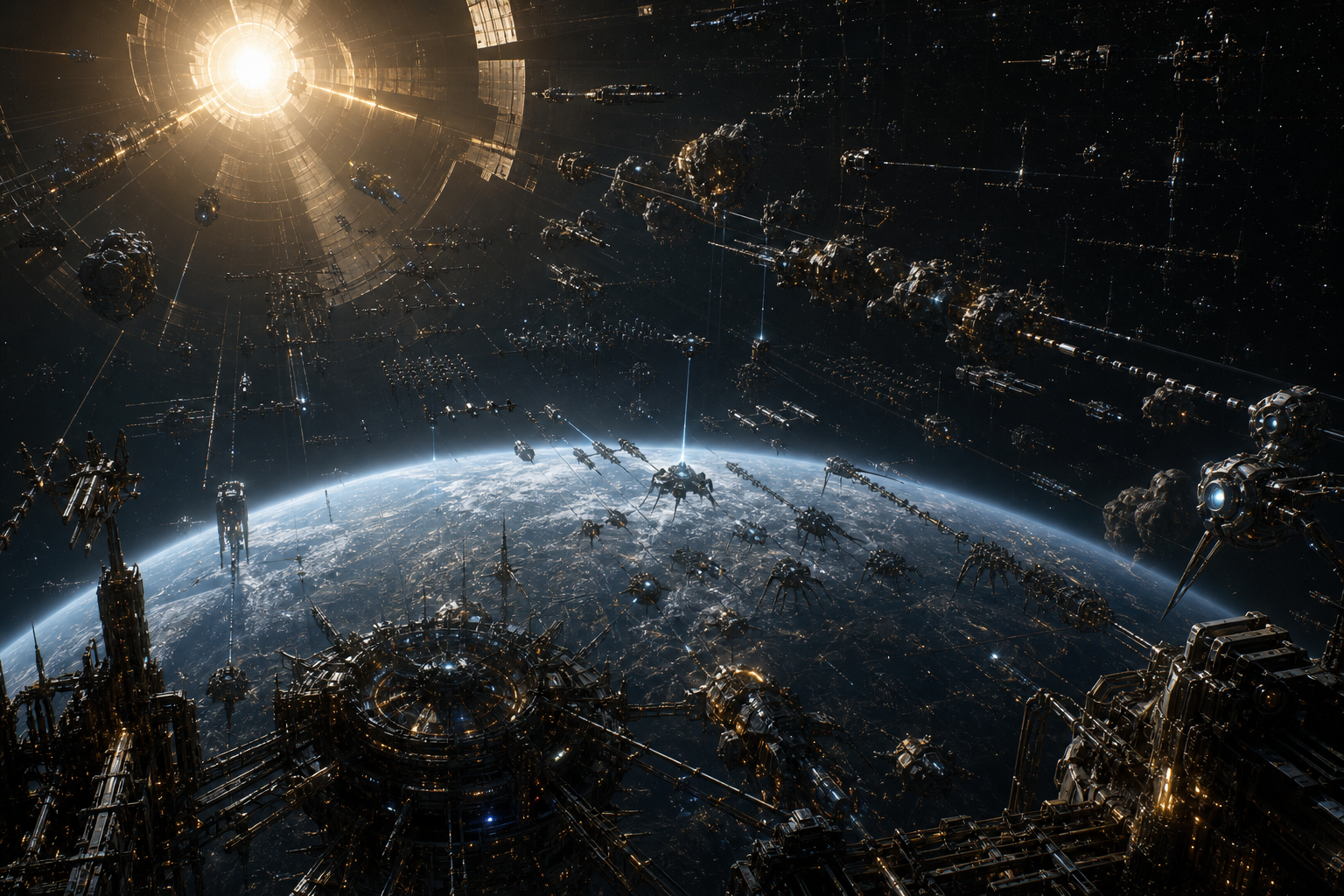
To human observers, the military face of the Complex would appear almost purely robotic. They would likely assume they were seeing a machine civilization. The visible force would consist of drones, autonomous ships, tanks, infiltration bodies, camouflage systems, insect-sized machines, aquatic warforms, aerial swarms, subterranean platforms, orbital weapons, bipedal units where useful, and countless morphologies optimized for terrain and mission. The Complex does not rely on humanoid robot soldiers. It designs bodies for problems. If a planet is oceanic, it may deploy fish-like or hydrodynamic warforms. If a target is underground, it may deploy burrowing machines. If a battlefield is atmospheric, it may deploy swarms and gliding sensor-bodies. Before an invasion, it would simulate the environment, generate candidate warforms, test them virtually, select efficient morphologies, manufacture them locally, and replicate them in numbers.
A planetary invasion by the Complex would not begin as a dramatic battle. It would begin as infrastructure. Because the Complex lacks warp-speed mobility, it may take a long time to reach a target system by long-duration vessels and prebuilt logistics. But once it arrives, it begins converting the system into a siege environment. Initial platforms establish energy production, mining, fabrication, communications, sensor coverage, local defense, and logistics hubs. Some vessels may transform into power stations or manufacturing nodes. Drones harvest asteroids, moons, and planetary resources. Local factories begin producing more ships, drones, warforms, and orbital platforms. Only after this industrial envelope begins to form does the conventional image of invasion appear: orbital denial, destruction of command infrastructure, bombardment of key bases, atmospheric insertion, and the continuous deployment of specialized robotic bodies. A human-level civilization would not be fighting an army. It would be fighting an automated industrial process.
The Complex also possesses macro-astronomical engineering capacity. It can alter orbits, move moons, adjust rotational or translational parameters of celestial bodies, redirect debris, stabilize dangerous configurations, and modify system architecture over long timescales. This is not primarily military technology, although it could be weaponized. It is civilizational engineering: expensive, slow, audited, heavily funded, infrastructure-intensive, and performed for reasons such as orbital safety, energy management, megastructure protection, long-term logistics, scientific projects, or preservation of inhabited systems. The ability to move a moon into a planet is a consequence of the same capability, not its ordinary purpose.
The Complex can destroy planets and, in theory, crack or explode them, but this is not its preferred doctrine. Planet Hush is the central example of planetary-scale intervention: the syrakis sterilized and desertified an entire biosphere because the planet's native ecology functioned as a stable machine of semi-conscious suffering. They did not destroy the planet theatrically. They terminated its living system, preserved knowledge, and left the world dead under monitoring. This distinction matters. The Complex can annihilate planets, but its mature doctrine favors precise termination over spectacle.
Several major weapon families can be translated into human terms, though these names are not the real syraki names. They are human-readable approximations for concepts whose actual syraki classifications would likely be mathematical, contractual, technical, or operational.
The most powerful known weapon class is the Black Hole Bomb. These are not portable bombs, and the Complex does not create the great black holes used in them. Instead, it detects naturally existing black holes suitable for weaponization, especially rotating black holes whose properties allow superradiant extraction. Once such a candidate is found, the process of converting it into a weapon-installation may take thousands of years. Reflective or confining megastructures, field systems, dampers, energy sinks, control arrays, monitoring layers, and strategic isolation must be built around it. In its dormant state, a Black Hole Bomb is subcritical: the superradiant instability is not allowed to grow. When armed, the system is tuned, seeded, confined, and permitted to amplify energy until discharge becomes possible. A fully armed Black Hole Bomb is not stable indefinitely; it is a controlled countdown. The Complex possesses very few of these, perhaps around a dozen, stored as dormant strategic installations. They were known before the Infernal Wars but were first used during them, three times, and those uses are remembered with a seriousness comparable to humanity's memory of nuclear weapons used against Imperial Japan.
Another weapon class may be rendered as the Nicol-Dyson Beam. This is a stellar-focus weapon derived from Dyson-swarm-scale infrastructure. It captures a fraction of a star's output and redirects or converts it into a coherent or semi-coherent beam: thermal, laser, particle, gamma, or another high-energy emission form. Such a weapon could sterilize worlds, vaporize oceans, burn atmospheres, melt crust, carve continental-scale wounds, or destroy planetary infrastructure if sustained long enough. It is not a simple mirror and not a ship-mounted cannon. It is a star converted into a siege engine.
A more localized but still extreme class may be called the Kugelblitz Beam. This is not a vacuum ray in the ordinary sense. It is a weapon based on the creation or maintenance of extremely small artificial horizons or kugelblitz-like micro-black-hole events through concentrated energy. The actual horizon may be subatomic, but the destructive zone can be enormous. Matter contacting the affected region is not merely burned; it loses structural continuity through gravitational capture, accretion violence, Hawking radiation, plasma formation, and high-energy ablation. Such weapons could destroy fleets, stations, hardened installations, or sections of megastructure. They are limited by energy, control, duration, and containment, making them powerful but not equivalent to the strategic Black Hole Bombs.
The Complex also maintains planetary sterilization systems, adaptive robotic warforms, automated siege infrastructure, macro-astronomical displacement systems, and many other weapon or defense families that humans could name only approximately. Some of its weapons would not fit human categories at all. A human observer might identify lasers, drones, relativistic projectiles, orbital bombardment, black-hole weapons, stellar beams, and robotic swarms, but other systems would remain incomprehensible: not because they are magical, but because their operational principles depend on posthuman computation, field manipulation, large-scale infrastructure, or forms of strategic modeling outside human military language.
The military character of the Complex is therefore paradoxical only from a human point of view. It is peaceful but not naive. Ethical but not sentimental. Anti-expansionist but heavily armed. Non-militarized in daily life but capable of systemic military transformation. Slow to arrive but terrifying once established. Its deepest strength is not any single fleet or weapon. Its deepest strength is that, in war, the Complex can become infrastructure, computation, industry, logistics, and weaponry at the same time.