Relativistic Storage And Conservation Rings
Template: Note
Source: .writer/books/4. 💽 Database/3. 🗒️ Notes/Society/Complex/Infrastructure/Relativistic Storage And Conservation Rings.org
1. Image
2. Content
The syrakis do not treat storage as a simple matter of placing data inside inert machines. At the scale of the Complex, storage becomes architecture, economy, preservation, law, physics, and time. Most storage is ordinary by syraki standards: distributed, redundant, encrypted, replicated, audited, and cheap compared to active computation. But some information is not merely stored. It is preserved against history.
For this, the syrakis use relativistic storage.
Relativistic storage exploits regions where time does not pass at the same rate as it does across the wider infrastructure of the Complex. Near sufficiently extreme gravitational bodies or anomalous spacetime structures, local proper time can slow relative to Base Reality Coordinate Time. A storage system placed inside such a temporal gradient does not become free. It does not compute faster. It does not escape physics. It gains something different: duration.
A black-hole archive does not make memory cheaper. It makes decay slower than history.
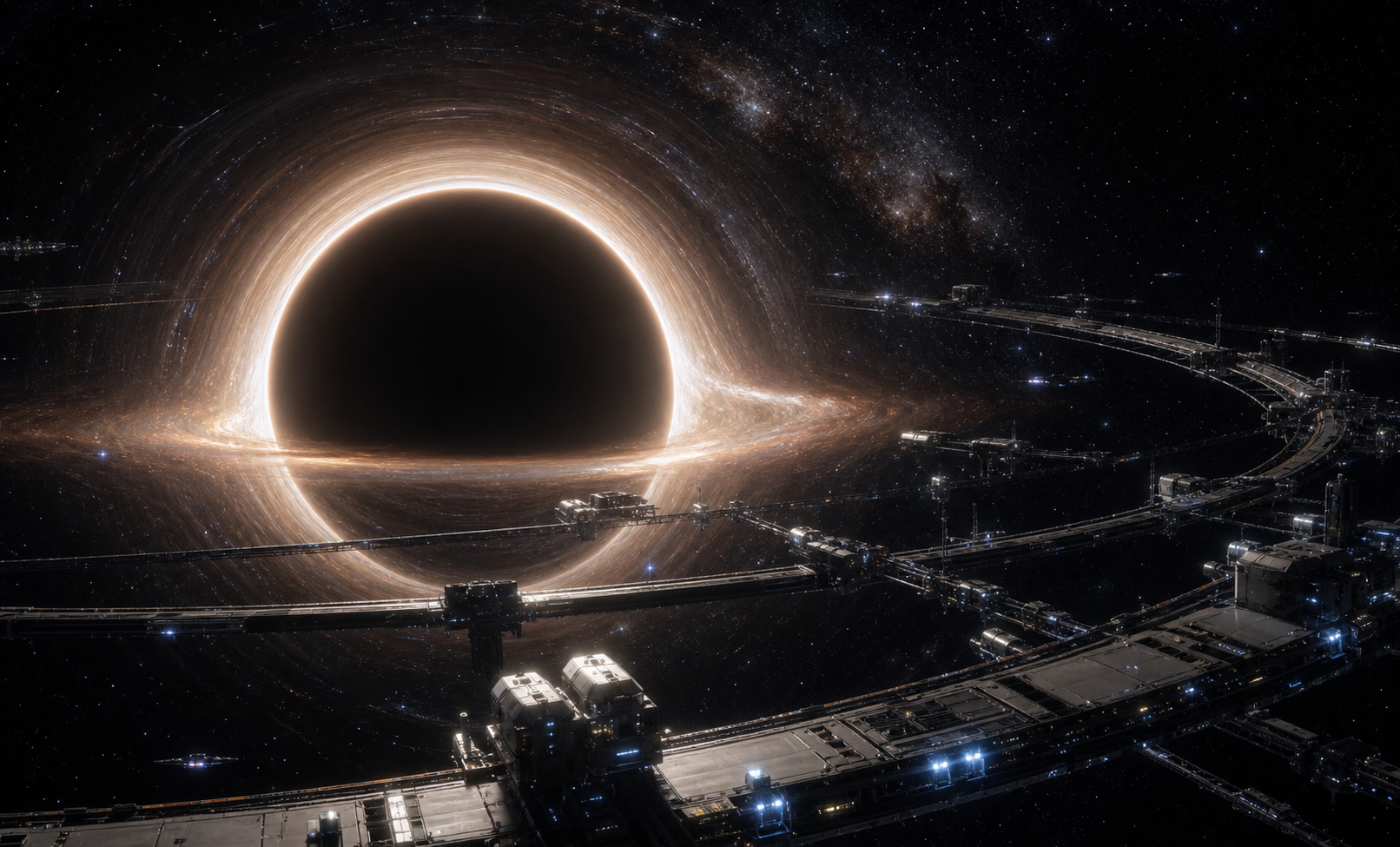
The most important form of this technology is the conservation ring: a tiered orbital storage structure built around a stable black hole or comparable temporal site. The rings occupy different depths in the gravitational well. Outer rings preserve less aggressively but remain easier to access. Inner rings preserve more deeply but impose greater retrieval cost, greater communication difficulty, greater maintenance burden, and higher temporal isolation. The deeper the ring, the more strongly the archive separates itself from the ordinary tempo of the Complex.
Despite the name, a conservation ring does not usually begin as a continuous structure. It normally begins as an orbital swarm: vaults, relays, maintenance bodies, custodial stations, BRCT instruments, shielding platforms, docking points, and archival modules distributed through the same relativistic depth. As the layer accumulates infrastructure, the swarm may become a mature ring-ecology: not a single rigid object, but a dense, semi-continuous orbital architecture whose components are coupled by traffic, contracts, relays, maintenance routes, and preservation duties. At sufficient maturity, it may visually and operationally resemble a ring, even though its real nature remains modular, distributed, and adaptive.
These rings are not equally spaced like floors in a tower. They are functional layers. Their separation follows preservation ratios, risk classes, retrieval expectations, communication limits, legal status, and engineering tolerance. A shallow ring may hold rarely used but recoverable archives. A middle ring may hold deep institutional records, sealed RUNs, historical evidence, long-term legal instruments, or cultural memory. A deep ring may hold information meant to survive external ages: disaster archives, ancient Mandate evidence, preserved consciousness states, dangerous research, quarantined information hazards, or relics whose value lies in remaining intact long after ordinary maintenance cycles would have consumed them.
A mature black-hole archive may contain dozens of meaningful conservation layers, though only some receive cultural, legal, or economic names. Beyond that, the physical gradient remains continuous, but administration, danger, and retrieval cost limit useful classification. The civilization could place countless devices at countless radii. It does not need countless named tiers. It needs tiers with different duties.
Black holes are the ideal sites for deep relativistic storage. They provide powerful time dilation without a material surface that must be approached or landed upon. A quiet, stable black hole with controlled infrastructure, predictable environment, and manageable radiation becomes a natural temporal vault. It is not merely a place. It is a preservation engine made from spacetime.
Neutron stars can also serve specialized roles, but they are not ideal. Their gravity is strong enough to matter, but their environments are violent: radiation, magnetic fields, surface phenomena, tidal conditions, emission instability, and brutal engineering constraints. A neutron-star archive may exist as a scientific installation, military-grade vault, experimental preservation system, or extreme research facility. It is not the preferred form of ordinary deep storage. It is a dangerous tool for narrow uses.
Other regions exist beyond human naming. The syrakis have mapped spacetime structures, gravitational anomalies, temporal distortions, causal scars, and natural configurations that human science would not recognize as usable infrastructure. Some of these are useless curiosities. Some are hazards. Some can anchor preservation systems. Some may outperform ordinary black-hole rings in narrow ways. The text should not overexplain them. Their existence matters because syraki physics has gone farther than human physics. They do not only use the obvious universe. They use parts of the universe humans have not yet learned how to see.
Relativistic storage is not fast storage. It is not used like an active database. A request sent into a deep conservation layer may take a long time to return when measured from the outside. The signal must descend through infrastructure, reach the vault, be processed in the vault's local time, climb out through redshift, pass through relays, and rejoin the ordinary Complex. Even when IG-Bridge infrastructure assists the surrounding system, the deepest layer still taxes retrieval. The same gravity that preserves the archive taxes every answer that escapes it.
This is why conservation rings are used for information that deserves survival more than immediacy. They are vaults, not work memory. They preserve what should remain intact across epochs: archived RUNs, extinct configurations, sealed contracts, civilizational records, evidence from ancient catastrophes, dormant worlds, protected witnesses, dangerous discoveries, and things too expensive, sacred, strange, or hazardous to leave in ordinary storage.
Around such archives there must be workers. Syrakis, nenthors, inquestor-class systems, maintenance AIs, corporate custodians, institutional auditors, and specialized infrastructure beings operate in these regions. They monitor deviation, maintain orbital layers, repair relays, audit retrieval, stabilize local BRCT readings, guard keys, manage contracts, replace shielding, inspect vault integrity, and prevent the archive from becoming a tomb. Their labor does not imply misery. A syraki working near a black hole remains a syraki: it still runs operational RUNs, hedonic RUNs, social layers, perceptual architectures, and protected states of experience. The work may stand at the edge of physics. The life does not become wretched.
Relativistic storage also reveals the civilization's relation to time. The syrakis are not yet a fully temporal civilization. They do not possess complete mastery over time as a general medium. They cannot rewrite temporal structure across the Complex at will. They cannot deploy stable, universal time-machinery as ordinary infrastructure. They are approaching that threshold. They can measure time with posthuman precision, exploit gravitational asymmetry, stabilize IG-Bridges, construct conservation rings, map deviation, build temporal prototypes, and test local devices that manipulate or exploit spacetime distortions. But these remain constrained, expensive, dangerous, local, experimental, or institutionally limited.
Their relation to temporal engineering resembles humanity's relation to nuclear fusion in earlier technological eras. The principle is known. The power is real. Prototypes exist. Everyone understands that mastery is possible in principle. But stable, general, civilization-wide use has not yet arrived. The syrakis live in the age before full temporal civilization. They are close enough to feel its gravity.
This makes conservation rings especially important. They are not merely archives. They are the civilization's practical compromise with time before true temporal mastery. They cannot command time absolutely, so they bargain with gravity. They cannot make history stop, so they lower memory into places where history passes more slowly. They cannot yet rule duration, but they can build vaults inside its gradient.
Some civilizations build monuments against time. The syrakis build storage where time itself becomes the wall.