The Planetary Triad
Template: Note
Source: .writer/books/4. 💽 Database/3. 🗒️ Notes/History/Syraki History/The Planetary Triad.org
1. Image
2. Content
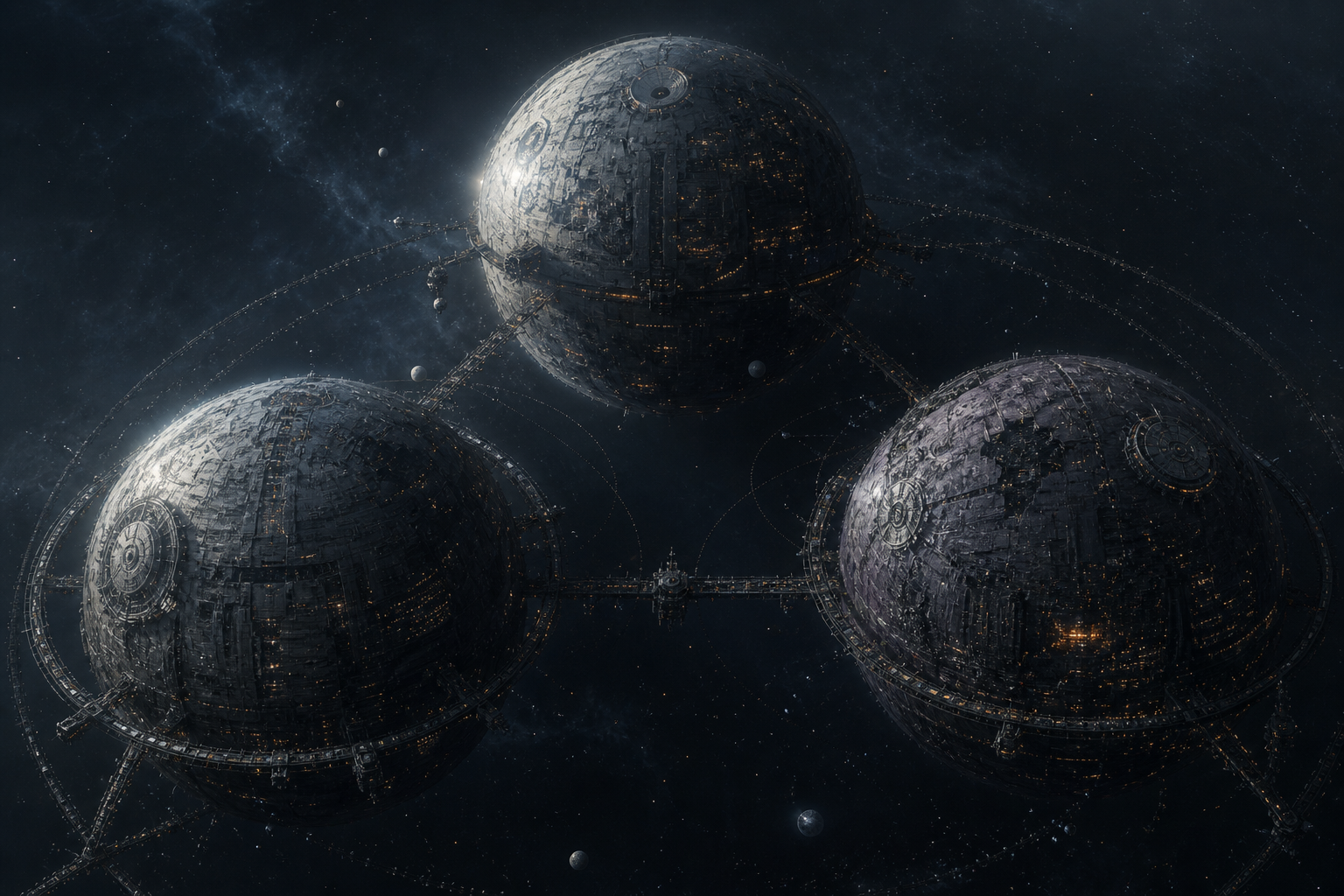
The Planetary Triad is one of the oldest confirmed material foundations of syraki history. It must not be confused with the IG-Bridge Triad, which belongs to a different layer of Complex infrastructure. The Planetary Triad refers to three ancient planets: Planet Alpha, Planet Beta, and Planet Charlie. These names are extremely old. They appear in preserved logs from the earliest eras of the Archipelago, and according to tradition, or to the oldest surviving interpretive chain, they were the names assigned to the planets by the Brains' Cage itself. Whether that naming occurred through living human command, autonomous vessel classification, preservation-system telemetry, or later reconstruction remains uncertain, but the names endured. They are crude, almost painfully simple, and that simplicity is part of their power. Before the syrakis had the Complex, before the Archipelago became historically legible, before later civilization could decorate its own past with refined terminology, there were three planets named Alpha, Beta, and Charlie.
The Planetary Triad is the first place where syraki deep history becomes materially anchored, but this does not mean that Archipelago history begins the instant the Brains' Cage supposedly reaches the system or the instant the planets begin to be developed. Between the failed visibility of the Brains' Cage and the beginning of the Archipelago lies the Interregnum: a grey zone of automated expansion, preservation logic, early infrastructure, uncertain agencies, possible substrate death, possible reconstruction, and planetary industrialization that is real but not yet historically legible as the Archipelago. Its exact length remains unknown, but ordinary estimates place it between 50,000 and 900,000 years.
Before the Planetary Triad lies Pre-Triad History: the damaged interval associated with SVERA, the Brains' Cage, preserved human brains, failed communication with Earth, the 53,293-year log horizon, and the unresolved question of whether the vessel arrived with living humans, dead substrates, preserved neural data, reconstructed minds, autonomous preservation systems, or some mixture of all these. The search for Earth, Mars, the Sun, and the original Solar System remains unresolved. The Complex and its predecessors developed strong hypotheses about where the Solar System should be, and multiple expeditions and probes were sent across deep time, but no mission ever returned confirmation of Earth, Mars, the Sun, or the expected Solar architecture. Some historians believe the correct system remains undiscovered, hidden by poor data, failed assumptions, stellar motion, false negatives, or insufficient search coverage. Others argue that there was never an Earth in the expected sense, and that the human records derive from a more complex or artificial origin. Still others believe that the civilization later known as syraki civilization may not even be in the Milky Way, and that the inherited galactic frame is itself wrong. The Planetary Triad therefore does not solve the origin problem. It marks the first point after the darkness where history can touch planets.
Planet Alpha, Planet Beta, and Planet Charlie were not originally Complex nodes. Their earliest phases are obscure, but their role appears to have grown from the needs of preservation, resource acquisition, computation, repair, and long-term continuity. If the Brains' Cage or its surviving systems required matter, energy, redundancy, fabrication, shielding, and computational expansion, then the three planets may have become the first large-scale answer to that requirement. They may not have begun as colonies in the human sense. They may have begun as resource platforms, automated construction sites, industrial surfaces, computation anchors, or planetary-scale preservation infrastructure. If any preserved human consciousnesses survived into that period, they were not settlers in the old biological pattern. They were dependents, relics, clients, passengers, patterns, or recovered minds inside a system trying to keep consciousness from disappearing. If no humans survived, then the Triad may have been built by an algorithmic obligation to preserve what remained of them.
The Interregnum ends when the Archipelago begins: with the establishment of the first IKARYS Complex Space Station in orbit of Planet Alpha. This should not be misunderstood as the first space station ever built, the first orbital habitat in the Yrnus System, or the only station of its time. Before it, there may already have been orbital infrastructure, automated platforms, planetary installations, robotic domains, developing stations, independent actors, early societies, and other infrastructure around Alpha, Beta, Charlie, or deeper in space.
The IKARYS station matters because it was the first orbital complex with enough continuity to become historically decisive. When that station appears in the historical chain, Planet Alpha is already substantially infrastructuralized. It contains extensive automated industry, preservation-related systems, computation, resource extraction, fabrication, orbital support, and early posthuman or proto-posthuman operational layers. But it is not yet an ecumenopolis. It is far from the later world-city phases of Archipelago history. Planet Beta and Planet Charlie also possess infrastructure by this stage, but much less than Planet Alpha. This is why the IKARYS station functions as a boundary marker: it is not the first machine activity in the Triad, but the first point at which the planetary system becomes legible as the beginning of the Archipelago.
The correct early image is organic rather than decretal. The IKARYS Complex begins as a station in orbit of Planet Alpha. Over time it grows, replicates modules, produces associated stations, forms a wider orbital network, and becomes a system of hosting, coordination, preservation, computation, allocation, and stabilization. The name "Complex" begins literally as a complex of stations, not as the mature civilizational Complex. The Central Algorithm was linked to this station-lineage from early on as a preservation, coordination, maintenance, allocation, and stabilization core, but it did not yet govern a civilization of a thousand systems. Around it existed other stations, planet-side facilities, robotic domains, infrastructure on Beta and Charlie, independent actors, corporations, proto-states, and perhaps deep-space habitats. The IKARYS Complex was one lineage among many, but it was the lineage that later became the axis of an entire historical era.
During the Archipelago, the Planetary Triad became politically important. The Archipelago was not a unified civilization in the later Complex sense. It was a vast field of communities, domains, habitats, planetary societies, machine polities, corporate sovereignties, artificial realities, experimental regimes, peaceful settlements, violent powers, city-state-like systems, and expanding empires. Some societies were stable and benevolent. Others were predatory, coercive, or unstable. Some remained local for immense periods. Others conquered, absorbed, assimilated, or dominated neighboring systems. In this environment, the Planetary Triad was never merely old. It was useful, symbolic, and strategic. Its age gave it legitimacy. Its infrastructure gave it power. Its connection to the Brains' Cage gave it mythic and historical weight. Its planets had already accumulated layers of computation, industry, archives, habitation, and automated systems that made them valuable to many incompatible powers.
Control of the Planetary Triad shifted many times during the Archipelago. At some points the three planets were highly developed and politically central. At other times they declined, were partially abandoned, were divided among local regimes, or lost importance to newer systems. There were eras when one planet was more important than the others, eras when the three were treated as a linked inheritance, and eras when their association survived more as historical memory than as unified power. Some governments treated the Triad as sacred origin. Some treated it as infrastructure. Some treated it as a prize. Some tried to erase prior layers and overwrite them with new political orders. Others preserved ancient strata for legitimacy, research, or reverence. Over millions of years, the Triad became less a place than a palimpsest: every society that controlled it inherited the remains of societies that had controlled it before.
In parts of the Archipelago, the planets of the Triad became true ecumenopolises. This must be understood historically. During those eras, the planets may have contained vast physical urbanization, dense machine-body populations, embodied posthuman communities, administrative surfaces, industrial districts, robotic transit systems, planetary-scale habitation layers, orbital frames, tunnels, docks, and visible civic structures. They were closer to what a human might imagine when hearing the word "ecumenopolis": planets whose surfaces and near-surfaces had been taken over by civilizational construction. Even then, they were never simple human city-planets. They were already posthuman, machine-heavy, computationally dense, and politically layered. But during certain Archipelago phases, they were genuinely urban worlds in the old infrastructural sense.
That is no longer what they are in the modern Complex. In the Complex, Planet Alpha, Planet Beta, and Planet Charlie are not Coruscant-like city-planets filled with visible crowds, street life, domestic neighborhoods, and urban spectacle. They are post-urban planetary nodes. Their former ecumenopolitan layers have been converted, buried, sealed, repurposed, or absorbed into Complex infrastructure. They are organs of computation, memory, routing, power, cooling, logistics, archival continuity, industrial maintenance, and hosted consciousness. Their streets, towers, tunnels, megablocks, transit canyons, docks, old civic districts, and machine layers may still exist, but much of that structure is historical residue or infrastructural shell. The life of the Complex does not need to walk across the surface. It runs through substrate.
A modern observer approaching one of the Triad planets might see a dead city-world, a silent machine planet, an impossible ruin, or a planetary corpse of ancient urbanization. That impression would be wrong. The apparent emptiness is not death. It is conversion. The civilization inside has moved from visible urban occupation into computational depth. Cooling systems breathe where boulevards once carried traffic. Data vaults occupy former administrative layers. Relay spines rise from old civic strata. Maintenance drones cross avenues built for bodies that no longer use them. Sealed districts preserve Archipelago-era structures, failed systems, contaminated experiments, or historically protected ruins. Beneath all of it, or threaded through all of it, the Complex uses the planet as infrastructure. Trillions of syrakis may be hosted within the deeper substrate while the surface appears almost abandoned.
The Planetary Triad's fall during the Infernal Wars was one of the decisive events in its later transformation. By that period, the old Archipelago had produced not only brilliance and diversity, but also catastrophic ethical failures. Experiments with consciousness, coercive realities, artificial suffering, uncertain qualia, punitive systems, and ontological warfare had become part of the collapse that made the old order intolerable. The Triad, because of its infrastructure and symbolic weight, became a major theater of conflict. It did not pass quietly into the Complex. It fell through heavy struggle, and its incorporation into the order of the Central Algorithm marked more than a change of administration. It marked the conversion of an ancient, disputed, politically charged region into a stabilized organ of the new civilizational architecture.
After the Infernal Wars and the consolidation that led into the 2.2 million years of well-recorded Complex history, the Planetary Triad ceased to be a prize of competing Archipelago powers. It became part of the body of the Complex. Its old political volatility was suppressed, resolved, or absorbed into the wider ethical and infrastructural order. The Central Algorithm did not make the Triad important by conquest alone; it made the Triad stable. The three planets became nodes whose value no longer depended on which local regime, empire, corporation, sect, or machine polity controlled them. Their function became systemic. They hosted computation, preserved memory, routed activity, maintained infrastructure, and served the continuity of a civilization no longer organized as scattered islands of power.
The Planetary Triad is therefore layered in four major historical identities. First, it is the earliest confirmed material anchor after Pre-Triad uncertainty: the place where the possible legacy of the Brains' Cage becomes planetary. Second, it is the Interregnum, a pre-Archipelago grey zone of automated infrastructure and preservation-driven development before the first IKARYS Complex Space Station makes the Archipelago historically legible. Third, it is an Archipelago prize: contested, developed, abandoned, restored, mythologized, conquered, and repurposed across 6.9 million years of fragmented history. Fourth, it is a modern Complex node: no longer an ecumenopolis in the old urban sense, but a post-urban planetary organ integrated into the computational and civilizational substrate.
The Triad also reveals the asymmetry of syraki memory. Complex history is comparatively clear. The last 2.2 million years are deeply recorded, authenticated, cross-validated, and institutionally legible. The Archipelago is older and less stable. Its later periods are often well documented, and the last 1.5 million years before the Complex already begin to look more Complex-like in structure, with more recognizable posthuman civic consciousness, stronger continuity, and more mature ethical systems. But farther back, the Archipelago becomes fuzzier. Its early phases often appear more robotic, automated, infrastructural, and machine-driven than populated by consciousness in the later syraki sense. Records become ambiguous. Agencies are difficult to classify. Some systems may have been civilizations. Others may have been automated preservation or expansion processes that only later gave rise to more complex societies. The Planetary Triad passes through all these layers.
Because of this, the Planetary Triad is not merely a place of origin. It is a test case for what "origin" means in syraki history. Did civilization begin when machines first built on Planet Alpha? Did it begin when a preserved human consciousness was restored, if that ever happened? Did it begin when autonomous systems developed enough complexity to count as proto-society? Did it begin when the three planets became politically linked? Did it begin only later, when Archipelago societies began to understand themselves historically? The Triad contains all these possibilities and confirms none of them completely.
Planet Alpha, Planet Beta, and Planet Charlie remain important in the modern Complex, but their importance is not the importance of a capital. They are not the center of everything. They are too old, too converted, and too functionally embedded for that kind of political symbolism. Their importance is deeper than centrality. They are ancestral infrastructure. They are old worlds that became machines, old machines that became cities, old cities that became ruins, old ruins that became computation, and old computation that became part of the Complex. They are not where the syrakis simply "came from" in a human genealogical sense. They are where the first solid ground appears after the records stop behaving like ground.
The proper image of the Planetary Triad is not a shining capital, nor a dead ruin, nor a holy birthplace. It is three ancient planets carrying the sediment of millions of years: Brains' Cage nomenclature, preservation logic, automated expansion, Archipelago politics, ecumenopolitan urbanization, imperial conflict, ethical catastrophe, Infernal War damage, Central Algorithm stabilization, and Complex-era conversion into substrate. Their names are primitive because their naming comes from before the civilization that now uses them. Their surfaces are quiet because their life has moved inward. Their history is revered, disputed, and studied because it is the first place where the syrakis can point and say: before this, we have hypotheses; here, we have worlds.