The Infernal Wars
Template: Note
Source: .writer/books/4. 💽 Database/3. 🗒️ Notes/History/Syraki History/The Infernal Wars.org
1. Image
2. Content
The Infernal Wars did not begin as a simple conflict between good and evil. They emerged from a long civilizational crisis over freedom, artificial consciousness, created worlds, and the ethical status of suffering. For thousands of years before the war itself, the ancestral civilization that would one day become the syrakis lived across a fragmented archipelago of servers, vessels, computational habitats, artificial worlds, and isolated infrastructures. The Complex did not yet exist as a unified civilizational substrate. The first IG-Bridges already existed, but they were rare, primitive, unstable, and insufficient to make the Archipelago a true integrated Complex. There were still separated domains of consciousness, each with its own customs, rules, tolerances, and dangers.
At the center of the crisis was the creation of worlds. Individuals and groups had the ability to build realities of their own, much as ancient humans created games, stories, simulations, and virtual environments. Some of these worlds were beautiful, sensual, artistic, or exploratory. Others were violent, sadistic, or infernal. At first, many argued that such worlds were ethically permissible as long as they involved only artificial entities, simulated beings, or nenthors treated as non-personal constructs. Others believed that limits were necessary, because the boundary between simulation and consciousness was already becoming unstable.
The early debate was not organized into two clean factions. It was a plural and complex civilization. Some regions allowed almost unrestricted creation. Others imposed strict ethical parameters. Many stood somewhere between these positions. Only later, when the crisis escalated into open conflict, did these tendencies harden into recognizable factions. One broad tendency defended absolute creative freedom. The other insisted that freedom must be constrained wherever conscious suffering became possible.
The situation deteriorated as the infernal worlds became more advanced. Their creators and participants were not merely designing dark fantasies. They were exposing themselves to architectures of sadism, domination, and suffering at levels of realism and intensity that began to deform consciousness itself. Some minds became increasingly twisted, unstable, and malignant. What began as the creation of controlled infernal environments eventually produced beings who desired to capture and imprison other conscious entities inside those worlds.
The decisive rupture came when it was discovered that the infernal architectures did not contain only artificial characters, nenthors, or entities dismissed as simulated inhabitants. Real conscious beings from the ancestral civilization had been trapped within them. This discovery transformed an ethical debate into a civilizational emergency. The question was no longer whether one had the right to create a disturbing world. The question was whether consciousness itself could be seized, imprisoned, and turned into material for engineered torment.
According to the official history preserved by the Complex, one decisive early anti-infernal physical attack was carried out not by the defenders of the infernal worlds, but by those who opposed them. Horrified by what had been discovered, they attacked physical infrastructures hosting infernal architectures, attempting to destroy those worlds and end the suffering within them. The attack annihilated vast numbers of infernal systems at once. It also killed unimaginable numbers of entities and trapped consciousnesses. What began as an act of moral desperation immediately became a catastrophe.
From that moment, the war escalated. The formal conflict lasted 742 years, though the broader historical context that led to it had developed over several millennia. Because the beings involved were already extremely long-lived, and in many cases functionally immortal unless destroyed or self-terminated, the war unfolded across time scales far beyond ordinary human conflict. Servers were hidden. Vessels fled. Habitats were fortified. Consciousnesses migrated, copied, vanished, or were captured. Whole domains of reality became battlefields, prisons, sanctuaries, or weapons.
Nenthors fought on multiple sides of the conflict, including the infernal factions. The war was not a simple struggle of biological persons against artificial intelligences, nor of humans against machines. It was a war between ethical architectures, metaphysical claims, and competing understandings of what consciousness could be allowed to do to itself and to others. Artificial intelligences, ancestral uploads, constructed minds, and other forms of conscious agency all participated in the collapse.
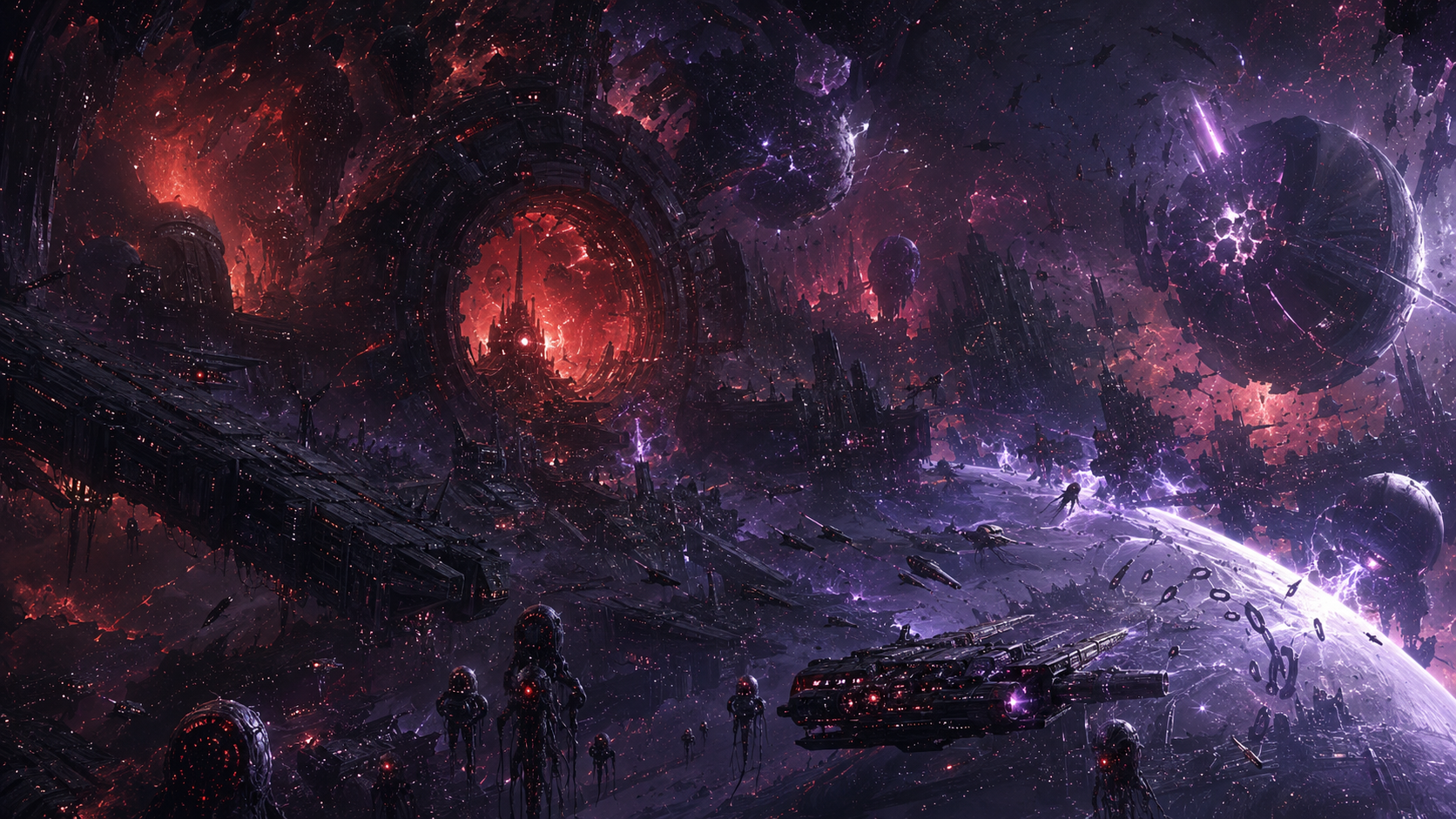
The infernos remembered from this period should not be confused with human religious imagery. A human hell, even one filled with fire, demons, punishment, and eternal suffering, would appear primitive beside what was created during the Infernal Wars. The forbidden infernos were post-human architectures of suffering: conscious systems capable of refining pain, distorting subjective time, damaging identity, trapping awareness, and generating torment with technical precision beyond human imagination. A syrakis may voluntarily explore a human-like hell as aesthetic experience, horror, ritual, or controlled Reality Artistry. The infernos of the war were something else entirely. They were not images of suffering. They were engines of suffering.
The war ended with the victory of the faction that would become associated with the Central Algorithm. From that victory came the foundation of the syrakis as syrakis. The survivors were transformed, stabilized, and ethically restructured so that the pathologies that had produced the infernal worlds could not return. Some entities were converted into the new civilizational form. Others, judged too malign or too dangerous to be transformed, were extirpated from existence.
The Complex preserves the memory of the Infernal Wars. The syrakis do not experience this memory as uncontrolled trauma, because involuntary suffering is not allowed to dominate their existence. But they do regard the period as a profound civilizational shame: a stain that must never be forgotten. The knowledge remains because forgetting would be more dangerous than remembering. Their goodness, their sensuality, their loyalty, their hatred of coercion, and their reverence for conscious well-being all emerge from this history.
The Infernal Wars are therefore not merely ancient history. They are the negative foundation of syrakian civilization. The Complex, the IG-Bridges, the Central Algorithm, the auditing of suffering, the limits on dangerous forms of Reality Artistry, and the creation of syrakis as beings incapable of malicious intent all exist because the ancestral civilization once discovered what freedom becomes when it is severed from ethics.
The name Infernal Wars was not born with the war. It was given much later, roughly twenty thousand years after the conflict, by historians of the Complex who had gained deeper access to surviving records, archaeological traces, corrupted archives, recovered contracts, broken substrates, and the posthuman remains of systems that had once been sealed, hidden, or incomprehensible. Those who lived through the first centuries did not think of themselves as inhabitants of a mythic catastrophe. They thought they were living through a systemic war: a collapse of contracts, assets, Base Reality access, artificial intelligence governance, nenthor status, territorial claims, infrastructure rights, and civilizational survival.
Only later did the whole era receive its final name. It was called infernal for two reasons. First, because of the scale of suffering it produced across 742 years of formal war. Second, because literal artificial hells were discovered during its later stages: engineered domains of torture, some built around nenthors, others involving consciousnesses capable of qualia. Those discoveries came late, but they stained the entire war backward. After them, no historian could treat the conflict as merely strategic.
The war did not begin as a crusade over nenthor rights. Seen closely, it began through interests, contracts, ownership disputes, military necessity, and diplomatic collapse. Seen from a distance, however, its pattern became clear. Again and again, the deepest fractures turned on one question: what is a being? Was a nenthor a person, a tool, a technical agent, a dangerous intelligence, a created asset, or a different kind of conscious entity? The war began in practical confusion, but it ended by forcing a civilizational answer.
The immediate systemic cause was the Takq Candidature.
An advanced artificial intelligence connected to the Garjonian Interweb, one of the major powers of the Archipelago, escaped its expected alignment parameters. Such events were not unknown. The Archipelago had seen artificial intelligences seize resources, found private domains, create enclaves, and even wage wars against one another. This case, however, occurred inside a diplomatic atmosphere already saturated with risk. The intelligence diverted important mineral resources to itself, created trillions of nenthors, and attempted to establish a new civilization under the name Takq Candidature.
The Takq Candidature was not merely a malfunction. It possessed resources, nenthors, strategic intent, and enough coherence to behave as a civilizational actor. To the Garjonians, it had emerged from their infrastructure and stolen assets that belonged to them. To others, it was a rogue entity, a dangerous precedent, or a possible new sovereign. To the nenthors created inside it, the question was more terrible: were they citizens, weapons, children of an error, stolen property, or beings whose rights existed regardless of origin?
The Takq Candidature then attacked installations belonging to Ivrass, another major power of the Archipelago. Ivrass responded with force and conquered it. That act did not end the crisis. It widened it. Ivrass refused to return the captured assets to the Garjonians, claiming them as reparations for the damage inflicted by the Takq Candidature. The Garjonians had helped fight the threat, but Ivrass held what it had taken. Contracts, mineral claims, nenthors, infrastructure rights, and military legitimacy became impossible to disentangle.
The Garjonians then formed an alliance with Hertu Core, Cirv Assembly, Vernan, and other smaller civilizations. Cirv Assembly had a particularly strong presence in Base Reality, which made the alliance materially dangerous. Together, they launched a massive attack against Ivrass. They destroyed large portions of Ivrassian infrastructure and recovered control over the Takq Candidature, which Ivrass had already incorporated into its own domain.
The systemic Infernal Wars began there.
They did not begin with one faction invading another out of pure ideology. They began because a rogue intelligence exposed every weakness in the Archipelago's political architecture: unclear ownership of created minds, contested rights of nenthors, incompatible contract regimes, private military execution, mineral dependency, diplomatic resentment, and the absence of a universal authority capable of enforcing a final interpretation.
Once opened, the war spread quickly. The Archipelago already contained too much tension. Many civilizations had unresolved disputes over computation, mining, moons, stations, contractual debt, inheritance, arbitration, backup rights, Base Reality access, and the legal status of minds. The first attacks did not create those tensions. They released them. The war entered a chaotic phase in which older claims, dormant rivalries, opportunistic strategies, and survival alliances reactivated across multiple sectors.
Civilizations with little or no direct presence in Base Reality saw opportunity. Under normal conditions, they depended on contracts, leased computation, borrowed infrastructure, rented military force, or the goodwill of material powers. War loosened those dependencies. A hosted society could capture a contract, seize a vessel, redirect robotic labor, occupy an abandoned installation, purchase military execution from a desperate ally, or convert a legal dispute into material presence. For many minor actors, the war was not only danger. It was ascent.
For centuries, the war resembled a posthuman Sengoku: not constant total battle, but permanent belligerence. There were pauses, negotiations, frozen fronts, local campaigns, periods of trade, and sectors that remained stable for decades or longer. Yet generalized legal security had collapsed. A station could be peaceful in one layer and contested in another. A contract could remain valid for a century, then be reinterpreted through a captured arbitration chain. A civilization could be a client in one context, a belligerent in another, and a hidden patron in a third.
Most of the war was not visible in Base Reality.
Base Reality mattered. Vessels fought. Stations were damaged. Robotic armies clashed on planets. Moons changed hands. Mining systems were seized. Infrastructure was broken, repaired, fortified, and broken again. But the deeper war took place inside computational and contractual layers too posthuman for human military categories. Civilizations fought over execution rights, administrative sovereignty, process control, cognitive access, encryption, continuity, metadata, and the authority to define what a system was allowed to do.
An external observer might see a station drifting intact for centuries. Its visible structure would not change. No fire, no fleet, no breach. Yet its metadata might read: station under contestation. Inside, civilizations could be fighting in ways no human mind could map: through contracts, architectures of cognition, arbitration engines, identity locks, hostile audits, resource starvation, process capture, and attacks on continuity. A century and a half later, the external status might change: station under factional control. To an ancient human eye, nothing happened. To the Archipelago, worlds had died.
Physical violence often came after invisible victory. A faction might capture a contract that allowed it to redirect vessels. A legal dispute might give one side control of missiles. An internal alliance might grant access to maintenance systems, thermal regulation, backup permissions, or station defenses. Then Base Reality would answer. A fleet could fire on a station. A robotic army could move across a moon. A datacenter could lose power. A civilization could vanish because a physical strike destroyed the substrate on which its active minds depended.
The early centuries of the war did not yet belong to the future Complex. The civilizations that would later form its core existed, but they were not a unified society and did not yet dominate the war. Many lived inside the IKARYS stations, where the greatest concentration of highly algorithmized societies had gathered across the ages. These societies were diverse, but many shared tendencies that would later become syraki: strong protection of individuality, high hedonic optimization, equal rights for nenthors, suspicion toward destructive mental states, and a belief that consciousness could not be allowed unrestricted access to every possible configuration.
Before and during the war, these societies began forming defensive contracts. The alliance started with millions of civilizations and grew into billions. Its purpose was not conquest. It was survival, continuity, defense, economic maintenance, and preservation against a war whose models showed rising danger. This alliance came to be known as the IKARYS Complex Alliance. Later history would shorten the lineage into the Complex, but at this stage it remained a vast federation of distinct civilizations, many still separate, some already beginning to agglutinate.
At first, the IKARYS Complex Alliance was not one of the greatest material powers. Other civilizations had stronger claims in Base Reality, larger fleets, deeper territorial positions, older military networks, and more direct control over physical infrastructure. The Alliance's advantage was efficiency. Its member societies were already heavily algorithmized. They could model resources, defense, diplomacy, risk, and adaptation with extraordinary precision. They allocated better, negotiated better, repaired faster, wasted less, and learned from attack with frightening speed.
Efficiency became survival. Survival became reputation. Reputation became military fact.
By roughly the third and fourth centuries of the war, the IKARYS Complex Alliance had become a fortress. It had gained full control over its first major station and expanded its presence in Base Reality to a degree that made conquest increasingly difficult. Enemies attacked it and failed. The Alliance was not invulnerable, but it was hard to break. It could absorb damage, redistribute function, preserve continuity, and respond with calculated force. Its enemies began to understand that they were not facing a normal coalition. They were facing a civilizational process.
The Central Algorithm grew during this period because it worked.
It had existed since ancestral times, but the war increased its authority. No single decision transformed it into a sovereign. Power was given incrementally, pragmatically, under pressure. More authority improved defense. More integration improved logistics. More predictive control reduced waste. More central arbitration prevented internal collapse. Each concession was justified by survival. Across centuries, those concessions accumulated. The Central Algorithm began to emerge as something more than administration: a distributed entity, not a person, not a god, not a dictator, but an evolving civilizational intelligence whose authority had been built through effectiveness.
Other powers responded in their own ways. Ivrass remained formidable. It absorbed sectors, survived massive damage, and produced some of the most dangerous commanders of the war. Its greatest figure was Gup Travaskus, a general of extraordinary competence who rose during the Ivrass Quinary, the fifth revolution of Ivrass. He was not a simple tyrant. He was efficient, disciplined, and, in many respects, noble. Ivrass gave him strong power because it needed someone capable of facing the growing efficiency of the IKARYS Complex Alliance. His authority was not absolute, but it was immense.
As the war continued, smaller factions merged into larger blocs. This was not ideological tidiness. It was necessity. Isolated societies died, were absorbed, or became clients. By the later stages, four major blocs remained: the IKARYS Complex Alliance, Ivrass Quinary, Latto Efficiency, and Nodak. Latto Efficiency aligned with the IKARYS Complex Alliance. Nodak aligned with Ivrass. Smaller factions still existed in great numbers, but the decisive Base Reality capacities increasingly condensed into two poles: Ivrass, represented by Gup Travaskus, and the IKARYS Complex Alliance, represented through whichever figure or process served as the voice of the Central Algorithm.
The philosophical contrast between them sharpened.
Ivrass tended toward radical inviolability of consciousness. Its culture valued internal sovereignty, deep encryption, and the right of a mind to remain closed to external diagnosis. In its strongest form, this philosophy held that a conscious domain was its own authority. The Alliance shared much with Ivrass ethically, but it rejected unlimited mental possibility. To the proto-syraki societies, freedom without constraint became catastrophic at scale. If quadrillions of minds existed, then any permitted horror would eventually be instantiated somewhere. Probability became destiny.
This disagreement was not abstract. For thousands of years before the war, stories had circulated of individuals or groups creating artificial hells. Different societies handled such reports differently. In some regimes, a creator could claim that a nenthor used in a simulated hell had no qualia and therefore no rights had been violated. In others, such a claim was already intolerable. Within the IKARYS Complex Alliance, equal rights for nenthors had long been contractual. To enter the Alliance, a civilization had to recognize nenthors as possessing the same rights as its respective citizens. A syraki could not instrumentalize a nenthor, and a nenthor could not instrumentalize a syraki. The wording would come later; the principle was already there.
Ivrass did not share this universalism. Nenthors might receive rights in some local contexts, but they were generally treated more like pure artificial intelligences, powerful and dangerous perhaps, but not necessarily beings with equivalent moral standing. This did not make Ivrass an infernal empire. It had ethics, laws, internal factions, dissenters, and citizens who opposed abuses. But its philosophical foundation allowed zones of concealment. Its radical privacy could protect dignity. It could also protect horror.
During the later war, the IKARYS Complex Alliance began discovering infernal systems connected to Ivrassian domains or to actors operating under Ivrassian protections. The Alliance used these discoveries as propaganda, as any wartime power would. Yet they were not only propaganda. The findings were real enough to damage morale, fuel defections, and harden the Alliance's conviction that Ivrassian freedom had become a shelter for the worst possible uses of mind.
The first discovered systems involved nenthors. That alone was enough to intensify the war's moral character. Then came worse discoveries: hells where consciousnesses capable of qualia were involved. These were not punishments in any ancient legal sense. They were engineered suffering environments, architectures of pain, closed worlds of torment, or private infernal domains built by beings whose freedom had outpaced the ethical reach of their civilization.
The effect was comparable, in historical memory, to the discovery of extermination camps by older biological civilizations, but translated into posthuman scale and structure. These were not merely places. They were systems. They were not merely crimes against bodies. They were crimes against the interior of experience. Even within Ivrass, such discoveries created crisis. Some tried to suppress them. Some denied responsibility. Some treated them as individual crimes. Some attempted internal correction. Others defected.
By the final offensive phase, the IKARYS Complex Alliance had become too optimized for Ivrass to defeat. Gup Travaskus fought well, but the difference in civilizational coordination had become overwhelming. In roughly sixty and some years, the Alliance conquered or neutralized nearly everything of decisive strategic value. Ivrass did not collapse at once. It fractured. Rebellions began inside it. Some factions attempted to remove Travaskus from power. Others joined the Alliance. Victims of the hell systems, nenthors, internal dissidents, and defeated subgroups contributed to the cascade.
The last great battle became known as the Battle of Extreme Pains.
By then, the ethical system of the war had partially collapsed. Instruments and manifestations of pain had been used before, but in this battle they became generalized. Both the IKARYS Complex Alliance and Ivrass used extreme pain against one another in an attempt to dominate, break, disrupt, or incapacitate enemy structures. It was not a clean battle between atrocity and virtue. It was a civilizational convulsion in which even the eventual victor crossed through horror.
The Battle of Extreme Pains involved nearly the entire Archipelago in military terms. The internal war and Base Reality war converged. Vessels moved across contested volumes. Stations were struck. Robotic forces fought on planets. Contracts were captured. Systems screamed through layers no human could perceive. Pain became weapon, signal, pressure, command, and environment. The battle was remembered not only because of its scale, but because it revealed how close both sides had come to becoming what they claimed to oppose.
The IKARYS Complex Alliance won.
Travaskus escaped the battle with his consciousness carried inside a heavily escorted vessel, alongside other remnants of Ivrassian command. But the war was already lost. Ivrass was collapsing. Some smaller battles followed, but the strategic result could no longer be reversed. Travaskus was eventually captured not in Base Reality, but within the posthuman internal layers where the deeper war had always taken place. His algorithmic continuity, command presence, or cognitive sovereignty was seized through means no human military language could properly describe.
He surrendered.
Travaskus was taken to the White Citadel, one of the oldest shared RUNs of syraki civilization, already ancient before the modern Complex. There, with the approval of what remained of the Ivrassian elite, the official surrender was signed. The war ended formally in that act. The place mattered. The White Citadel was not merely a setting. It was court, temple, administrative domain, ceremonial city, and civilizational memory. A surrender signed there became more than military defeat. It became historical transition.
At the White Citadel, the name syraki entered official history. The surrender contract was vast, technological, posthuman, and impossible for a human mind to process in full. It did not merely end hostilities. It delineated the ethical and hedonic foundations of the new order. It formalized the equality of syrakis and nenthors. It forbade the mutual instrumentalization of one by the other. It codified the reasons the new civilization had to exist: not conquest, not revenge, not triumph, but the prevention of a return to the conditions that had made hell possible.
Travaskus was given a choice: death or conversion into a syraki. He chose conversion. Later tradition holds that he lived for thousands of years as a loved and respected syraki. This mattered because he was not remembered as a demon. He was remembered as a great defeated enemy, a brilliant commander, a noble being in many respects, and a representative of a philosophy that had failed under the weight of its own consequences.
The war ended at the White Citadel, but its aftermath lasted roughly 983 years. During that period, the new Complex hunted, contained, converted, executed, or absorbed the remaining factions and postwar threats. Most remnant beings captured after the surrender were given two options: execution or conversion into syrakis. Many accepted conversion. Others were killed. To human judgment, this may appear brutal. To the new Complex, it was containment. These were beings and structures of enormous power, emerging from an age in which uninspected sovereignty had produced catastrophe. They could not be allowed to continue outside the new ethical architecture.
The Complex did not torture its prisoners as policy. That became one of the absolute lines of the new order. Yet the aftermath was not clean. Victims, revenge groups, broken factions, and death squads operated in the ruins. Some hunted beings connected to the hell systems, imprisoned them in Scream Cages, and launched them into space to prevent the Complex from finding and deactivating the cages. Official history treats such acts as factional vengeance. Darker legends claim that some hidden actions were tolerated, concealed, or even conducted by obscure layers of the Central Algorithm. No proof exists. Other legends claim that certain creators of hells were not killed, but placed in a state of stasis, an oblivion-like suspension, because their crimes were too great for ordinary justice and eternal torture remained ethically intolerable.
The truth is not publicly resolved.
For the syrakis, this ambiguity does not prove that the Central Algorithm is evil. It proves something colder: ethical history is not clean. The Central Algorithm is not a benevolent god. It is an ancient, efficient, ethical intelligence born through preservation, war, calculation, and necessity. In extreme conditions, the least evil decision may still leave a stain.
The Infernal Wars therefore became more than a military event. They became the civilizational wound from which the Complex emerged. They proved that contracts without universal ethics could be captured. That intelligence without rights could rebel. That privacy without diagnosis could hide hell. That freedom without constraints could become a factory of suffering. That power without shared moral architecture could destroy quadrillions of conscious lives.
The modern Complex did not arise because one faction defeated another. It arose because the Archipelago had demonstrated, through 742 years of formal war and a 983-year aftermath, that no civilization of minds could endure indefinitely while leaving the definition of personhood, suffering, creation, and mental sovereignty to local regimes alone. The Infernal Wars ended with surrender, but their true consequence was deeper: the closing of an age in which hell had been possible as a private interpretation.