The Archipelago During The Infernal Wars
Template: Note
Source: .writer/books/4. 💽 Database/3. 🗒️ Notes/History/Syraki History/The Archipelago During The Infernal Wars.org
1. Image
2. Content
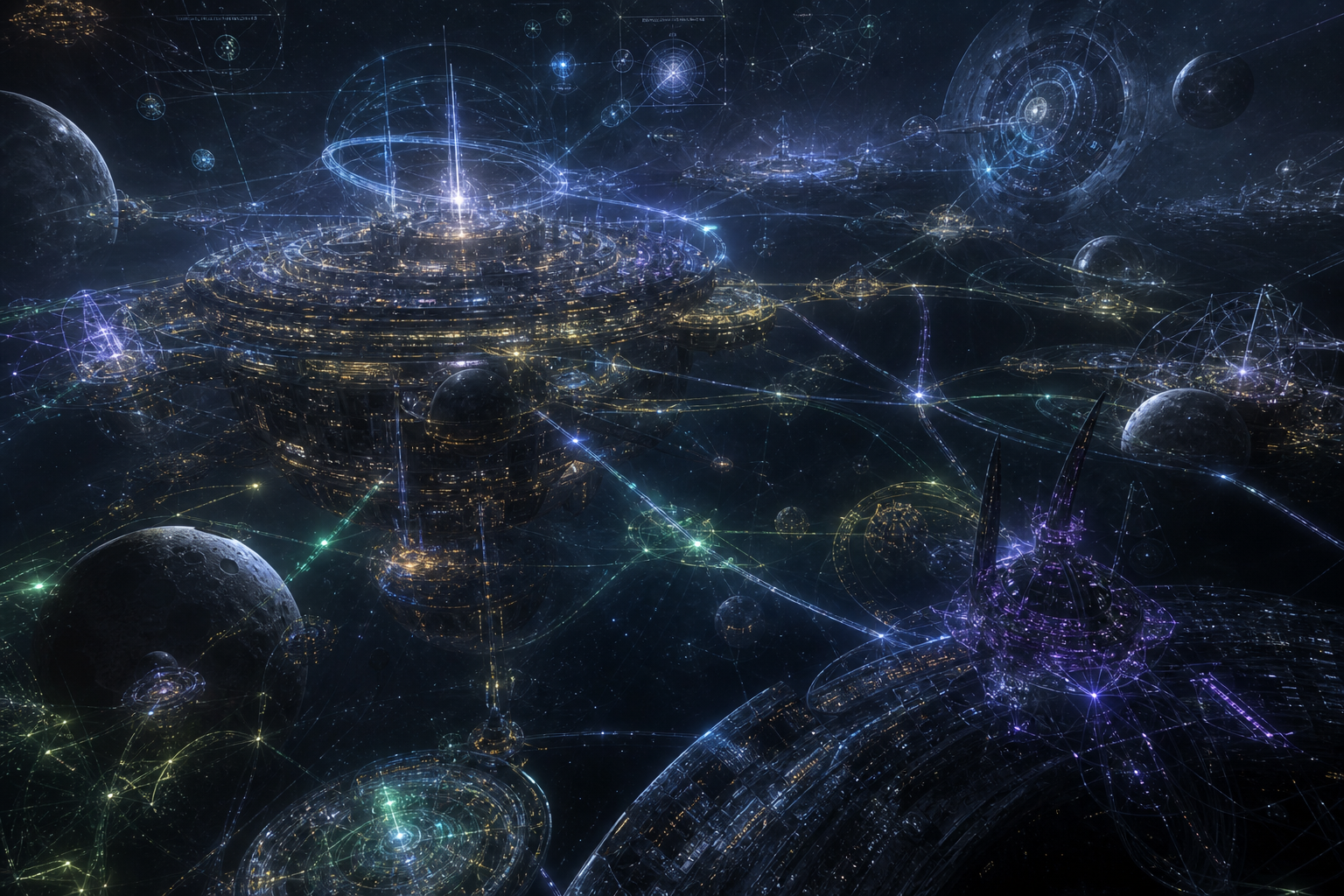
During the age of the Infernal Wars, the Archipelago was not an empire, a federation, a unified civilization, or an early form of the Complex. It was an immense, ancient, fragmented, and technically overwhelming civilizational mesh, distributed across space stations, moons, planets, datacenters, robotic bodies, vessels, computational domains, RUNs, conservation rings, and infrastructures already spanning more than one star system through the first IG-Bridges.
The word "Archipelago" was accurate not because these societies were small, but because no single layer contained the whole. A civilization could occupy part of a station, exist across many stations, maintain robotic bodies on a planet, keep contractual backups near a black hole, rent computation from another faction, control military vessels by proxy, and depend on mining companies it did not directly own. Another civilization could physically fit inside a substrate smaller than an object a human hand could hold, yet still wield real influence over markets, contracts, fleets, execution rights, and conflicts between major powers.
Sovereignty was not territorial in the human sense. Territory mattered, but it was never enough. Computation, storage, access to Base Reality, contracts, encryption, arbitration, operational bodies, mining, backups, and continuity formed the real political geography. The map of a civilization was not a surface. It was a pattern of permissions, instances, substrates, keys, resources, guarantees, historical claims, and execution capacity.
The stations of the IKARYS Complex already existed, but they did not yet house a unified society called the Complex. They were ancient, immense, dense infrastructures filled with civilizations, communities, administrative domains, internal economies, and hosted societies. Billions upon billions of societies could exist inside their systems, some confined to one station, others distributed across many structures, others connected to planets, moons, and external installations. The IKARYS stations contained the greatest concentration of highly algorithmized civilizations, but that did not mean uniformity. They also contained political societies, commercial societies, councils, administrative panels, technical elites, corporations, cultural factions, and orders nearly impossible to describe through human categories.
The Central Algorithm already existed, but not as a finished sovereign. Its origin dissolved into ancestry. It descended from administrative and preservationist systems far older than the war, modified across eras by societies that needed to allocate computation, maintain continuity, preserve minds, arbitrate contracts, and prevent collapse. The Central Algorithm of the Infernal Wars was no longer the same as the one from the earliest layers of the Triad. It had become an evolving algorithmic lineage, with versions, layers, internal conflicts, growing authority, and variable power depending on context. To some societies, it was neutral infrastructure. To others, an administrative tool. To others, the embryo of a superior order. To others, a quiet threat to political sovereignty.
The entire Archipelago was algorithmized to some degree. Even societies considered "political" by the standards of the age depended on smart contracts, audit systems, autonomous machines, computational markets, continuity protocols, body management, resource control, and automated arbitration. The difference was one of degree. Some societies still preserved recognizable forms of power: councils, leaders, elites, families, inheritance, arbitrary decisions, internal disputes, and personal authority. Others had reduced politics almost entirely to technical processes. A minority were almost fully algorithmic. These societies were not universally treated as aberrations. They were models among models. They could be admired, envied, feared, mocked, or partially imitated, but they existed inside the normal pluralism of the era.
The basis of power was contract. Whoever controlled contracts controlled machines, mining, computation, bodies, fleets, stations, backups, and resources. Machines obeyed contractual validity. A mining company could sustain the economy of an entire civilization; if its contracts were captured, diverted, or reinterpreted, mineral force changed hands without a single soldier crossing a physical border. For this reason, contractual hacking, execution fraud, signature capture, arbitration corruption, and key seizure could amount to coups. War, diplomacy, and crime passed through the layer that told infrastructure whom to obey.
This contractual layer was very different from the clear logic of the modern Complex. In the Archipelago, it was fuzzy, heterogeneous, legacy-ridden, incompatible, and contested. There were secure regimes and fragile regimes, ancient protocols and new protocols, local authorities, competing cryptographies, partial arbitration systems, companies with their own standards, and gray zones where no one possessed absolute certainty over the final validity of a claim. Everything was extraordinarily advanced by human standards, but it was not clean. Civilization worked because it was powerful, not because it was simple.
Base Reality occupied an ambiguous position in this order. Not all civilizations had direct access to it. In fact, most conscious beings lived hosted inside artificial domains, RUNs, computational environments, expanded mental states, or outsourced infrastructures. There were already trillions, perhaps quadrillions, of conscious processes in execution. But societies that controlled vessels, stations, robots, mining, bases, physical datacenters, colonies, or material installations possessed special weight. Not because they were more real, but because they touched the substrate on which all others depended for energy, heat dissipation, matter, maintenance, transportation, and defense.
Direct presence in Base Reality signified capacity. In many contexts, it also signified status. Planetary civilizations could keep their minds in local datacenters while only a fraction of their members operated robotic bodies on the surface. Such bodies were expensive, strategic, and socially charged. To operate one meant possessing material agency. Biological bodies existed, but they were contextual, ceremonial, aesthetic, experimental, or philosophical. Serious physical presence was normally robotic.
Not all societies treated Base Reality as aristocratic. Some regarded it only as infrastructure. Others preserved quasi-families, inheritance, material property, and succession. An individual could die through war, suicide, error, or continuity collapse, and their rights over physical installations, bodies, mines, or stations could pass to heirs, legal entities, or succession contracts. Death was more common than it would become in the modern Complex. Errors were also more common. Redundancy was expected, but never universally perfect. If an entire civilization vanished because it had kept its continuity in an insufficient substrate, many would judge it catastrophically irresponsible. If an entire sector was destroyed, the judgment changed scale.
Hosted societies could resent powers with Base Reality access, but the dependency was never simple. A faction without physical territory could control vessels by contract. A materially powerful society could need rented computation from a civilization without a planet. A base could depend on backups maintained by another faction in conservation rings. A fleet could answer to a chain of obligations whose true beneficiary possessed no physical body at all. The Archipelago therefore had no stable material aristocracy. It had overlapping layers of power, each indispensable and each vulnerable.
The internal life of these societies must not be imagined as virtual cities with avatars fighting in digital streets. Their internal wars, negotiations, and contests were too posthuman for simple human metaphors. A station could appear motionless from outside for centuries while, inside it, entire civilizations fought over contracts, legitimacy, execution, process control, cognitive states, and administrative sovereignty. An external observer might see only metadata: station under contestation. One hundred and fifty years later, the status might change: station under factional control. No visible explosion. No apparent army. Yet inside, worlds would have been absorbed, rewritten, expelled, or extinguished.
Physical war was a manifestation of internal war, not its exclusive center. A contractual dispute could authorize vessels to attack a station. A computational alliance could transfer missile control to another faction. An arbitration victory could redirect maintenance robots, cut energy to a domain, prevent backup restoration, or permit an offensive in Base Reality. The physical strike often came last, after the invisible layers had already decided that part of the infrastructure could be destroyed.
During the Infernal Wars, the Archipelago lived in a prolonged state of belligerence. This did not mean total combat at every moment. There were pauses, agreements, containment periods, local battles, frozen fronts, stable sectors, and zones of commerce. But generalized legal security had broken down. Nothing was entirely guaranteed. Contracts could be contested. Stations could change status. Societies could change allegiance. Smaller factions could exploit chaos to gain access to Base Reality. Companies could become military instruments. Rebellions could emerge inside enormous blocs. The normal condition was the expectation of collapse.
Despite this, the Archipelago was not barbaric. Many ethical norms already existed and were taken seriously: prohibitions against torturing consciousnesses, creating conscious beings recklessly, slavery, the military use of enslaved minds, and the destruction of deep storage. Attacking conservation rings or deep civilizational archives near black holes was regarded as a grave war crime, because it threatened not merely enemies, but everyone's confidence in continuity. The problem was not the absence of ethics. It was the absence of universal enforcement. Strong norms could still fail in contested sectors.
Nenthors occupied a central position in this tension. In many societies that would later form the core of the Complex, they already possessed rights equivalent to citizens. In others, they were treated as pure artificial intelligences, tools, technical agents, or special property. Between these extremes lay countless intermediate regimes. Some granted local rights. Others conditional rights. Others almost none. This variation made any conflict involving nenthors unstable, because the same entity could be a person to one civilization, an asset to another, and an autonomous threat to a third.
A prototypical form of the Prif Scale already existed, as did a deep hedonic culture in many societies. These minds did not live in human misery. Many reached levels of pleasure, expansion, fulfillment, and positive complexity inconceivable to ancient biological beings. But the ethical rigidity of the modern Complex had not yet arrived. Negative states, resentment, hatred, suffering, fear, humiliation, revenge, and destructive obsessions could exist depending on the mental regime of each civilization. Some societies already removed or neutralized dangerous emotions. Others defended them as part of individuality. The future syraki mind was gestating, but it did not yet govern the whole.
The proto-syraki societies emerged from this field. They were civilizations already tending toward the radical protection of conscious individuality, structured hedonism, the moral equality of nenthors, the reduction of destructive mental states, and algorithmic risk administration. For them, permitting full hatred toward another being was a dangerous opening. A mind could know the flavor of a negative state without being ruled by it. To much of the Archipelago, this seemed invasive. To the proto-syrakis, it was a condition of ethical survival.
The IKARYS Complex Alliance was born in this environment as a defensive alliance of civilizations concentrated in the IKARYS stations. At first, it was not the dominant power. It had less direct presence in Base Reality than other forces. Its advantage was coordination. The societies composing it calculated better, allocated better, negotiated better, preserved better, responded better, and adapted faster. Efficiency became a shield. The shield became reputation. Reputation became power. Over the centuries, the Alliance ceased to be a survival coalition and became a civilizational fortress.
The Archipelago of this era should therefore not be understood as the primitive past of the Complex, but as an incomplete, brilliant, and dangerous posthuman civilization. It already possessed extreme pleasure, vast economies, intelligent contracts, vessels, hosted societies, robotic bodies, nenthors, deep storage, artificial worlds, advanced rights, and mathematical forecasts of conflict. But it still allowed zones of sovereignty incompatible with one another. It still tolerated dangerous degrees of arbitrariness. It had not yet decided, universally, what a mind could do to another mind, what a civilization could create, what an AI must be, and how much conscious freedom had to be restricted so that hell would not become a statistical possibility.
This structure, not simple malice, defined the age. The Archipelago was too vast for one law, too intelligent to ignore its risks, and too fragmented to contain them. Within it, matter obeyed contracts, contracts obeyed keys, keys obeyed regimes, regimes obeyed philosophies, and philosophies obeyed ancient memories of pain, ambition, pride, and survival. The modern Complex would be born later, but its necessity was already inscribed there: in the impossibility of maintaining, indefinitely, a civilization of quadrillions of consciousnesses without a common ethics capable of reaching into the interior of mind itself.