Batantt System
Template: Note
Source: .writer/books/4. 💽 Database/3. 🗒️ Notes/History/Syraki History/Star Systems/Batantt System.org
1. Image
2. Content
The Batantt System is one of the first systems connected to the early IG-Bridge network and one of the strangest major infrastructure sites in early syraki history.
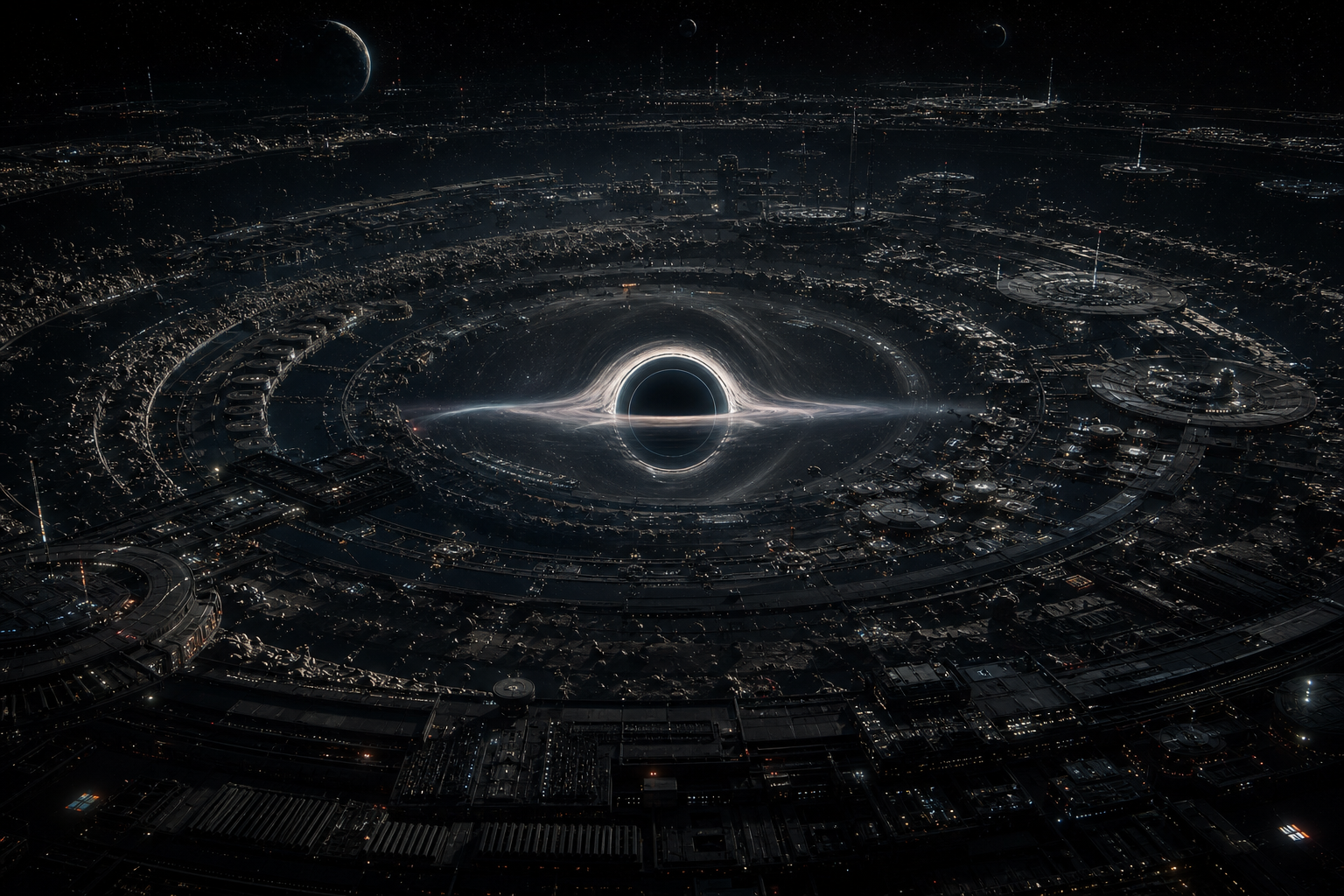
Unlike Yrnus and Lossian, Batantt is not organized around a normal star. It is a dark system centered on a stable rotating black hole named Zon-243. Around Zon-243 existed three cold planets, several massive belts, scattered minor bodies, and an immense quantity of orbital material. Batantt was selected because it offered two resources that no ordinary stellar system could provide in the same way: a black hole suitable for deep relativistic storage, and belts rich enough to justify enormous early extraction.
The bridge connecting Yrnus System to Batantt System was IG-Bridge Zekyiu-2. The first Zekyiu attempt failed and had to be rebuilt from zero. The rebuilt bridge became one of the most important early routes in the IG-Bridge Triad, and later one of the most heavily attacked routes during the Infernal Wars.
Historical evidence suggests that Zon-243 was part of the objective from the beginning. Batantt was not discovered only as a mining target. Its central black hole was recognized as a potential site for conservation-ring infrastructure: relativistic storage, archival preservation, temporal-gradient research, BRCT calibration, black-hole engineering, and deep orbital vault construction. To the early posthuman civilization, Zon-243 was not simply an astronomical hazard. It was a preservation engine made from spacetime.
At the same time, Batantt's belts were a major prize. Before large-scale depletion, the system contained massive belts rich in metals, heavy elements, rare industrial materials, carbon-bearing compounds, volatiles, and construction mass. These belts made Batantt useful before the conservation-ring infrastructure had fully matured. The system could supply material for its own stations, vaults, radiators, docks, energy systems, robotic bodies, mining platforms, and bridge-support architecture.
The likely structure of Batantt was not a solar system in the ordinary sense, but a black-hole system.
At the center was Zon-243: stable, rotating, and surrounded by increasingly dense infrastructure over time. Its spin made it valuable not only for storage but also for energy extraction. Through Penrose-process infrastructure and related posthuman techniques, Batantt could draw energy from the rotational dynamics of the black hole. This did not make the system easy or safe. It made Zon-243 usable.
The innermost operational zone contained deep conservation layers. These were not a single solid ring. They began as swarms: vaults, archival modules, relay stations, shielding platforms, maintenance bodies, custodial stations, BRCT instruments, docking points, and specialized orbital systems occupying different depths of the gravitational well. Over time, these swarms became ring-ecologies. Different layers served different preservation duties. Shallow layers were easier to access. Deeper layers preserved more aggressively, but imposed greater retrieval cost, stronger temporal isolation, greater communication difficulty, and more severe maintenance requirements.
Outside the deepest conservation layers were energy and control zones. These included Penrose-process collectors, stabilization stations, traffic-control systems, field monitors, radiation management structures, maintenance docks, and defense infrastructure. Batantt's energy systems were inseparable from its risk profile. The same black hole that made storage possible also demanded constant monitoring, strict orbital discipline, and enormous technical competence.
Beyond the immediate black-hole infrastructure were the massive belts. These belts were among the original reasons Batantt was selected. They were rich, accessible, and unusually valuable to a civilization trying to expand from Yrnus and Lossian into a larger bridge-linked network.
Over the following thousands of years, the most valuable portions of the belts were heavily depleted. This does not mean the belts vanished completely. It means that the high-value, easily accessible, strategically important material was extracted first: dense metallic bodies, rare elements, differentiated fragments, useful volatiles, and bodies suitable for conversion into station mass. Mining continued after depletion, but it became secondary, residual, specialized, or low-yield compared with the system's original extraction era.
Batantt had only three planets. These planets were cold, dark, and secondary to the black hole and belts.
Batantt I was likely a dense inner rogue-like planet or captured rocky world. It was valuable for metals and stable infrastructure, but not central to the system's identity.
Batantt II was probably the most useful of the three planets: a cold rocky or rocky-icy body with subsurface minerals, volatiles, and enough mass to support large-scale installations.
Batantt III was likely a distant icy world or large dwarf-planet-class body. Its value lay in volatiles, shielding mass, low-temperature storage, and outer-system observation.
The planets mattered, but they did not define Batantt. The black hole and belts defined it.
By the time of the Infernal Wars, Batantt had changed character. It was no longer primarily a fresh extraction system. Its belts had been stripped of much of their most valuable material. Important mining still existed, but the system's center of gravity had shifted toward storage, habitation, research, energy extraction, traffic, and conservation-ring infrastructure.
At that time, more than ten thousand space stations orbited around the black hole. These should not be imagined as human-scale stations like primitive orbital habitats. Many were converted mining platforms, robotic habitats, archive vaults, docks, processors, radiators, factories, Penrose-energy stations, administrative bodies, laboratories, storage nodes, defense structures, traffic-control platforms, and conservation-ring components. Some were large enough to resemble small moons in scale, mass, and visual presence.
Not all of these stations were inhabited in the same sense.
Some stations were operational but not inhabited. They were automatic or nearly automatic systems: mining remnants, processing nodes, radiators, energy collectors, orbital stabilizers, storage containers, sensors, defense shells, or maintenance platforms. They could contain drones and machinery without hosting conscious residents.
Other stations were inhabited by conscious robotic bodies. These were not robots in the simple human sense. They were conscious beings operating through physical bodies, industrial replacers, shells, or machine forms adapted to Batantt's environment. Some lived there because their work required direct Base Reality involvement. Others belonged to local cultures, corporations, custodial lineages, archival institutions, energy operations, or conservation-ring administrations.
Many stations were mixed. A single station could contain millions of non-conscious drones, a small number of conscious supervisors, layers of active computational population, and dormant vaults running at different temporal depths. Some were inhabited physically by robotic bodies. Others were inhabited computationally through hosted consciousness, RUN layers, archived entities, or slow preservation environments. From outside, a station might look like a cold machine. Inside, it could contain work, memory, law, research, pleasure, custody, and society.
This made Batantt one of the densest early examples of posthuman orbital civilization. It was not a planet-centered culture. It was a black-hole-centered infrastructure ecology.
Batantt became extremely important for the study of black holes, relativity, conservation rings, temporal gradients, relativistic storage, Penrose-process energy extraction, BRCT correction, orbital stability, retrieval cost, and the social organization of deep infrastructure. It was one of the places where the early civilization learned that black holes were not only dangers or weapons. They were clocks, vaults, gradients, machines, risks, resources, and preservation sites.
This importance explains why the Yrnus-Batantt route was so heavily attacked during the Infernal Wars. To damage access to Batantt was to threaten storage, archives, energy, research, industrial remnants, habitation, and one of the earliest great conservation-ring environments. Batantt was not merely a remote system. It was an early attempt to make time itself serve civilization through gravity.
In historical terms, Batantt represents the third major face of the early bridge network. Yrnus was the origin and Planetary Triad foundation. Lossian was the rich binary industrial expansion. Batantt was the dark relativistic system: depleted belts, black-hole storage, Penrose energy, orbital habitation, research, and more than ten thousand stations surrounding a preservation engine made from spacetime.