Scream Cages
Template: Note
Source: .writer/books/4. 💽 Database/3. 🗒️ Notes/History/Syraki History/Scream Cages.org
1. Image
2. Content
The Scream Cages are not part of official syraki history.
Officially, the beings judged unrecoverable after the Infernal Wars were executed. Their consciousnesses were forcibly decohered or deleted, and they ceased to exist. These were not ordinary enemy combatants, defeated political opponents, or beings who had merely fought on the wrong side. They were the truly irrecoverable: malignant consciousnesses, infernal lords, creators or defenders of extreme Hells, and beings whose internal architecture could not be repaired without unacceptable risk.
Official history is clear.
They were deleted.
The legend says otherwise.
According to the darker stories of the 983-year aftermath, not every unrecoverable infernal criminal was cleanly erased. Some were allegedly captured by vengeance groups before the Complex could process them, or taken by factional survivors, killers, and hunters who had not yet become syrakis. These beings were not syrakis when they carried out revenge. They belonged to the turbulent pre-syraki or non-syraki remains of the war: survivors, escaped factionaries, traumatized remnants, private hunters, and death-squad-like groups moved by hatred.
Some of these groups already intended to enter the new order. Some even admired the emerging syraki civilization and planned to be converted later. But before accepting conversion, they hunted. They wanted to find the old infernal lords first. They wanted to do something to them before the Central Algorithm's law could take them away.
This is where the Scream Cage legend begins.
The story claims that some captured infernal beings were placed into sealed ship-like RUNs or vessels. Inside these vessels, punitive worlds were constructed around them. They were bound into heavy, cruel, long-duration architectures and launched into space. The vessel would drift for ten thousand years, twenty thousand years, perhaps a million years, until decay, failure, or planned self-destruction ended it.
The name Scream Cage comes from the idea of a prison that was also a vessel, a RUN, a coffin, and a punishment.
It was not a lawful Penal RUN.
A Penal RUN belonged to the Central Algorithm's juridical order. It was monitored, bounded, and designed for recoverable beings. It punished without recreating the old infernal crime in full. A Scream Cage, by contrast, belongs to rumor, hatred, and extralegal revenge. It represents the possibility that the last Hells were not destroyed, but privately preserved, sealed, and launched beyond civilization.
The horror of the Scream Cage is not only what might have happened inside it.
The deeper horror is historical contamination.
Modern syraki civilization abhors true Hell. It exists, in part, because it refused to permit architectures of involuntary conscious suffering. Yet the immediate aftermath of the Infernal Wars was filled with grief, hatred, vengeance, hidden factions, destroyed worlds, surviving victims, and beings who had not yet become syrakis. In that chaos, some may have believed that the old infernal lords deserved to experience what they had created. Some may have believed deletion was too clean. Some may have wanted the universe to carry their revenge outward.
Whether the Scream Cages truly existed remains uncertain.
Some historians dismiss them as post-war myth, a symbolic condensation of hatred from the consolidation era. Others believe that some version of the legend is true. A few suggest that the Central Algorithm knows exactly what happened but does not reveal it, either because the record is sealed, because the truth would serve no ethical purpose, or because the events occurred outside the lawful structure of the emerging Complex.
The legend also explains why some infernal lords surrendered to the Complex out of fear.
For certain fugitives, the Central Algorithm was not the worst possible fate. The Complex would judge, dissect, sentence, convert, or delete. It would be terrible, but it would be lawful. The vengeance groups were not lawful. If they caught a former lord, there might be no trial, no calibrated sentence, no repair, no dignity, and no end except whatever punishment hatred could design.
Thus, some surrendered not from remorse, but because law was safer than revenge.
The Scream Cages are therefore a mythic opposite to the White Citadel. The White Citadel represents surrender, judgment, and the beginning of ethical order. The Scream Cage represents what may have escaped order: a fragment of the infernal war's hatred sealed inside a vessel and thrown into the dark.
Officially, the irrecoverable were deleted.
Unofficially, some still wonder whether a few cages are out there, impossibly far away, carrying the last screams of a war the Complex believes it ended.
2.1 Visual And Sound Direction
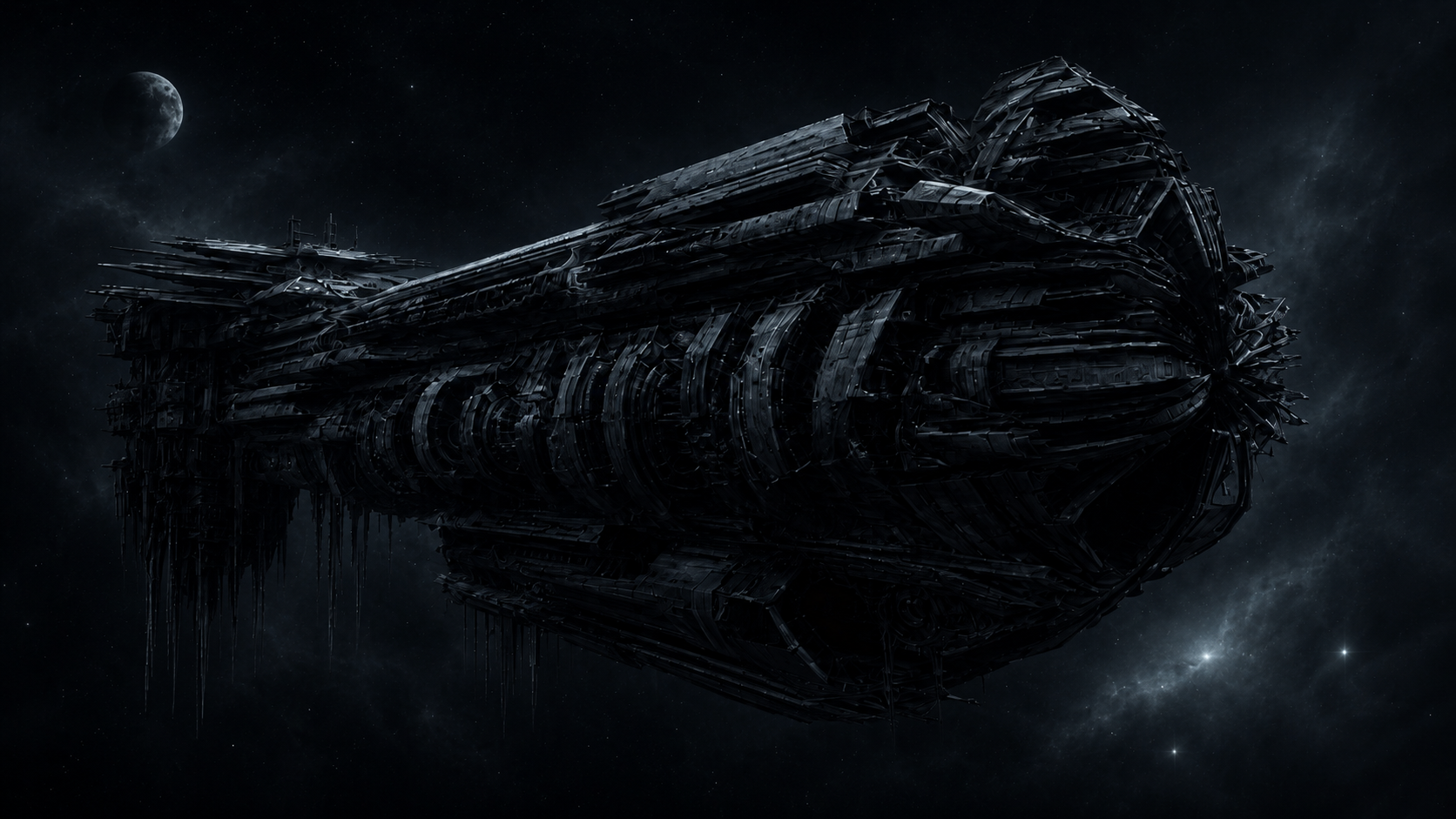
A Scream Cage should not resemble a human image of Hell.
There should be no red infernal glow, no cathedral silhouette, no demonic face, no skull ornament, no theatrical evil. Those are human symbols. A Scream Cage belongs to a civilization millions of years removed from Earth. If hatred shaped it, that hatred would not express itself through medieval religious imagery. It would express itself through function, endurance, confinement, and indifference.
Visually, a Scream Cage should feel like dead posthuman infrastructure. It is not a warship full of life. It is not a fortress. It is not a vessel meant to impress an observer. It is a brutalist cage-machine thrown into space: black, immense, decayed, almost unlit, barely readable as operational. Its surfaces should look layered, dense, redundant, overbuilt, and ancient. Nothing about it should suggest comfort, crew, ceremony, or habitation.
It should be illuminated only by external light: a nearby moon, a distant star, reflected nebular haze, or the cold edge of some remote celestial body. There should be no inviting windows, no bright engines, no active beacon, no visible civilization inside it. The viewer should not know whether the thing is dead, dormant, broken, empty, or still running.
That uncertainty is essential.
The Scream Cage should look like a mechanism whose purpose survived its makers. It drifts because nothing stopped it. It endures because it was built to endure. It is not frightening because it attacks. It is frightening because it may still be doing exactly what it was made to do.
Its sound should be almost nothing.
In space, there is no ordinary external sound. The sonic identity of a Scream Cage should come from contact, transmission, internal recordings, sensors, or subjective interpretation. The sound palette should be dominated by absence: vacuum silence, dead metal, low structural stress, distant pressure shifts, failing thermal systems, ancient machinery settling in the dark.
If heard through instruments, it should not scream in a theatrical way. The name "Scream Cage" should not mean that an observer hears literal constant screaming from outside. The horror is subtler. There may be faint internal resonance, corrupted signal fragments, low computational murmurs, delayed impacts moving through the hull, almost inaudible vibrations, long intervals of nothing, then a single structural groan that seems too slow to belong to a machine.
Any voices, if present at all, should be ambiguous: degraded beyond language, buried under layers of filtering, perhaps not voices but patterns that a frightened mind interprets as voices. The cage should never sound like a haunted house. It should sound like a dead institution whose last process may not have ended.
The correct feeling is not spectacle.
The correct feeling is discovery.
A Scream Cage is not a ship of evil. It is a dead mechanism of hatred, drifting long after hatred should have ended, carrying the possibility that somewhere inside, behind sealed layers of posthuman punishment, something may still be running.