Archipelago
Template: Note
Source: .writer/books/4. 💽 Database/3. 🗒️ Notes/History/Syraki History/Archipelago.org
1. Image
2. Content
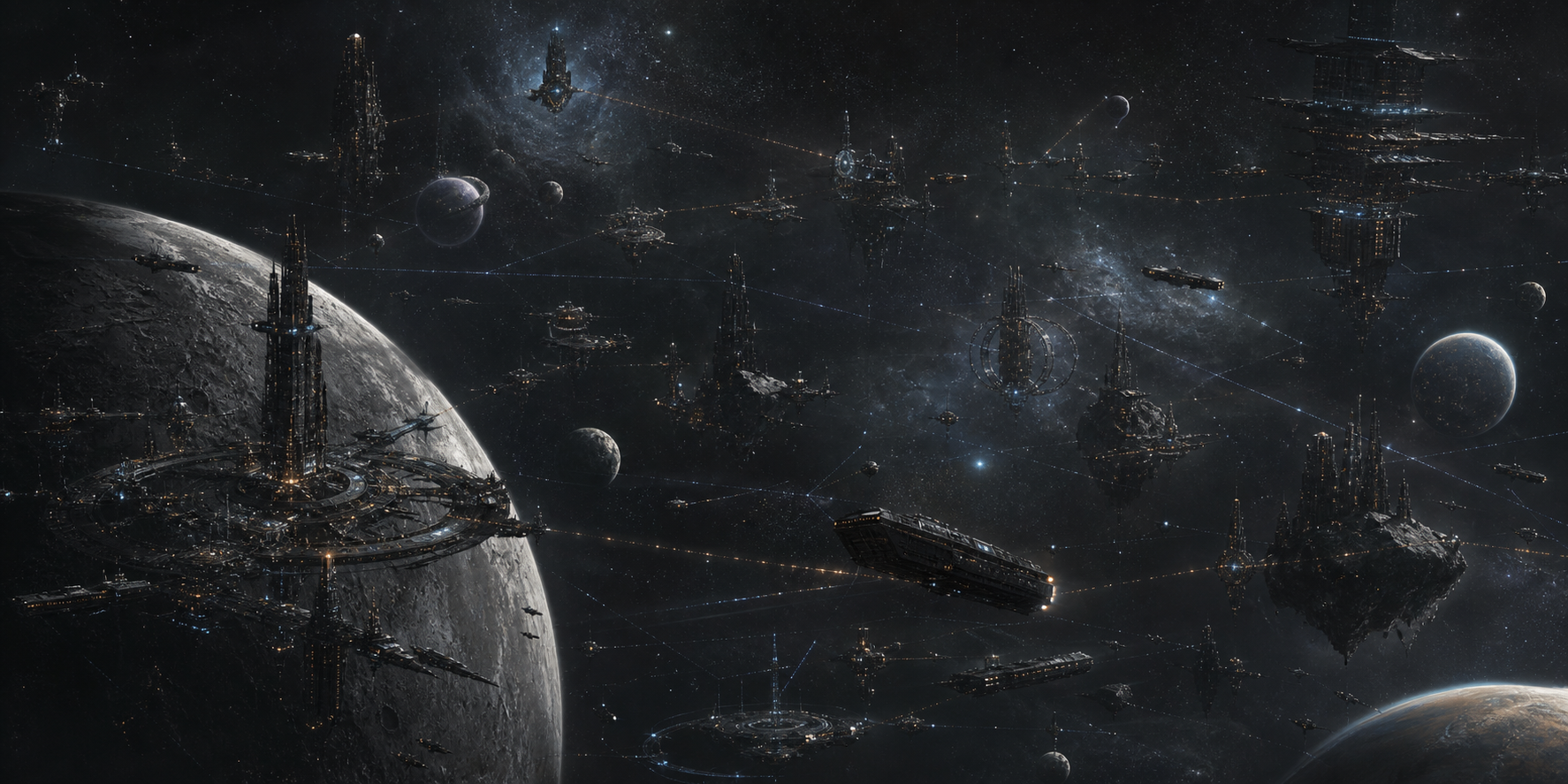
The Archipelago was the civilizational structure that existed before the Complex.
Historically, the Archipelago lasted for approximately 6.9 million years. It does not begin at the supposed arrival of the Brains' Cage in the system later associated with Triad (planets), and it does not begin at the first automated development of Planet Alpha, Planet Beta, or Planet Charlie. Those belong to the Interregnum, the grey zone between Pre-Triad History and legible Archipelago history. Its exact duration is unknown, but most historical estimates place it between 50,000 and 900,000 years.
The Interregnum ends, and the Archipelago begins, with the establishment of the first IKARYS Complex Space Station in orbit of Planet Alpha. By that point, Planet Alpha was already heavily populated with infrastructure: automated industry, preservation systems, computational layers, resource-processing networks, orbital support, and early posthuman or proto-posthuman operational structures. But it was still far from an ecumenopolis. It was not yet a world-city, not a mature planetary civilization, and not a Complex node in the later sense. Planet Beta and Planet Charlie also possessed infrastructure, but substantially less than Planet Alpha.
It can be understood as a proto-Complex: a vast posthuman arrangement made of stations, planets, moons, ships, computational habitats, physical infrastructure, private domains, and distributed syraki or proto-syraki societies. In broad outline, it resembled what would later become the Complex, but it lacked the unified continuity, legal architecture, and deep infrastructural integration that define the Complex proper.
The essential difference was connection.
The Complex is structured around integrated civilizational continuity. Its nodes are bound by stable infrastructure, centralized ethical coordination, the Central Algorithm, and major relay or IG-Bridge systems that allow distant regions to function as parts of one broader substrate.
The Archipelago was not like that.
Its worlds, stations, moons, ships, and computational territories were far more disconnected. Many regions existed as semi-independent islands of civilization, linked through fragile, partial, delayed, or negotiated contact rather than through a unified civilizational body. Its connectivity was more local, more fragmented, and more peer-to-peer in spirit. A station might maintain relations with nearby domains, corporate structures, private systems, or allied computational habitats, but there was no fully unified Complex-wide order holding everything together.
For this reason, the name Archipelago is appropriate. It was not a single continent of civilization. It was a scattered field of islands.
The Archipelago contained the material and social precursors of the Complex: physical infrastructure in Base Reality, postbiological populations, early virtual civilizations, corporate and private domains, ships, stations, moons, planets, computational worlds, and emerging systems of coordination. However, these parts had not yet been consolidated into a single civilizational substrate.
The Infernal Wars changed that historical trajectory.
After the Infernal Wars, the old fragmented order became ethically and politically intolerable. The disconnected condition of the Archipelago had allowed too much autonomy without sufficient protection, too much reality-making without universal safeguards, and too many local systems capable of becoming hells. The answer was not merely punishment or reconstruction. It was unification.
The Complex emerged when the Archipelago was consolidated into a deeper, stricter, and more coherent civilizational order.
This unification did not erase all local difference. The Complex still contains private domains, corporate systems, peripheral regions, local infrastructures, ships, stations, planets, moons, and many forms of internal autonomy. But unlike the Archipelago, those parts now exist inside a shared ethical and infrastructural architecture. The Central Algorithm, the foundational contract, and the integrated communication and bridge systems make the Complex a civilization rather than a loose field of disconnected posthuman islands.
Jabari's early life belongs to this older world.
When Jabari is described as a proto-syraki, this does not mean that ve was human or lived on Earth. It means that ve belonged to the transitional civilization before the mature Complex. Ve lived inside the Archipelago, in a period when syraki existence had not yet been fully unified under the structures that would later define the Complex.