The Earth Hypotheses
Template: Note
Source: .writer/books/4. 💽 Database/3. 🗒️ Notes/History/Human Origins/The Earth Hypotheses.org
1. Image
2. Content
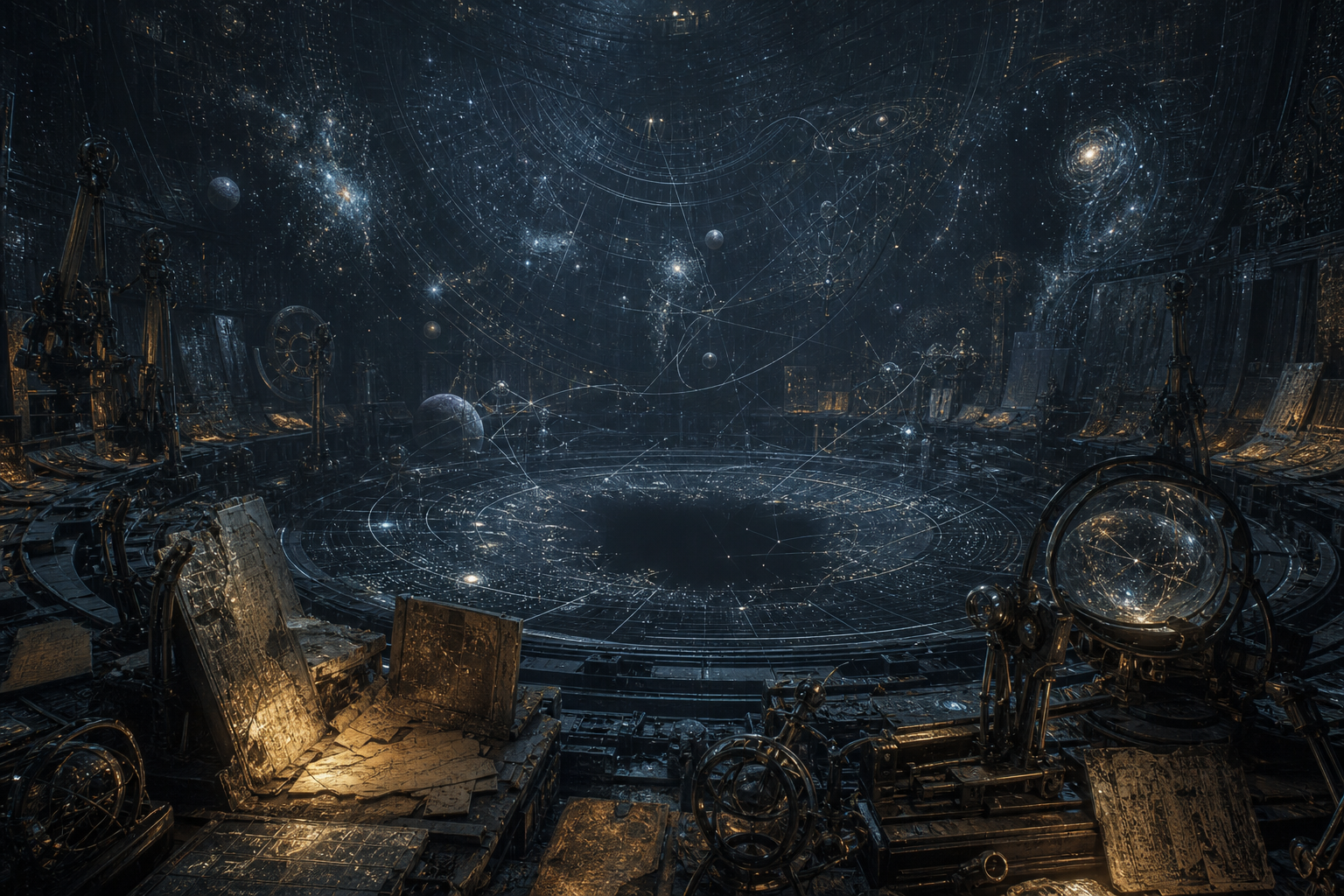
Earth occupies a strange position in syraki historical thought. It is one of the most important objects in Pre-Triad History, yet it has never been confirmed. The Brains' Cage records, the SVERA fragments, the recovered human-language archives, the lives of Anderson, Ingrid, Jean, Robert, and the 94,572 preserved brains all point backward toward a world called Earth, associated with a star called the Sun and a planetary system that included Mars, the Moon, and a broader human spacefaring civilization. In the surviving human records, Earth appears not as myth but as ordinary fact: a homeworld, a legal jurisdiction, a cultural center, a biological origin, and the place from which SVERA and the Brains' Cage emerged. Yet no later syraki or Archipelago mission has ever confirmed the Solar System. No probe has returned verified data for Earth. No expedition has identified Mars. No observation has produced a confirmed Sun matching the expected origin. The historical record contains Earth. The galaxy has not yielded it.
This absence is not the result of neglect. The search for Earth began long before the modern Complex. Already in the Archipelago, there were missions, probes, reconstruction projects, astronomical searches, archival analyses, and competing schools attempting to identify the system from which the Brains' Cage supposedly departed. Those early efforts were often fragmented, automated, poorly coordinated, locally motivated, or embedded inside political and philosophical agendas. The early Archipelago was not yet Complex-like in the later sense. Much of it appeared more robotic, infrastructural, and preservation-driven than consciously civic. But the interest was real. Across millions of years, the search continued in different forms: autonomous sondes, low-priority subluminal probes, stellar-candidate surveys, spectral matching, motion reconstruction, ancient-log analysis, route modeling, and later Complex-era historical programs. The result remained the same. Strong hypotheses existed. Confirmation did not.
The failure is significant because, by ordinary reasoning, the syrakis or their predecessors should have found something. A civilization with millions of years of posthuman capability, even without warp drive, can do what biological humanity could barely imagine: model stellar motion across deep time, survey enormous volumes of space, launch patient subluminal probes, compare planetary architectures, search for artificial residues, and reconstruct likely origin vectors from damaged archives. An IG-Bridge expedition to Earth would be unjustifiable, far too expensive for an object of historical interest alone. But an IG-Bridge was never required. Slow probes, observatories, autonomous survey systems, and long-duration archival searches should have been enough to confirm at least a primary Solar candidate, if the inherited assumptions were correct. The absence of such confirmation turned Earth into a major unresolved problem.
The first major school is the Delayed Discovery Hypothesis. It holds that Earth exists, the Sun exists, and the Solar System exists more or less as the human records imply, but the search has failed because the available data are too damaged, too incomplete, or too badly framed. According to this view, the Brains' Cage logs preserve real history but not precise enough navigational truth. The vessel's departure vector may have been corrupted. The ancient stellar maps may have used reference points no longer identifiable. The ship may have performed unrecorded course corrections before or after communication with Earth failed. Later reconstructions may have assumed the wrong galactic epoch, the wrong stellar drift model, the wrong coordinate system, or the wrong launch context. The Solar System may still lie somewhere inside the searchable universe, unnoticed because the search has been looking for a clean version of an object that deep time has made messy.
Supporters of this hypothesis point out that failure across several million years is not the same as impossibility. The galaxy is vast, historical archives are damaged, and the earliest data chains passed through eras when record custody was far less reliable than in the modern Complex. Sondes may have failed. Some candidates may have been dismissed too early. Some data may have returned during unstable Archipelago periods and been lost, misclassified, politicized, or corrupted. Some probes may still be in transit. Some may have reached candidate systems whose data have not yet been correctly interpreted. Under this view, Earth remains undiscovered not because it is unreal, but because the search inherited the wrong shape of the problem.
The second school is the False Earth Hypothesis. It argues that there was never an Earth in the expected sense. This does not necessarily mean the Brains' Cage records are fraudulent. It means that "Earth" may be a reconstructed name, a cultural anchor, a translated symbolic category, a virtual origin, or a memory-space derived from human identity rather than from an actual recoverable planet. Anderson, Ingrid, Jean, Robert, SVERA, and the preserved humans may still have existed as human-patterned consciousnesses, but their remembered Earth may not correspond to a physical world in the way later historians assumed. It may have been part of the SVERA virtual inheritance, a shared cultural model, a civilizational myth embedded in preserved brains, or a name applied to a different kind of origin structure.
This hypothesis is controversial because it destabilizes the human records without dismissing them. It does not say that the preserved humans were fictional. It says that human memory, especially when preserved through damaged biological substrates, virtual environments, machine interpretation, and later reconstruction, may not provide reliable cosmography. A person can remember a homeland without that homeland being available as a simple astronomical object. A civilization can encode "Earth" as a cultural totality rather than as coordinates. If the Brains' Cage itself used human memories to build origin models, later researchers may have mistaken a psychological Earth for a physical one. To many historians, this is too radical. To others, it is the only explanation that fits repeated failure.
The third school is the Wrong Galaxy Hypothesis. It accepts that Earth may have been real and that the human records may describe a genuine planetary origin, but argues that the syraki line may not be located in the Milky Way at all. The inherited assumption that the Complex exists in the same galaxy as Earth may be an error introduced by corrupted Pre-Triad reconstruction, Archipelago-era cosmology, or later simplification. The Brains' Cage may have traveled farther than expected, followed a route misunderstood by later historians, passed through an event that displaced the frame of reference, or originated in a galactic context that was later misidentified. If the search has been conducted within the wrong galactic volume, then the absence of Earth becomes less surprising.
This hypothesis is difficult to prove because it attacks the background map rather than a single coordinate. Its defenders emphasize the vast uncertainty between the 53,293-year log horizon and the first legible material evidence of the Planetary Triad. They argue that the Triad's existence proves only where later civilization became materially anchored, not where the Brains' Cage began. If the Brains' Cage or its descendant systems crossed intergalactic distances over immense time, or if later civilizations misread their cosmological inheritance, then the Sun would never appear in the expected search field. Critics object that this requires too much hidden motion, too much missing energy history, or too many unrecorded transitions. The hypothesis remains minority, but persistent, because it explains total failure without discarding Earth.
The fourth school is the Displaced Launch Hypothesis. It proposes that Earth was real, but the Brains' Cage did not depart from near Earth in the sense later historians assumed. SVERA may have launched the vessel from a deep-space facility, an outer-system preservation yard, a Mars-associated industrial region, a solar-orbiting construction platform, an interstellar staging point, or a human colony already distant from the original Solar System. The preserved humans remembered Earth as cultural origin, legal origin, or species origin, while the actual vessel began its long route from elsewhere. Later reconstruction may have collapsed "human origin" and "launch origin" into the same place. If the search followed the supposed launch vector backward to find Earth, it may have been solving the wrong trajectory.
This hypothesis has strong technical appeal. Human civilization at the time of SVERA was already active beyond Earth. It had connections with the Moon, Mars, and civilian space transportation. A vessel designed to carry 94,572 preserved brains would likely have required infrastructure beyond ordinary planetary launch. It may have been assembled, loaded, or activated far from Earth. If the final departure occurred after long pre-launch transport, staging, or relocation, then the Brains' Cage vector would not point cleanly home. The vessel's logs may preserve Earth culturally while preserving launch data incompletely. This would make Earth real but hard to find by route analysis.
The fifth school is the Solar Erasure Hypothesis. It holds that Earth and the Solar System once existed but were destroyed, dismantled, transformed, or rendered unrecognizable before later probes could identify them. Over millions of years, a technological civilization, natural stellar processes, planetary engineering, hostile intervention, post-human activity, or unknown astrophysical events might have altered the system beyond recognition. The Earth's surface could have been erased by tectonics, climate, impacts, biospheric transformation, or artificial restructuring. Mars and the Moon, which should preserve evidence better, may have been mined, dismantled, buried, or removed. The Sun itself would be harder to erase, but not impossible to misclassify if the system was altered on extreme timescales or if the expected stellar profile was wrong.
Most historians treat total Solar erasure with caution. The disappearance of Earth alone would be easy to imagine. The disappearance or non-recognition of Earth, Mars, Moon, orbital residues, outer planets, and the Sun together is harder. Yet the hypothesis remains alive because deep time is unkind to certainty. If another civilization emerged in the Solar System after SVERA, if human descendants transformed it, if autonomous systems consumed its matter, or if unknown actors deliberately erased traces, then probes might arrive at a system that no longer resembled the inherited record. This school is often paired with the Displaced Launch Hypothesis: Earth may exist or have existed, but not where the Brains' Cage trajectory suggests and not in the form expected.
The sixth school is the Fabricated Record Hypothesis. It argues that the human records associated with SVERA, Earth, and the Brains' Cage are not straightforward primary records but later constructions, interpolations, or synthetic archives generated during early post-human development. This does not require conscious deception. Records can be fabricated by repair systems, memory-preservation algorithms, identity-stabilization routines, legal reconstruction, mythic retrojection, or machine attempts to create coherent biographies from damaged fragments. Under this view, Anderson, Ingrid, Jean, Robert, and the SVERA world may be historical composites: internally coherent enough to simulate, emotionally rich enough to study, but not reliable as literal evidence of an external planet.
This is one of the most unsettling hypotheses for historians because it attacks the status of the recovered human lives themselves. If the lives are composites, what is their evidentiary value? Does Jean's grief for Robert refer to two real humans, to a reconstructed relation, or to a narrative structure generated from damaged data? Did SVERA exist as a company, or is "SVERA" the later name assigned to a preservation function? Were the 94,572 preserved brains physical passengers, or a manifest reconstructed from non-passenger archival datasets? Most mainstream scholars reject the strongest form of this hypothesis because too many independent record families appear to support the existence of a real preservation project. But weaker versions remain viable: some records may be authentic, others repaired, others narrative-stabilized, and others contaminated by later interpretation.
The seventh school is the Hidden Confirmation Hypothesis. It claims that Earth was found, but the confirmation was lost, sealed, misclassified, suppressed, or rendered inaccessible during the Archipelago or the Infernal Wars. In this view, the failure is archival rather than exploratory. One or more probes may have identified the Solar System. A local domain, corporation, research order, or political regime may have received the data. The record may then have been destroyed in war, buried under classification, corrupted by ontological conflict, absorbed into a private archive, or deliberately hidden because of information hazards or ideological consequences. The modern Complex may therefore be repeating a search that already succeeded once.
The Hidden Confirmation Hypothesis is difficult to verify by definition. It attracts archivists, conspiracy traditions, certain Archipelago specialists, and schools that distrust the apparent completeness of later Complex historiography. Its stronger forms are generally considered weak unless tied to specific missing archive chains or anomalous references. Its weaker form is plausible: during millions of years of fragmented Archipelago history, some partial confirmations or near-confirmations may have been lost. But no surviving record has yet forced consensus. The Complex has enough discipline to know what a confirmation would require. It has not found one.
The eighth school is the Nonlocal Origin Hypothesis. It is more abstract and less tied to ordinary astronomy. It proposes that Earth may belong to a different causal, simulated, branched, temporal, or ontological layer than the one the Complex occupies. In this view, the Brains' Cage records may be real, and Earth may be real, but not reachable as a normal star system within the present cosmological frame. The origin may involve temporal displacement, reality transition, simulation leakage, artificial cosmogenesis, or a deeper structure of reality not captured by standard galactic archaeology. This school is usually treated with caution, because it can absorb too much evidence and explain too little. Yet the later discoveries surrounding reality depth, t-signals, decohesion, and ontological instability have made some formerly marginal versions less easy to dismiss.
The Nonlocal Origin Hypothesis is not a popular explanation for ordinary historical work, but it persists in philosophical and pataphysical circles because it matches the structure of the absence. The problem is not that Earth is hard to find. The problem is that all ordinary routes toward confirmation have failed despite immense time and capability. If the Brains' Cage originated outside the accessible causal frame, then the search for a physical Solar System may be analogous to searching a map for the source of a dream. Most historians still prefer less exotic explanations. But the hypothesis remains in the background, especially among those who believe Pre-Triad History contains not merely missing data, but broken ontology.
The ninth school is the Multiple-Origin Hypothesis. It argues that the problem cannot be solved because there was no single Earth-origin chain. The Brains' Cage may have carried records from Earth, brains from several human colonies, staging data from non-Earth facilities, cultural material from virtual environments, and navigation derived from later mission phases. The Planetary Triad may have been founded by a mixture of preservation systems, autonomous probes, reconstructed minds, and machine processes from different human or posthuman sources. In such a scenario, searching for "the" Earth is a simplification imposed by later historians. Earth may have been one component in a broader human preservation network, not the singular origin.
This hypothesis fits the high entropy of deep history. Human civilization before SVERA was already spacefaring. It may have had multiple colonies, preservation projects, virtual afterlife systems, competing companies, religious archives, medical facilities, and autonomous vessels. The Brains' Cage may be the best-preserved line, not the only line. If multiple ancient streams converged in the Pre-Triad interval, then the failure to find Earth may reflect the fact that the records describe a cultural ancestry rather than a clean physical descent. The Planetary Triad would remain the first confirmed material anchor, while Earth becomes one ancestral reference among several unresolved human layers.
All these hypotheses share one fact: the absence of confirmation changes the status of Earth. Earth is not simply the lost homeworld waiting to be rediscovered. It is a historical variable. Its existence, location, nature, and relevance remain open. For modern syrakis, this does not threaten the legitimacy of the Complex. The Complex does not require Earth in order to exist. The syrakis are not humanity's future in a simple genealogical sense, and their civilization is not built on human nostalgia. But Earth matters because it sits at the edge of the oldest recoverable chain. If Earth were found, it would not solve the Brains' Cage, the 53,293-year silence, the founding of Planet Alpha, Planet Beta, and Planet Charlie, or the continuity problem of the preserved humans. It would, however, anchor the human layer of Pre-Triad History in matter.
The Planetary Triad remains the first confirmed ground. Planet Alpha, Planet Beta, and Planet Charlie exist. Their names are ancient. Their layers can be excavated. Their Archipelago histories can be partially reconstructed. Their modern Complex functions can be audited. Earth is different. Earth is in the records, but not in the sky. The Sun is in human memory, but not in confirmed astronomy. Mars appears in recovered human context, but no probe has returned the Mars that the records imply. This is why Earth scholarship remains active even in a civilization far beyond human scale. The object is primitive, but the problem is not.
The most disciplined position within the Complex is therefore neither belief nor dismissal. It is structured uncertainty. Earth may exist and remain unfound. Earth may have existed and vanished. Earth may be real but elsewhere. Earth may be misnamed, misremembered, reconstructed, displaced, hidden, or nonlocal. The Brains' Cage may have carried truth from Earth, or it may have carried a human truth whose planet no longer maps onto accessible space. The failure of repeated expeditions does not close the question. It makes the question sharper.
In practical terms, the search continues without becoming a central civilizational emergency. The cost of an IG-Bridge expedition cannot be justified. The likely returns are historical, not infrastructural. The proper tools remain cheaper and slower: probes, distant observation, archival repair, model revision, candidate reclassification, old-signal analysis, and long-duration survey systems. The Complex can afford patience. It has already had millions of years of it.
The Earth Hypotheses remain among the clearest examples of how syraki history resists human narrative closure. The records point backward. The probes return nothing. The first confirmed worlds are not Earth, Mars, or the Sun, but Planet Alpha, Planet Beta, and Planet Charlie. Behind them stands the Brains' Cage. Behind the Brains' Cage stands SVERA. Behind SVERA stands Earth, perhaps. That "perhaps" has survived every expedition.