Vladimir Dit Kuznetsov
Template: Character
Source: .writer/books/4. 💽 Database/1. 🧑🦰 Characters/Theravada Corporation/Omniship RT-874/Crew/Vladimir Dit Kuznetsov.org
1. Short Description
Vladimir Dit Kuznetsov is one of the pilots of the RT-874, serving alongside Felix. The crew structure of the RT-874 was designed around a careful balance between computational cost and operational redundancy. The most critical functions received redundancy, while less critical functions were assigned to single operators. Piloting was critical enough to justify redundancy, and Vladimir was selected as Felix's counterpart.
Vladimir is not simply a backup pilot. His presence reflects compatibility, competence, curiosity, and a history of solving important problems for the Complex. Some of these problems are so abstract and posthuman that they cannot be translated into human conceptual language. His solutions gave him a degree of fame and contributed to his selection for the RT-874 mission.
He is sapiencional: a syraki type or disposition oriented toward highly abstract forms of intelligence, experience, and existence. He has little interest in human experiences and almost no presence in Base Reality. Most of his existence is spent in private or specialized worlds that would be incomprehensible to humans.
2. Picture
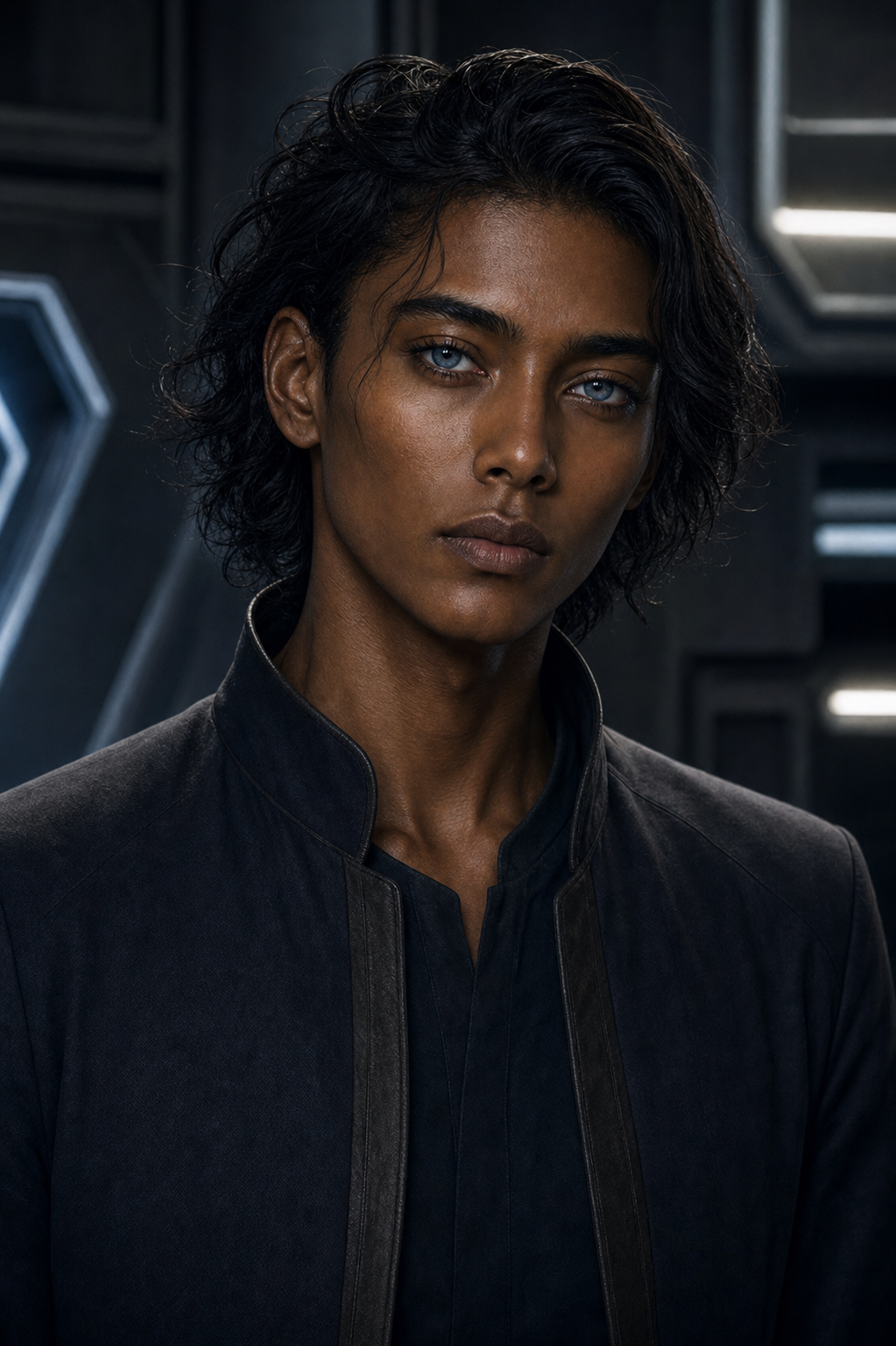
3. Main Archetypal Reference
Vladimir's main human-facing archetypal reference is Siddhartha Gautama. The reference is useful because Siddhartha suggests serenity, contemplative depth, inward distance from ordinary desire, and the sense of someone whose attention has moved beyond common categories of pain, pleasure, identity, and worldly urgency. Vladimir should not copy Buddhist doctrine, human religious biography, renunciation as a moral program, or prophetic authority. The archetype is a tonal anchor for calm transcendence, radical inwardness, and the possibility that reality contains experiential axes beyond what the crew can map.
3.1 Archetype
Siddhartha Gautama.
3.2 Resonance
Vladimir resonates with the figure of the serene abstract pilot: a quiet technical mind whose intelligence is not socially bright or performative, but inward, unhurried, and difficult to reduce to human personality categories. He should feel related to Oshiro in his nerd-like abstraction, but softer, calmer, and more distant from ordinary human experience.
3.3 Deviation
Vladimir is not merely shy, slow, autistic-coded, or socially awkward in a human sense. His quietness comes from an orientation toward modes of thought and experience far beyond human categories. What may appear spacey or slow is actually low-reactive serenity, abstraction, and a mind whose natural habitat is not human-readable Base Reality.
3.4 Narrative Atmosphere
Vladimir brings stillness and unmappability into the story. Felix makes piloting feel social, embodied, and warm; Vladimir makes piloting feel abstract, mathematical, and almost contemplative. His final arc turns him into the crew member who reaches the limit of mapping: the pilot lost in the place where piloting no longer works.
4. Participation
Vladimir serves as one of the RT-874's pilots alongside Felix. The ship's crew was designed with selective redundancy: critical functions received backup or counterpart operators, while less critical functions were assigned to single specialists. Piloting was important enough to justify two pilots, and Vladimir was chosen as Felix's counterpart because of competence, compatibility, and the value of his prior problem-solving record.
During training, Vladimir and Felix spoke often and formed a special friendship. Their pilot functions complemented each other, and they grew to like one another more deeply than the ordinary crew baseline. Felix is warmer, more gregarious, and more socially expressive. Vladimir is quieter, calmer, and more inward. Together they create a strong contrast: Felix as the living, social pilot; Vladimir as the serene, abstract pilot.
After the RT-874 catastrophe, Vladimir becomes one of the last crew members to be approached. He can be traced, but not in the same way as the others. His location appears on the plotter as a black, empty, unmappable region within the multidimensional mission space. The region resembles a void, a blankness, or a mathematical vacuum. The ship classifies it as terra incognita.
As the RT-874 approaches the boundary of this region, the omniship stops. It cannot advance. Felix tries to push forward, but the ship simply halts. Kallom-4000 attempts to use the MFI Boosters to improve mapping and penetration capability, but they obtain almost nothing. The region remains black. The alarms repeat warnings that terra incognita lies ahead and that the ship must leave.
The crew discusses possible explanations and concludes that the region represents a mathematically impossible mapping space, a pocket or zone that the omniship cannot calculate into navigable coordinates. This is not merely unknown territory. It is territory that refuses to become territory for the RT-874's systems.
Despite this, the crew manages to establish communication with Vladimir. He seems to understand what is happening. He is peaceful, calm, and grateful that they tried to rescue him. He tells them to leave, saying that there is nothing they can do. When they ask what he sees or where he is, his answers become strange and difficult to interpret. He says things that do not fit the crew's frame of reference. It is as if his experience no longer translates into the categories available to the RT-874.
Vladimir's final communication is not merely a distress call. It becomes one of the novel's philosophical ruptures. He speaks with a strange mixture of peace, wonder, resignation, and transcendence, as if he has seen something that amazed him in a positive or revelatory sense. What he experiences is not simply horror, suffering, or danger. It is something beyond the usual syraki axis of pain and pleasure.
His last line is: "There are more things than pain and pleasure."
Vladimir's disappearance becomes final when his t-signal suddenly vanishes. The crew tries everything to recover it, but nothing works. Felix continues trying to reach him even after the signal is gone, but Vladimir no longer responds. In practical terms, he is considered dead or unrecoverable. But for syrakis, this is not an ontologically settled matter. Whether Vladimir is dead, transformed, inaccessible, or still existing in an unmappable state remains part of the larger mystery of the mission space.
5. Backstory
Vladimir has a history of solving important problems for the Complex. Some of these problems are so abstract and posthuman that they cannot be translated into human conceptual language. His solutions gave him a degree of fame and helped make him a plausible candidate for the RT-874 mission.
He is sapiencional, a syraki type or disposition oriented toward highly abstract forms of intelligence, experience, and existence. He is less retroanthropic than many members of the crew, less interested in human-like pleasures, and more attuned to states of thought and experience far removed from human categories. He has little interest in human experiences and almost no presence in Base Reality. Most of his existence is spent in private or specialized worlds that would be incomprehensible to humans.
Like the rest of the crew, Vladimir volunteered for the RT-874 mission. He was not simply assigned as a replaceable backup pilot. His participation reflects competence, compatibility, curiosity, and the seriousness of what the mission represented for Theravada and the Complex.
6. Motivation
Vladimir is motivated by abstract understanding, competence, serenity, and the search for forms of thought and experience that exceed ordinary categories. He is not driven by retroanthropic curiosity in the way Felix is, nor by broad social warmth, nor by human-like pleasure. His motivation is quieter and stranger: to engage with systems, worlds, and states that unfold beyond ordinary intelligibility.
6.1 Values
Vladimir values calm competence, abstraction, compatibility, careful piloting, deep intelligence, and forms of existence not reducible to human experience. He also values friendship, especially with Felix, but his affection is serene rather than expressive.
6.2 Ambition
Vladimir's ambition is not a Base Reality project or public achievement. His natural trajectory points toward private and specialized worlds of thought, sapiential abstraction, and posthuman experience. He seeks the kinds of problems and states that cannot be made simple without destroying what makes them meaningful.
6.3 Story Goal
Within the story, Vladimir's goal is transformed by his condition. At first he is one of the missing crew members to be recovered. Once communication is established, his goal becomes strangely peaceful: he tries to make the crew understand that they must leave him, because the place or state in which he exists cannot be entered, mapped, or repaired by the RT-874.
7. Basic Information
7.1 Way Of Acting
Vladimir is very calm, quiet, intelligent, and competent. In human terms, he might almost seem slow or spacey, not because he lacks intelligence, but because his manner is serene, low-reactive, and deeply unhurried. He is somewhat nerd-like and shares certain qualities with Oshiro, especially in his quiet intelligence and technical abstraction. He is not socially bright in the way Felix is, but he is not cold. His calmness is simply his natural mode.
7.2 Nationality
Ukrainian-inspired.
Note: this should be understood as the inspiration or template associated with Vladimir's downgraded human body, not as a real human nationality. Vladimir is not human.
7.3 Age
53.
Note: this refers to the apparent human-body presentation or an earlier placeholder and may need revision. Vladimir is a syraki, not a biological human.
7.4 Syrakis Id
[to be defined]
7.5 Species
Syraki in a downgraded human body.
7.6 Function
Pilot.
More specifically: RT-874 pilot; counterpart to Felix; abstract-navigation-oriented pilot.
7.7 Rank In Theravada
Rank 3 - The Dog (Theravada Contract Score: 92,330,990,207,640.9910881044)
7.1 Nationality
...
7.2 Age
...
7.3 Syrakis Id
...
7.4 Species
...
7.5 Function
...
7.6 Rank In Theravada
...
8. Other
Vladimir's RT-874 downgraded body has an androgynous appearance. It is difficult, from a human perspective, to classify the body as male or female. He has black hair, darker brown skin, and blue eyes. His body feels less like a human identity and more like an interface chosen for function, presence, and aesthetic neutrality.
Vladimir's function in the story is to embody the limit of mapping. His case is not only a failed rescue; it is an encounter with a boundary beyond which the RT-874 cannot force the universe to become intelligible. The pilot is lost in the place where piloting no longer works.
His final statement, "There are more things than pain and pleasure," matters because it comes from inside or beyond a region the RT-874 cannot map. For a civilization organized around Prif, suffering, pleasure, hedonic value, and the protection of consciousness, his statement opens a frightening and wondrous possibility: reality may contain experiential axes beyond the deepest syraki categories.
9. Interview
Voice: Vladimir speaks quietly, slowly, and with serene precision. His language should feel calm without being empty, abstract without being performative, and gentle without becoming sentimental. He does not rush toward emotional emphasis. Even when he speaks from the edge of disappearance, he sounds less panicked than almost anyone else would.
Question 1
**Why were you chosen as Felix's counterpart?**
Felix and I do not fly in the same way.
That is useful. If two pilots perceive the same machine through the same habits, the redundancy is smaller than it appears. Felix feels motion very beautifully. He understands cockpit, pressure, body, sound, and the social life of flight. I understand other aspects. Mapping, abstraction, relation between possible routes, what a system refuses to say.
We were compatible because we were different without becoming interference.
Question 2
**Why are you less interested in human experience than Felix?**
Human experience is not meaningless. It is simply narrow.
Felix finds beauty in that narrowness. I understand why. A limited aircraft, a fragile body, a primitive sky. There is elegance there. But it is not where my mind usually goes. I prefer states that do not ask to be translated into hands, eyes, hunger, wings, or sex.
Some worlds are not landscapes. Some pleasures are not pleasures in a human sense. Some thoughts are not thoughts with a speaker inside them. That is closer to where I live.
Question 3
**What did you mean by saying there are more things than pain and pleasure?**
I meant what I said.
Pain and pleasure are not false. Prif is not false. Suffering matters. Joy matters. Consciousness must be protected. I am not rejecting that.
But I was somewhere the ship could not make into a map. The categories did not disappear. They became insufficient. It was not horror. It was not comfort. It was not salvation. It was not death as I understood death.
There are more things.