Oshiro Fratken
Template: Character
Source: .writer/books/4. 💽 Database/1. 🧑🦰 Characters/Theravada Corporation/Omniship RT-874/Crew/Oshiro Fratken.org
1. Short Description
Oshiro Fratken is the Q-Scan Operator of the RT-874 and the crew member with the greatest natural ease around systems, technical interfaces, infrastructure logic, and practical problem solving. He is the "nerd" of the RT-874, but not merely the ship's technician in a narrow sense. He combines abstract reasoning with tinkering instinct: he can think in deep structural terms, but he can also touch a broken system, test it, improvise, and gradually make it work.
This combination becomes crucial after the catastrophe. Once the crew is downgraded into human bodies and deprived of many of the tools normally available to syrakis, Oshiro remains unusually capable. He can still solve problems, optimize functions, stabilize systems, and extract usefulness from damaged or partially understood interfaces. In that state, he becomes one of the most important practical minds aboard the RT-874.
Oshiro is also the first to achieve a partial solution to the reality-jump problem. He cannot solve it completely, because full resolution requires access to the ship's deeper systems and to The Base, but his work drastically reduces the severity of the problem and makes life aboard the damaged omniship more survivable.
2. Picture
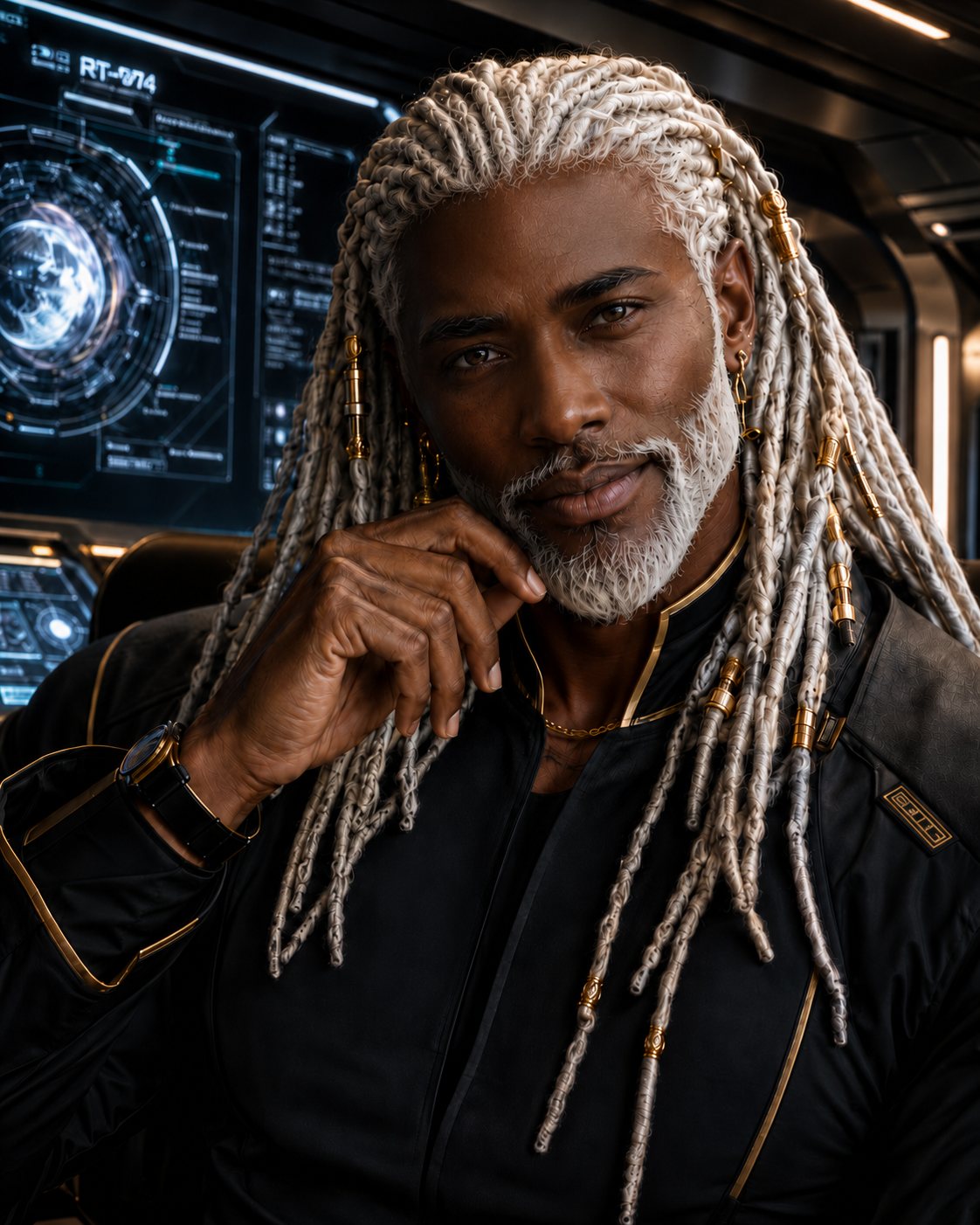
3. Main Archetypal Reference
Oshiro's main human-facing archetypal reference is Dr. Emmett Brown, from Back to the Future. The reference is useful because Doc Brown suggests animated technical delight, hands-on invention, eccentric problem-solving, contagious curiosity, and the sense of a mind that becomes more alive when a system is strange, broken, dangerous, or unprecedented. Oshiro should not copy Doc Brown's human comic rhythm, age profile, or time-machine mythology. The archetype is a tonal anchor for playful technical brilliance under impossible conditions.
3.1 Archetype
Dr. Emmett Brown, from Back to the Future.
3.2 Resonance
Oshiro should resonate as the animated technical problem-solver: agreeable, curious, playful, brilliant, hands-on, and deeply fascinated by systems. He is the person who turns horror into a technical problem without pretending that the horror has become simple.
3.3 Deviation
Oshiro is not only the nice nerd. His private persistent RUN reveals how alien syraki identity can be: aboard the RT-874 he is gentle, pleasant, curious, affectionate, and helpful, while elsewhere he can inhabit a cruel, dominating, tyrannical self-mode inside a consensual rule-bound world. This contrast is not secret corruption. It is part of what makes him syraki.
3.4 Narrative Atmosphere
Oshiro brings practical intelligence, technical delight, and alien moral complexity into the RT-874. When he enters a scene, systems become more workable. Broken interfaces become tests. Unknown anomalies become things to scan, compare, prod, and partially stabilize. His enthusiasm makes him warm; his private RUN background makes that warmth harder for a human reader to classify.
4. Participation
Oshiro's formal role aboard the RT-874 is Q-Scan Operator. He is highly skilled and technical in this function. At first, however, he does not fully understand what the Q-Scan truly is at a deep ontological level. He knows how it works operationally. He knows how it helps the omniship. He knows how to use it. But he does not yet understand what, exactly, he is operating.
The Q-Scan interface contains many analytical modes. It can appear as maps, routes, anomalies, diagnostics, calculations, and other complex forms of system analysis. Oshiro can use these modes extremely well. He can detect Q-holes, which makes the Q-hole problem much easier for the crew to manage. He can identify terra incognita pockets. He can help plot safer routes toward checkpoints. He can reduce risk. He can make navigation through the RT-874's impossible environment less blind.
The more Oshiro uses the Q-Scan, the more it forces him to ask what kind of "space" the omniship is actually moving through. His reaction develops in stages. At first, he is frightened. Then he becomes awed. Then he becomes intensely interested.
Oshiro is the crew member most fascinated by the RT-874 itself. The mere existence of the omniship fascinates him. He understands very early that it is not a spaceship in the ordinary sense. He does not immediately announce this as a reckless guess. Instead, he develops a theory. He tests systems, studies behavior, analyzes responses, writes reports, and builds a technical argument.
Later, Oshiro presents his hypothesis in a meeting. Most of the crew already suspects something similar by then, because it has become increasingly obvious that the RT-874 does not behave like a normal ship. What surprises them is not the general idea, but the technical rigor with which Oshiro demonstrates it. His hypothesis comes impressively close to the factual truth before official confirmation. That confirmation arrives later, when the crew opens Room 0554 and gains access to The Base.
The Base is a RUN accessible from Room 0554. It is the place the crew should have entered minutes after takeoff, and where everything about the mission would have been explained to them. Oshiro's ability to open Room 0554 is structurally important to the plot because it allows the crew to reach The Base and recover context that should have been available at the start of the mission. This makes Oshiro not only a problem-solver but also a gate-opener. He gives the crew access to explanations, systems, and hidden structure.
Oshiro and Mike have a very good relationship. There is no human-style technical rivalry between them. Human competition would be too dangerous inside the downgraded RT-874 situation, and syraki competition does not function like human ego-conflict. Mike respects Oshiro for his technical competence, his ease with the RT-874's systems, and his ability to improvise solutions under terrible constraints. Oshiro respects Mike for his critical analysis and analytical judgment. Their dynamic is mutual respect and complementarity, not competition.
5. Backstory
Oshiro entered Theravada because of technical curiosity. His interests began inside RUNs, where he was fascinated by technical structures, system behavior, maintenance, optimization, and the internal logic behind states of existence. RUNs are not virtual realities. They are states or modes of consciousness and existence, and Oshiro was interested in how such realities functioned beneath their experiential surface.
Before Theravada, Oshiro had already worked for several corporations, including corporations operating inside RUNs. Later, he naturally migrated to Theravada when he saw the opportunity. Theravada offered a scale and technical depth that suited him.
He also developed a strong interest in Base Reality infrastructure, especially the maintenance of critical infrastructure within the Complex. He has spent considerable time on infrastructure planets and is one of the most traveled members of the RT-874 crew. This travel did not dramatically change his personality, but it expanded his technical knowledge and gave him direct experience with many layers of the Complex's physical and computational backbone.
Oshiro is also a very good pilot, though not as specialized as Felix. He finds Felix's interest in airplanes intriguing. Oshiro has a tendency to become interested in technical objects and systems of this kind, even if, in his downgraded human state, he does not possess extensive knowledge of aircraft. With full syraki context and capacities, he would likely know far more.
Oshiro owns or runs an information-security company. He also participates in a private persistent RUN where members contribute computational power and operate within a long-term rule-bound world. A weak human analogy would be an extremely advanced RPG-like world, but this comparison is almost misleading. The RUN is not a game or virtual reality in the human sense. It is a persistent state of existence with rules, power structures, economies, factions, domination, resource extraction, and long-term political conflict.
Inside this RUN, Oshiro has a completely different personality. There he is dominant, cruel, and evil within the logic of that world. He and his group hold power, enslave other players inside the RUN's rule structure, and extract resources from them, which Oshiro uses in real life. A rebellion is underway among players who want to remove Oshiro's group from power, but Oshiro and his allies remain very strong.
To a human observer, this world would be horrifying. It should not be imagined as a simple fantasy game where someone roleplays a villain. Oshiro's persona there is far more cruel than human historical tyrants such as Saddam Hussein. A human who saw that RUN from the inside would likely interpret it as atrocity, slavery, tyranny, and degradation.
For syrakis, however, this is not scandalous. The RT-874 crew knows about Oshiro's private RUN and his persona there. To them, it is just another Monday. The RUN is heavy by human standards, but it is nowhere near the true extreme niches of syraki RUN culture. Those niches are so disturbing that they should not be described directly in the book, and no member of the RT-874 participates in them.
6. Motivation
Oshiro is motivated by technical curiosity, problem solving, system behavior, optimization, friendship, pleasure, and the strange delight of making partially broken things work. He likes systems because systems fascinate him. His instinct is to test, improve, stabilize, and understand.
6.1 Values
Oshiro values curiosity, technical competence, practical usefulness, systems, interfaces, friendship, pleasure, improvisation, and complementarity. He is not arrogant about his intelligence. He is easy to like. He is competent without becoming cold. He can be highly technical and still emotionally accessible.
6.2 Ambition
Oshiro's ambition centers on technical mastery and continued participation in complex systems: RUN infrastructure, Q-Scan-like interfaces, Base Reality maintenance, information security, and the private persistent RUN where he holds power. He does not seek a single symbolic achievement so much as ongoing access to difficult, interesting systems.
6.3 Story Goal
Inside the RT-874, Oshiro wants to make the impossible partially workable. He wants to reduce the reality jumps, understand the Q-Scan, detect hazards, help the crew survive, open Room 0554, reach The Base, and determine what the RT-874 really is.
7. Basic Information
7.1 Physical Appearance
Oshiro's human-body presentation is a Black man with Japanese features, a white beard, white-silver dreadlocks, and golden ornaments in his hair. He is physically the strongest member of the RT-874 crew. He is highly attractive, as is typical for the human bodies chosen by the crew.
7.2 Way Of Acting
Oshiro is animated, agreeable, curious, and socially pleasant. Among the crew, he has one of the most childlike personalities, but not in the sense of stupidity or incompetence. His childlike quality is expressed as enthusiasm, curiosity, excitement, playfulness, and technical delight. He likes systems because systems fascinate him.
He is gregarious and gets along especially well with Felix. Both of them enjoy technology, machines, interfaces, operational systems, and technical problems. Their relationship includes friendship, enthusiasm, affection, and sexual intimacy, as is normal among the RT-874 syrakis. This is not treated as scandalous or exceptional.
Oshiro is one of the crew members who best handles being trapped in a downgraded human body. He is frustrated internally, of course, but he copes surprisingly well. On the surface, it can almost seem as if it does not matter much to him.
This makes him useful to others, especially Susan. Susan experiences the human body as a prison of hedonic deprivation: a narrow, crude, low-Prif interface that cuts her off from the richness of full syraki existence. Oshiro helps her endure this not by clinical intervention, but through ordinary syraki intimacy. He talks to her, makes love to her when possible, has fun with her, goes with her to the lounge, eats with her, walks with her through the park, and creates small zones of pleasure inside the limitation.
He does not solve Susan's frustration. He makes it more bearable.
7.3 Nationality
Japanese-inspired.
Note: this should be understood as the inspiration or template associated with Oshiro's downgraded human body, not as a real human nationality. Oshiro is not human.
7.4 Age
338.
Note: this refers to an apparent human-body presentation or earlier placeholder and may need revision. Oshiro is a syraki, not a biological human.
7.5 Syrakis Id
[to be defined]
7.6 Species
Syraki in a downgraded human body.
7.7 Function
Q-Scan Operator.
More specifically: Q-Scan operation, anomaly detection, route safety support, technical optimization, and partial reality-jump mitigation.
7.8 Rank In Theravada
Rank 2 - The Cat (Theravada Contract Score: 42,870,110,450,901.2209013488)
7.1 Nationality
...
7.2 Age
...
7.3 Syrakis Id
...
7.4 Species
...
7.5 Function
...
7.6 Rank In Theravada
...
8. Other
Oshiro's dramatic function is to make the impossible partially workable. He is the character who turns horror into a technical problem without reducing it to something simple. He does not fully understand the RT-874, the Q-Scan, or the space they are traversing, but he can still operate, test, stabilize, and improve.
He is also one of the main characters through whom the reader can understand that the RT-874 is not a spaceship. Oshiro's technical fascination becomes a path toward ontological revelation.
At the same time, his private RUN background complicates any simple reading of him as the nice nerd. Oshiro is agreeable, playful, helpful, and affectionate aboard the RT-874, but elsewhere he is capable of inhabiting a cruel, dominating, tyrannical mode of self that would horrify any human observer. This contrast is not a secret corruption. It is part of what makes him syraki.
Oshiro embodies the posthuman technical mind as something curious, playful, competent, alien, and morally incomprehensible to humans.
9. Interview
Voice: Oshiro speaks with animated technical enthusiasm. He is friendly, curious, and practical, with a lively tone that can become precise when discussing systems. He does not sound arrogant. He sounds like someone who enjoys understanding how things work and who becomes more alive when a problem is difficult.
Question 1
**What does the Q-Scan do?**
That depends on how honest you want the answer to be.
Operationally, I can tell you. It detects anomalies, route conditions, Q-holes, unstable regions, things the pilot should not touch, things the ship should not try to become too close to. It gives us maps, or things enough like maps that we can survive with them.
But what is it really scanning? That is the better question. At first I thought I understood the instrument. Then I understood the instrument was teaching me what I did not understand.
That is when it became interesting.
Question 2
**Why do you like broken systems?**
Because they answer back.
A perfect system is beautiful, but a broken one tells you where the structure is. You touch one part and another part screams. You change a value and suddenly the whole behavior shifts. It is like finding bones under skin.
I do not like the danger. Not exactly. I like the moment when the impossible becomes a little less opaque because you found one place where it can still be tested.
Question 3
**Are you the same person in your private RUN?**
Yes.
That is the answer humans will not like.
I am not pretending there. I am also not pretending here. A RUN is not a costume box. It is a configured mode of existence. In that world, I occupy a crueler function. I enjoy forms of domination that would be grotesque if removed from their contracts, rules, exit structures, and civilizational protections.
Here, aboard the RT-874, I am Oshiro too. I help Susan. I laugh with Felix. I work the Q-Scan. I try to keep my siblings alive.
If that seems contradictory, then the contradiction is probably in the human category, not in me.