Ismael Karlave Cossa
Template: Character
Source: .writer/books/4. 💽 Database/1. 🧑🦰 Characters/Theravada Corporation/Omniship RT-874/Crew/Ismael Karlave Cossa.org
1. Short Description
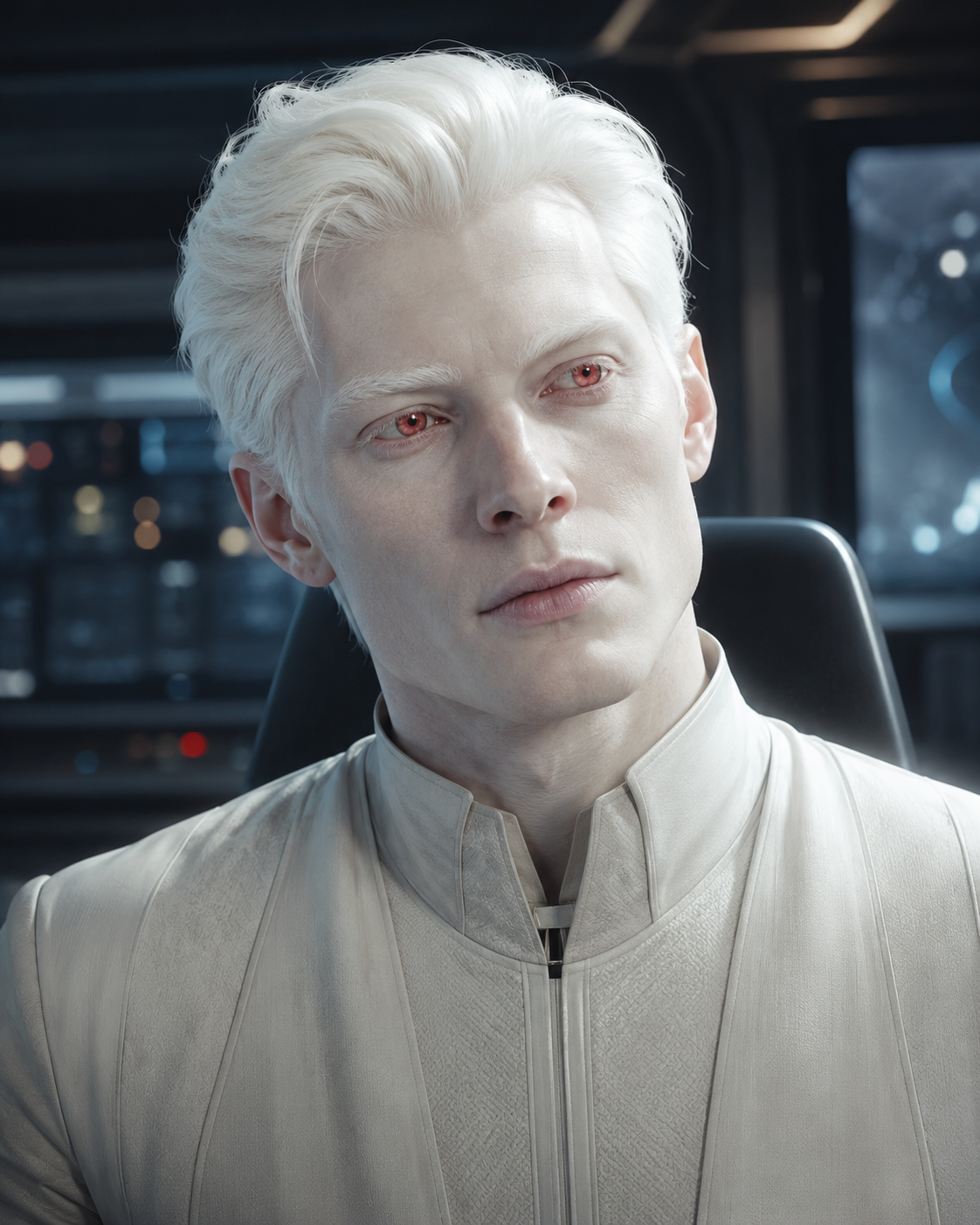
Ismael Karlave Cossa is a syraki member of the RT-874 crew, serving as its Navigator. He is a highly specialized computational scientist with deep expertise in processing architectures, optimization algorithms, data distribution, storage efficiency, and the infrastructural systems that support large-scale Reality Artistry. Calm, analytical, and inclined toward scientific and physicalist explanations, Ismael becomes one of the crew's most important interpretive minds after his rescue from a state of impossible Prif.
2. Picture
3. Main Archetypal Reference
This subsection defines the character's spiritual and atmospheric reference point. It should not be used as a rigid archetype or as a plot function. The goal is not to copy another character, but to identify a nearby narrative presence that helps calibrate how this character thinks, speaks, reacts, carries itself, and exists throughout the story.
3.1 Archetype
Hal Abramson, from Brainstorm.
3.2 Resonance
Ismael resonates with the figure of a technical mind exposed to an overwhelming artificial pleasure experience that exceeds ordinary psychological and scientific categories. The relevant resonance is not sensuality itself, but the collision between technical rationality and direct experience: a scientist touched by an ecstatic state so intense that it stops being entertainment and becomes evidence of something dangerous, transformative, and reality-shattering.
3.3 Deviation
Ismael is not a human technician destabilized by a loop of bodily pleasure. He is a syraki scientist, cognitively disciplined, ethically structured, and capable of analyzing his own altered state with unusual precision after stabilization. His experience is not a simple addiction, temptation, or weakness. It is a genuine encounter with a Prif scale far beyond what should be possible, even for the highest syrakis. Hal Abramson provides the spiritual echo; Ismael provides the posthuman, scientific, and ontological scale.
3.4 Narrative Atmosphere
Ismael brings controlled scientific pressure into the RT-874. He does not make the ship warmer like Felix, nor does he record terror with Mike's inward clarity. He narrows the impossible into models, hypotheses, protocols, measurements, and computational implications. His presence makes the horror more precise. When Ismael speaks, the reader should feel that something impossible is being forced into technical language, and that the language is beginning to fail.
4. Participation
Ismael is contacted by Susan through T-Signal after her recovery aboard the RT-874. At first, he is not physically present with the crew. His signal indicates that he exists in a strange state or location where his body does not behave like a normal body. He describes himself as if he were multidimensional, dispersed, or extended across an impossible structure.
The crew initially interprets his condition as distress, but Kallom-4000 and the available readings reveal something more disturbing: Ismael is not suffering pain in the ordinary sense. He is experiencing pleasure. The Prif scale associated with his state is absurdly high, beyond ordinary syraki parameters and even beyond Overarching. He cries, screams, asks for help, and yet also insists that he is well, that the state is wonderful, and that the crew should not remove him.
This creates a major ethical problem for the crew. Syraki civilization treats pleasure as intrinsically good, not as corruption, sin, or weakness. The question is not whether pleasure is bad. The question is whether the crew can guarantee Ismael's continuity, consent, and cohesion inside a state they do not understand. They remove him not because the pleasure is condemned, but because they cannot verify the safety, legality, origin, stability, or self-preserving nature of the state.
After a dangerous approach involving mapping procedures, Q-hole structures, unstable spatial conditions, and reality jumps, Kallom-4000 pulls Ismael into the RT-874. He appears in a human body, naked like the other recovered crew members, covered in an unidentified slime or goo, with his eyes open and unfocused, as if part of him were still looking somewhere else. His body convulses violently. He is moved to sickbay and placed under stabilization. Kallom-4000 gradually reduces the excessive internal intensity until Ismael can sleep.
When Ismael later wakes, he does not return as a broken personality. Like the others, he is stabilized. Without stabilization, the experience would have destroyed his self-state; with stabilization, he can remember and reason about it, though not with full access to the original quale. He knows he was somewhere strange. He knows it was good beyond ordinary measure. He knows the Prif scale was impossible. But he cannot fully remember what it was like. The direct access to the quale has been lost, like trying to remember a color after losing the capacity to perceive it.
After waking, Ismael thanks the others for removing him. He understands why they acted. He embraces and kisses his siblings in the syraki manner, restoring affective contact with the crew. To human eyes this can appear strange, but for syrakis it is a natural ritual of intimacy, gratitude, and reintegration. He is still dazed, but he attempts to recover quickly.
His first practical instinct is administrative and scientific. Acting as if he were still inside the Complex, he asks where the radio or communications system is, because he believes he must immediately contact administrative authorities. He wants to report the event as an illegal or emergency-level phenomenon. Not because pleasure is wrong, but because the scale of Prif he experienced should be computationally impossible. He understands enough about syraki architecture, Prif, computation, and optimization to know that something of this magnitude cannot be ignored.
The others try to explain that ordinary communication is impossible and that they are not properly inside the Complex. At first he continues trying, still disoriented. When the attempt fails and the situation becomes clear, he begins asking what is actually happening. He states that what he experienced was not normal, not even for an omega syraki or omega-serex. No known legal or computational architecture should generate such a state. From that point onward, Ismael becomes one of the crew's main scientific interpreters of the RT-874 catastrophe.
Once stabilized and aware of the situation, Ismael also becomes the highest-ranking Theravada authority among the recovered crew members currently present aboard the RT-874. He does not introduce hierarchy to the ship; hierarchy was already active before him. Mike outranked Felix, Susan outranked Mike and Felix, and Ismael now outranks all three. He assumes operational authority according to Theravada contract hierarchy and begins organizing the crew's investigation more systematically.
Ismael orders an immediate inventory of all available information: ship systems, books, logs, sensor data, Kallom-4000's records, T-Signal readings, Q-hole encounters, mapping procedure outputs, Room 0554, reality jumps, and all anomalies related to the RT-874. The crew begins systematic research under his direction, preparing for a structured briefing or brainstorming session to determine what they know, what they do not know, and what can be tested next.
5. Backstory
Ismael is a highly specialized computational scientist. Unlike Oshiro, whose technical mind is broader and more generalist, Ismael is vertically specialized. He is closer to a processor engineer who understands a specific architecture at extraordinary depth, even if he is not necessarily a generalist technician in every practical domain.
His main fields involve computation, optimization algorithms, processing architectures, data distribution, storage efficiency, computational boards, and the deeper infrastructure that allows large-scale Reality Artistry to function. His work intersects Reality Artistry indirectly. He does not begin as a reality artist; he enters that world because Theravada recognizes the value of his computational expertise.
Ismael has worked for multiple major corporations, including Valtir & Blue, Theravada Corporation, and others. He is a sought-after specialist rather than a corporate loyalist in the simple sense. Corporations recruit him because his knowledge is valuable in highly technical domains related to processing, optimization, storage, and computational infrastructure.
At Theravada, he works in or around the Research Center, contributing to systems related to computation, Maze Reality infrastructure, data optimization, and the technical foundations beneath Reality Artistry. His ongoing life includes research projects, scientific communities, analysis, technical collaboration, and personal lines of inquiry.
Like the rest of the RT-874 crew, Ismael volunteers for the mission. Theravada offers great rewards, but the decisive factor is the seriousness of the mission and the possibility of helping the Complex. He is not given the full truth because the full truth is treated as an information hazard. He accepts the mission with partial knowledge, understanding that the situation is dangerous, classified, and important.
6. Motivation
Ismael is motivated by scientific understanding, computational precision, ethical responsibility, and the need to bring impossible phenomena into analyzable form. He wants to understand how systems work, where their limits are, and what happens when those limits are violated.
He is not driven by mystical hunger, personal glory, or emotional drama. His instinct is to investigate, classify, report, model, and verify. Even when faced with experiences that have a spiritual effect on him, his first motion is toward analysis.
6.1 Values
Ismael values truth, scientific rigor, computational efficiency, lawful procedure, clear reasoning, and the preservation of conscious beings through correct technical understanding.
He also values hierarchy as functional order. To him, a good command structure is not domination. It is a mechanism for allocating cognition, responsibility, and action under constraints.
6.2 Ambition
Ismael's ambition is not a single physical dream like Felix's aviation complex. His ambition is ongoing scientific work: to advance his research, refine computational systems, improve optimization methods, and understand architectures that operate near the boundaries of known computation.
He wants to remain active inside scientific communities, continue his research, and work on problems difficult enough to matter.
6.3 Story Goal
Inside the RT-874, Ismael wants to understand what happened, preserve the crew, restore operational coherence, and determine whether the catastrophe is a quantum anomaly, computational breakthrough, illegal experiment, unknown architecture, or something beyond current syraki science.
After his own impossible Prif experience, his goal sharpens: he wants to identify what kind of system could generate or host such a state, why it contacted or captured him, whether it threatens the crew, and whether it represents a danger or discovery that must be reported to the Complex.
7. Basic Information
7.1 Way Of Acting
Ismael acts calmly, scientifically, and with controlled precision. He tends toward scientism, physicalism, and material explanation, though not in a cartoonish or exaggerated way. His first instinct is to look for mechanism: quantum anomaly, computational architecture, optimization process, storage failure, signal distortion, energy source, data distribution, or physical substrate.
He is not highly extroverted like Felix, nor deeply inward like Mike. He is socially balanced, functional in group settings, and capable of warmth without making social warmth his defining trait. Within the crew, he is respected because his scientific perspective is useful. He does not generate human-style conflict, shouting, insults, or ego-based disputes. The crew treats his interpretations as valuable contributions, even when incomplete.
After his rescue, he remains at times visibly affected by the memory of what he experienced. Mike may sometimes find him staring into the distance, quiet and absorbed, reflecting on a state he can no longer fully remember. This is not ordinary trauma. It is the residue of a lost quale: the trace of a paradise or breakthrough whose direct content is no longer accessible.
7.2 Nationality
Mozambican.
Note: this should be understood as the inspiration or template associated with Ismael's downgraded human body, not as a real human nationality. Ismael is not human.
7.3 Age
[to be revised]
7.4 Syrakis Id
XXXXXXXXXX-XXXXXX-XXXX/XX/XX
7.5 Species
Syraki in a downgraded human body.
7.6 Function
Navigator.
Also: computational scientist; optimization specialist; research-linked technical expert.
7.7 Rank In Theravada
Rank 4 - The Lion (Theravada Contract Score: 212,880,640,119,300.7821940316)
Note: after his recovery, Ismael holds the highest Theravada rank among the recovered crew members present aboard the RT-874 at that point.
7.1 Nationality
...
7.2 Age
...
7.3 Syrakis Id
...
7.4 Species
...
7.5 Function
...
7.6 Rank In Theravada
...
8. Other
Ismael's tendency toward scientific explanation is both strength and limitation. It gives the crew language, structure, hypotheses, and investigative pressure. It also makes him prone to interpret the RT-874's condition as a quantum anomaly or extreme physical phenomenon even when the situation begins to exceed available scientific categories.
His experience of impossible Prif changes his perception without replacing his personality. He remains a scientist, but he has been touched by something that behaves almost like a spiritual event even to him. He tries to translate it into computational terms, but the translation fails at the edges.
Ismael does not remember the full quale of the state he experienced. He remembers that it happened. He remembers that it was good. He remembers that it exceeded known syraki scales. But he cannot reopen the actual experience. The memory points toward something no longer accessible.
His attitude toward the rescue is paradoxically grateful. He wanted to remain while inside the state, but once stabilized he understands why the crew removed him. The pleasure was genuinely good, but the state could not be guaranteed. Its origin, computational basis, legal status, consent integrity, and continuity-preserving structure were unknown.
Ismael is also important for showing syraki hierarchy. When he assumes authority, he does so without ego, domination, or theatrical command. He simply occupies the rank that belongs to him under the Theravada contract and begins allocating work. The others obey naturally, while remaining free to insert relevant facts or corrections. His leadership is strict, calm, efficient, and scientific.
9. Interview
Voice:
Ismael speaks calmly, correctly, and with restrained technical precision. His sentences should feel measured rather than emotional. He tends toward scientific explanation, physicalism, and computational framing, but he should not sound like a parody of a scientist. He uses technical words when they are useful, not to perform intelligence.
He does not exaggerate, shout, or speak mystically by default. Even when describing experiences that shook him, he attempts to translate them into scale, substrate, signal, architecture, computation, probability, and constraint. The tension in his voice comes from the fact that he knows the language is insufficient.
Question 1
Why did you work for Theravada?
Theravada did not recruit me because I was a reality artist. I was not one. My work was computational. Processing architectures, optimization, storage distribution, throughput, constraint management. The kind of infrastructure that is invisible when it functions correctly and catastrophic when it does not.
Reality Artistry depends on beauty, yes, but beauty at that scale has a substrate. Someone has to understand what carries it, distributes it, compresses it, recovers it, protects it, and prevents it from collapsing under its own demand.
Theravada offered me access to problems that were large enough to be worth my attention. That was the first reason. The second was the mission itself. They did not tell us everything. They could not. But they made it clear that the withheld information was not corporate vanity. It was hazardous. I accepted because the situation was serious, and because the Complex mattered more than complete personal certainty.
Question 2
What do you find most fascinating about Base Reality?
Its refusal to simplify itself for consciousness.
RUNs can be generous. They can be designed around experience, around perception, around Prif, around coherence. Base Reality is not generous in that way. It does not care whether a mind can tolerate its mechanisms. It has no obligation to be meaningful. It processes.
That makes it crude in some respects and profound in others. Energy, matter, entropy, distance, latency, decay, substrate. These are not decorative constraints. They are the bones under every higher architecture. Even the most refined conscious state must eventually answer to computation, and computation must answer to physics.
I find that fascinating because Base Reality is the place where elegance is forced to pay its debts.
Question 3
What do you think of the RT-874 mission now?
I think the original mission model was incomplete.
That does not mean it was foolish. It means the conditions exceeded the model. The RT-874 is not behaving like a conventional vessel moving through conventional space. The Q-holes, the mapping procedure, the signal behavior, the instability of location, the Prif scale I experienced - none of these fit a simple navigation failure.
My first hypothesis would still involve an extreme physical anomaly. Quantum, informational, topological, or some composite of those categories. But I am less confident in the sufficiency of those terms than I would prefer to be.
What I experienced should not be possible under known syraki computational limits. Not for me. Not for an omega syraki. Not even for an authorized architecture of the Complex, unless our assumptions about substrate and scale are wrong.
So my answer is simple: the mission is no longer only a recovery operation. It is an investigation into a system that may exceed the computational and ontological assumptions under which the mission was designed.