Felix Colomb
Template: Character
Source: .writer/books/4. 💽 Database/1. 🧑🦰 Characters/Theravada Corporation/Omniship RT-874/Crew/Felix Colomb.org
1. Short Description
Felix Colomb is a syraki member of the RT-874 crew and its primary pilot. He is the most gregarious and socially connective member of the crew, a long-serving Theravada worker, an experienced mining pilot, and the crew member with the deepest familiarity with human-like and retroanthropic forms of life. His warmth, technical enthusiasm, and instinct for comfort make him one of the emotional stabilizers of the RT-874 after the catastrophe.
2. Picture
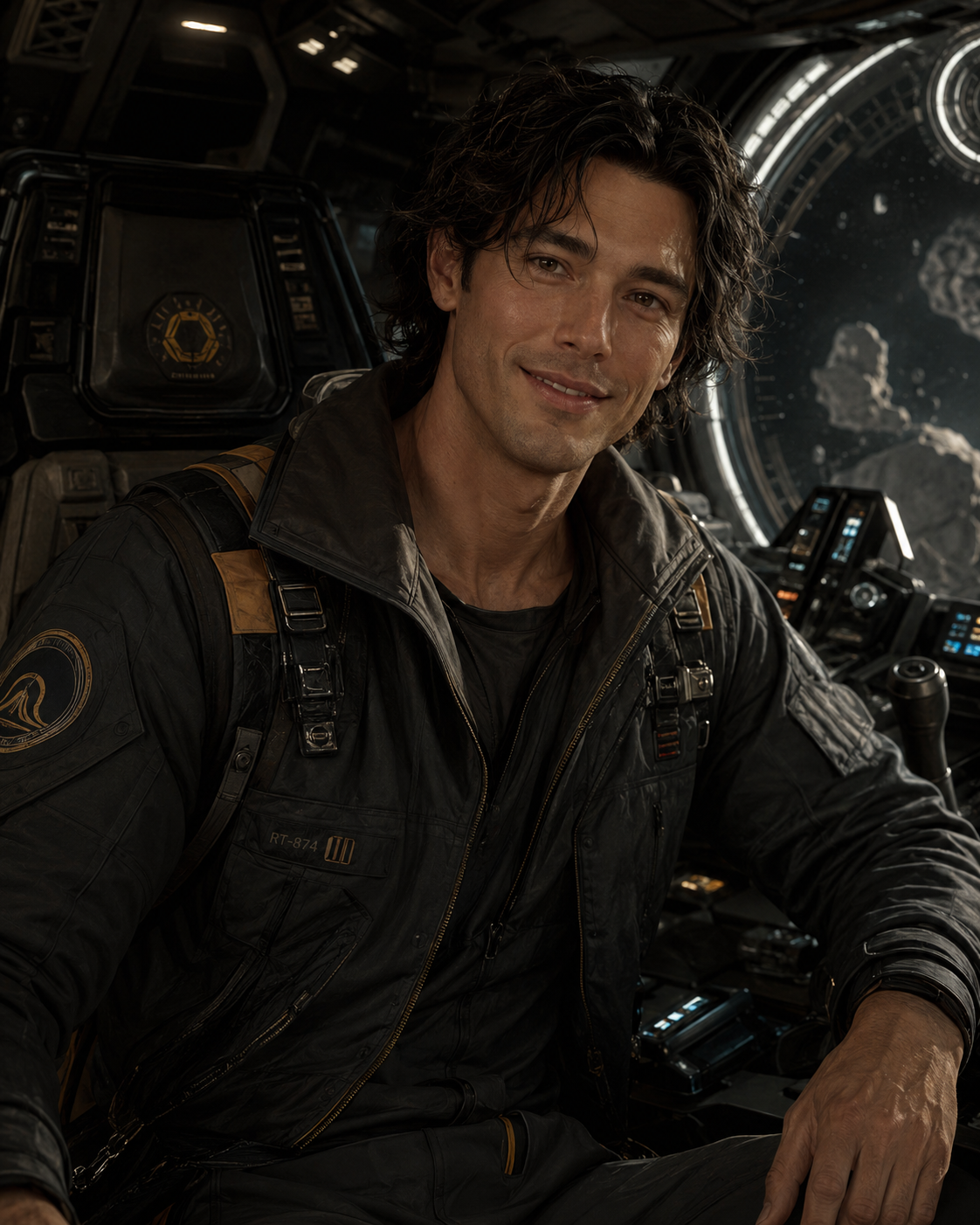
3. Main Archetypal Reference
This subsection defines the character's spiritual and atmospheric reference point. It should not be used as a rigid archetype or as a plot function. The goal is not to copy another character, but to identify a nearby narrative presence that helps calibrate how this character thinks, speaks, reacts, carries itself, and exists throughout the story.
3.1 Archetype
Harry Kim, from Star Trek: Voyager.
3.2 Resonance
Felix shares Harry Kim's approachable warmth, loyal crew presence, social openness, and lack of arrogance. He feels like someone others can stay near without defensive tension: competent, friendly, emotionally available, and naturally suited to belonging inside a crew rather than standing above it.
3.3 Deviation
Felix is not young, naive, or humanly inexperienced. He is an ancient syraki, a long-serving Theravada pilot, a mining specialist, a participant in retroanthropic aviation communities, and a far more hedonistic and socially mature being. Where Harry Kim feels like a promising young officer, Felix feels like an old posthuman soul temporarily compressed into a warm, extroverted human body.
3.4 Narrative Atmosphere
Felix brings warmth into machinery. When he enters a scene, the RT-874 becomes less like a tomb and more like a wounded vessel with people still alive inside it. He carries cockpit instinct, social ease, technical curiosity, and the fragile comfort of someone who knows how to keep others from collapsing.
4. Participation
Felix is recovered after Mike has already returned to the RT-874 and begun working with Kallom-4000. Before his rescue, Felix endured the Water World experience and repeated drowning-like conditions that would have completely broken his self-state if Kallom-4000 had not stabilized his syraki/ciriq after recovery.
After stabilization, Felix remembers the experience rationally rather than as raw, incapacitating trauma. The memory still causes distress inside the RT-874, but it remains under control because Kallom-4000 stabilized his syraki/ciriq. His recovery does not show invulnerability; it shows the difference between human trauma and syraki mental stabilization.
Within the RT-874, Felix serves as the pilot and becomes one of Mike's closest companions. He helps Mike navigate the ship's impossible condition, participates in the rescue of Susan and Ismael, and uses his cockpit instinct during encounters with Q-holes, reality jumps, unstable locks, and nonstandard spatial hazards.
Felix also becomes important in the crew's attempt to understand what the RT-874 actually is. He discusses aviation, spacecraft, ship behavior, and technical anomalies with Oshiro, the most technical and "nerd-like" member of the crew. Together, they spend significant time analyzing the RT-874 and eventually conclude that it is not a normal spaceship, and possibly not a spaceship in the true sense at all.
In Chapter 13, Felix is central to the emotional and hedonic structure between Mike, Susan, and himself. His gregarious nature, lack of possessiveness, comfort with human-like experience, and ability to care for others through food, touch, massage, conversation, and physical presence make him essential to the crew's stabilization after Ismael's rescue.
[encrypted]
5. Backstory
Felix worked for Theravada for a very long time. Among the RT-874 crew, only Rüdolf served Theravada longer. Felix nevertheless holds the lowest rank aboard the omniship, because rank is not determined simply by time of service. Theravada hierarchy follows a different logic involving function, operational responsibility, clearance, competence domains, and command suitability.
Felix is an excellent pilot. He has flown many kinds of vessels, but his main professional background is in mining operations. He is primarily a Theravada mining pilot, experienced in piloting ships through industrial, spatial, and resource-extraction environments.
Over many years of work for Theravada, Felix accumulated enough resources to create or acquire a mineral-processing company. This company contracts with Theravada to process minerals connected to Theravada's mining operations. Although Theravada Corporation is best known for Reality Artistry, it operates across many strategic sectors, including mining, infrastructure, energy, computation, logistics, and physical resource chains. Its dominance in Reality Artistry is partly supported by this broader material power.
Felix's interest in piloting began with spacecraft. From there, curiosity led him backward into the history of spacecraft, early human spaceflight, and eventually human aviation. He became interested in the way ancestral humans flew primitive aircraft, fought aerial wars, reached space with limited machines, and experienced flight through fragile biological bodies and mechanical interfaces.
Felix participates in syraki communities dedicated to aviation, primitive astronautics, historical vehicles, and retroanthropic flight experiences. These communities discuss technical reconstruction, operational realism, historical procedures, aircraft behavior, spacecraft limitations, and the creation of RUNs or replicas designed to simulate early human flight as accurately as possible.
Felix has flown human aircraft in RUNs, including experiences inspired by World War II aviation, human wars, early atmospheric flight, and the first human spacecraft. For him, this is not merely academic interest. It is a form of lived pleasure, social participation, and retroanthropic fascination.
Like the rest of the RT-874 crew, Felix volunteered for the mission. Theravada offered great rewards, but the decisive factor was the possibility of helping the Complex. He was not told the full truth because the full truth was considered dangerous and could not be safely disclosed. He was told that the situation was serious, that complete explanation was impossible due to information-hazard risk, and that the mission mattered to the Complex. Felix understood the seriousness and accepted voluntarily.
6. Motivation
Felix is motivated by pleasure, friendship, shared experience, piloting, technical curiosity, and loyalty to the Complex. His hedonism is not selfish decadence; it is a syraki orientation toward Prif, companionship, comfort, experience, and the creation of positive conscious states.
He wants to survive the RT-874 catastrophe because he loves existence, loves other syrakis, loves flying, loves his communities, and still has things he wants to build.
6.1 Values
Felix values friendship, social connection, shared pleasure, technical competence, beauty in motion, good conversation, comfort, and voluntary contribution to the Complex.
He believes existence should be lived richly and happily. Pleasure, care, social warmth, and competence are not separate values to him; they belong to the same structure of meaningful life.
6.2 Ambition
Felix's personal dream is to build, in Base Reality, a retroanthropic aviation complex: something like an airport containing real human aircraft or functional replicas, where syrakis can experience flight as ancestral humans did.
This project would allow syrakis to fly physical aircraft with cockpit, runway, engine, air, gravity, vibration, mechanical limitation, and bodily presence. It would bring into Base Reality something that is usually easier to experience inside RUNs.
The project is extremely expensive because constructing this type of physical infrastructure in Base Reality requires enormous resources. Felix's mineral-processing company and long-term economic activity are partly connected to this ambition.
6.3 Story Goal
Felix wants to return to the Complex, recover the rest of the crew, survive the RT-874 catastrophe, and resume the life he still loves: his friendships, his communities, his aviation interests, his company, his work, and his dream of building a physical aviation complex in Base Reality.
7. Basic Information
7.1 Way Of Acting
Felix is the most gregarious member of the RT-874 crew. In a full syraki state, this sociality would express itself through much deeper and more natural forms of connection. In a downgraded human body, it appears through simple human gestures: offering food, giving massages, touching, talking, keeping company, easing tension, and making others feel less alone.
He knows how to create comfort around him. He knows how to start a good conversation. He knows how to make others feel accompanied without making himself the center of everything.
His greatest weakness is the same as his greatest strength: he needs connection. The downgraded human condition deprives him of the natural depth of syraki sociality. Because of this, Felix can feel lonely even while physically near the others. He avoids being alone when he can, not because he is weak, but because the human body gives him only a narrow, impoverished version of the connection he is used to.
Under operational pressure, Felix can still function as a pilot. His technical instincts, experience with ships, and practiced relation to cockpit environments allow him to act during crisis. Afterward, however, he may seek contact, comfort, conversation, or physical closeness to stabilize himself.
7.2 Nationality
Frournatian.
Note: this should be understood as the inspiration or template associated with Felix's downgraded human body, not as a real human nationality. Felix is not human.
7.3 Age
[to be revised]
7.4 Syrakis Id
4596412923-589933-1851/33/48
7.5 Species
Syraki in a downgraded human body.
7.6 Function
Pilot.
More specifically: RT-874 pilot; experienced multi-vessel pilot; Theravada mining pilot.
7.7 Rank In Theravada
Rank 1 - The Goldfish (Theravada Contract Score: 8,442,150,904,220.3379105501)
Note: this is the lowest rank aboard the RT-874, but it does not mean Felix is inexperienced or unimportant. He has served Theravada longer than every RT-874 crew member except Rüdolf. Rank does not map directly onto time of service.
7.1 Nationality
...
7.2 Age
...
7.3 Syrakis Id
...
7.4 Species
...
7.5 Function
...
7.6 Rank In Theravada
...
8. Other
Felix is the RT-874 crew member with the greatest familiarity with human-like life. This familiarity was one of the reasons he was useful for the mission. He understands human and retroanthropic experience not only as data, but as something he has inhabited through RUNs, especially aviation and early-spaceflight experiences.
He is not possessive in the human romantic sense. His affection is aggregating rather than rivalrous. This becomes important in the relationship between Mike, Susan, and Felix. Felix can love both without treating either as property or threat.
Felix's body and mind are downgraded, but his social instincts remain syraki. He uses the crude tools available to the human form--food, touch, talk, proximity, sex, rest, comfort--to approximate deeper syraki forms of Prif and connection.
He is especially suited to scenes where machinery and warmth coexist: cockpit pressure, technical discussion, massaging Mike's shoulders, speaking with Oshiro about the RT-874, comforting someone after crisis, or quietly showing that the crew still has a social body even inside an ontological disaster.
9. Interview
Voice:
Felix speaks warmly, directly, and with social ease. He is more informal than Mike and less clinical than Susan. He can become technical when talking about ships, aviation, mining, or flight, but he does not sound cold. His technical enthusiasm carries pleasure. He tends to connect ideas to lived experience: cockpit, body, motion, atmosphere, pressure, sound, vibration, and the feeling of control inside a limited machine.
His speech should not sound arrogant, submissive, or performatively charming. He is friendly without swagger. He is affectionate without weakness. He is competent without needing to dominate the room.
Question 1
Why do you like flying so much?
I do not think there is a clean answer to that. I could give you a chain of causes if you wanted one. I started with spacecraft. Then I became curious about older spacecraft. Then older vehicles. Then atmospheric flight. Then the first machines humans trusted with their bodies. But that would only describe the path, not the taste.
At some point, a thing enters you as pleasure. Not as an argument. Not as a function. As itself.
I like the moment when a machine stops being an object and becomes a line through space. I like the narrowing of attention. I like the honesty of limitation. A wing does not care what you believe. A cockpit gives you only what it can give. There is beauty in that.
Question 2
What do you miss most from the Complex?
Connection.
Not conversation. We have conversation here. Not touch. We have touch too, crude as it is. I mean the ordinary depth of being with others. The way presence used to have more dimensions than this body can hold.
Here I can sit beside Mike and still feel far away from him. That is not his fault. It is not mine either. It is the body. It makes islands out of us.
So I cook. I talk. I touch shoulders. I stay near people. I make small bridges because I no longer have the great ones.
Question 3
What was the Water World to you?
Something I would not have returned from without Kallom.
I remember it now. I can speak about it. That does not mean I survived it by strength. I did not. I was stabilized. There is a difference.
Without that stabilization, the memory would not be a memory. It would still be happening. Or I would be broken around it.
So when I laugh now, when I fly, when I sit with the others, do not mistake that for innocence. It is maintenance. It is repair. It is the mercy of a civilization that learned not to worship wounds.