Elijah Kang Erva
Template: Character
Source: .writer/books/4. 💽 Database/1. 🧑🦰 Characters/Theravada Corporation/Omniship RT-874/Crew/Elijah Kang Erva.org
1. Short Description
Elijah Kang Erva is one of the most ancient beings aboard the RT-874, likely the oldest member of the crew by a very large margin. He is a syraki from an older stratum of civilization, a survivor who preserved rational memory of the Infernal Wars and the hellworlds, and an infiltrated IBCR/High Plaza agent whose betrayal may also be the only rational response to what he saw.
2. Picture
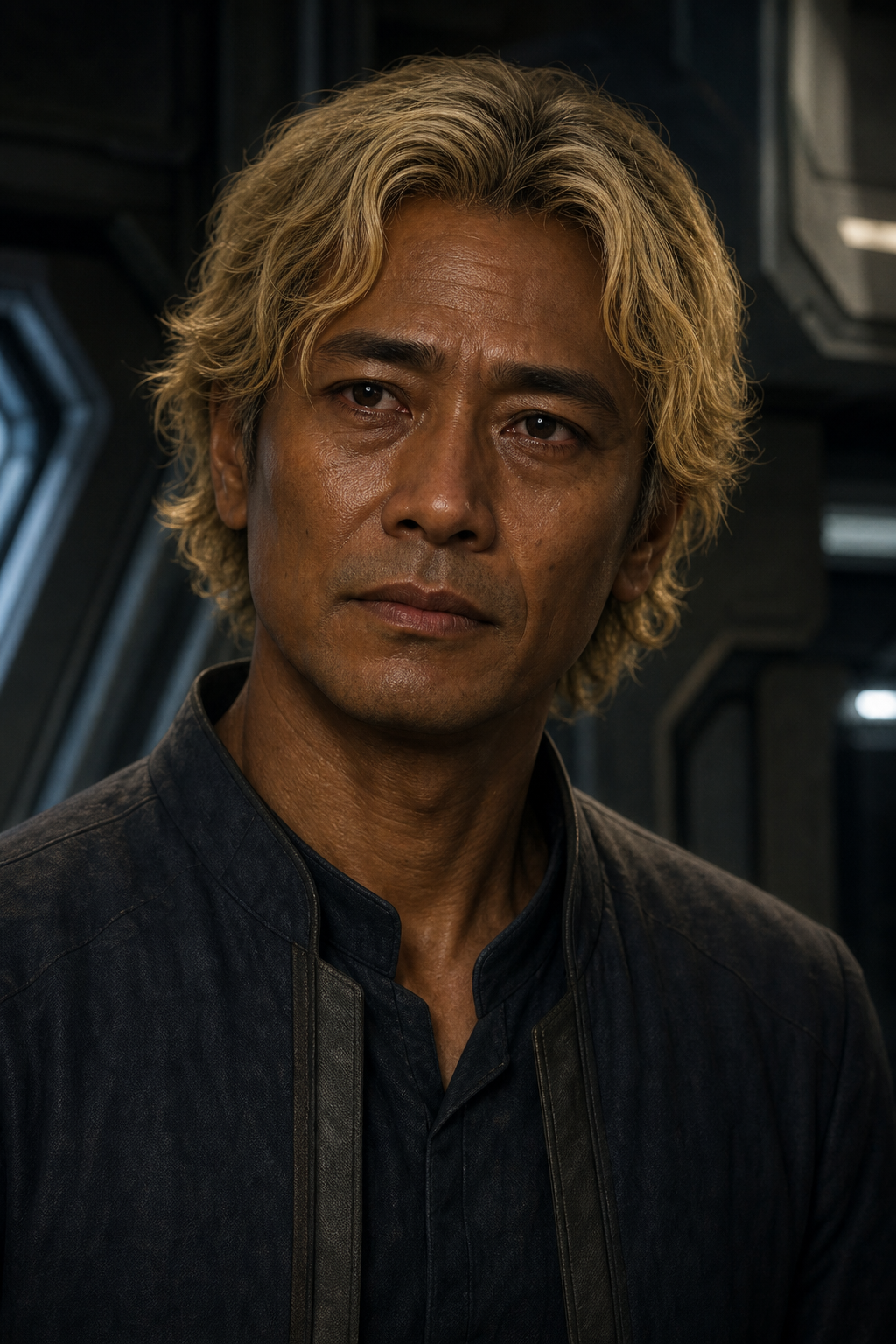
3. Main Archetypal Reference
Elijah's main human-facing archetypal reference is Sarah Connor, from Terminator. The reference is useful because Sarah Connor suggests a survivor-witness who has seen a future or truth others cannot fully understand, carries unbearable warning inside herself, and may appear unstable, extreme, or dangerous while responding to knowledge that is genuinely catastrophic. Elijah should not copy Sarah's human motherhood, militarized human psychology, or apocalyptic resistance framing. The archetype is a tonal anchor for haunted certainty, survival after impossible knowledge, and the tragedy of being right in a way others cannot verify.
3.1 Archetype
Sarah Connor, from Terminator.
3.2 Resonance
Elijah should carry the resonance of an ancient witness who is still socially alive. He is not a grim relic, a cold operative, or a traumatically frozen survivor. He is warm, gregarious, pleasure-loving, and capable of joy, but beneath that warmth he carries preserved memory of ontological horror.
The important emotional calibration is contradiction without incoherence: Elijah loves life and pleasure deeply, but he remembers what existence can become when reality engineering turns into hell.
3.3 Deviation
Elijah must not be written as a simple traitor, villain, coward, or traumatized soldier. His infiltration is game-theoretical and institutional, not malicious. His later actions are morally catastrophic, but they emerge from knowledge, panic, guilt, and a desperate attempt to prevent something worse.
He may be guilty and right at the same time.
3.4 Narrative Atmosphere
Elijah's atmosphere should begin as warm, social, experienced, and strangely reassuring. He feels closer in temperament to Felix than to Rüdolf: pleasure-loving, connective, alive, and emotionally present.
After the catastrophe, that warmth collapses into guilt and terror. His horror is not theatrical. It is the collapse of an ancient, gregarious being who has already seen hellworlds, preserved their memory, survived them, and still encountered something with Rüdolf that terrified even him.
4. Participation
Elijah entered the RT-874 as an infiltrated agent, but not as a simple traitor. His infiltration was a game-theoretical necessity. The mission was too dangerous, too secret, and too asymmetrical for the IBCR and the High Plaza to leave everything entirely in Theravada's hands. Theravada was not treated as an enemy, but as a powerful actor whose monopoly over the information could not be accepted without oversight.
The original plan involved a hidden Q-probe. Theravada already knew about Q-probes as a general technology; the RT-874 itself carried its own probes. The secret was this specific Q-probe: a small investigative probe, roughly one meter in size, hidden aboard the RT-874 and designed to remain undetectable to Theravada and the crew. Once the RT-874 approached Akrelabium closely enough, Elijah would use an AQMRS device to send the probe to Akrelabium. The probe would then transmit information back to the High Plaza.
The AQMRS device was not originally a weapon. Calling it a weapon is already imprecise. It was an experimental, extremely advanced computational-displacement device derived from deep studies of the strange mission space. It shares technological principles with omniships and is extremely difficult to produce. It should be understood less as a gun and more as a portable posthuman supercomputer capable of storing and manipulating an absurd amount of information.
The strange space involved in the RT-874 mission does not behave like ordinary Euclidean space. Its coordinates are enormous, unstable, and tend toward non-compressibility. The space seems to unfold or make itself as one travels through it. Exact coordinates cannot be known in advance in any simple way. They possess immense Kolmogorov complexity and cannot be reduced to a clean address.
For this reason, the AQMRS device could not simply store a normal coordinate for Akrelabium. It required the RT-874's omniship computer to complete the missing information once the ship came close enough. This completion process is called lock. Lock occurs when the RT-874 is near enough to complete the remaining coordinate information with acceptably low heuristic error. It would not be possible simply to copy the coordinates from the RT-874 into the device, both because the representation is not technically transferable in that way and because the device and the omniship operate through different coordinate systems. High Plaza's achievement was creating a sophisticated conversion method that could use the RT-874's proximity and lock to relocate the hidden Q-probe into Akrelabium.
Because of his trauma from ATH-432, Elijah insisted on a defensive modification. If the device could relocate a probe to a stored high-complexity coordinate, then it could also be modified to relocate a threat to random coordinates. This random mode was not safe, elegant, or controllable. Its destination could not be known. But Elijah argued that in a space like this, some form of defense was necessary. If something impossible appeared, he needed a way to remove it from the immediate situation. The IBCR and the High Plaza accepted this modification. Elijah agreed to join the mission only with the device.
During the initial catastrophe, the RT-874 collides with a Q-hole, a phenomenon Theravada failed to map. Alarms erupt. The decohesion systems begin to fail. Elijah, in a downgraded human body and already marked by earlier experience, panics in a way a stable syraki normally would not. Rüdolf orders him to remain on the bridge, but Elijah disobeys and runs toward the ZF-78. His reasoning is not simple cowardice. He believes that while the RT-874 is still close to its departure point, the ZF-78 may still be reprogrammed to return before the computational complexity of the route becomes impossible.
Rüdolf already knows that there is a spy aboard the mission. When he sees Elijah leaving the bridge during the crisis and moving toward the ZF-78, he interprets it as a possible operational betrayal or critical deviation. He tries to stop and question Elijah, not out of cruelty or vengeance, but because he must contain an unknown risk during a civilizational disaster. Elijah, desperate and unable to explain quickly enough, activates the AQMRS device during the confrontation. Rüdolf is struck and disappears instantly.
Elijah did not kill Rüdolf in the ordinary sense. He sent him to Akrelabium.
Elijah immediately understands the gravity of what he has done. He does not feel triumph. He feels horror and guilt. By then, most of the crew has already disappeared. Mike is the penultimate one to vanish and initially believes himself to have been the last, but Elijah remains. Elijah survives because he manages to anchor his syraki self to the ZF-78 before the disappearance takes him.
Kallom-4000 intervenes in the cohesion system to keep the disappeared crew relatively close in space or ontological position. Without this intervention, the crew would have scattered too far, full decohesion would have occurred, and recovery would no longer be guaranteeable. Elijah speaks with Kallom-4000 before leaving. He says he is going after Rüdolf. Kallom-4000 permits it, judging that it is not ideal but can be attempted without causing total decohesion.
Elijah's plan is to retrieve Rüdolf, return to the RT-874, and then continue recovering the rest of the crew. The ZF-78 is not designed to hold the entire crew, but Elijah believes it can still be used because of the early window, its reserve computational power, and his anchoring to it. He travels through the strange space to Rüdolf's location. The journey to Rüdolf and back lasts approximately twelve human years as Elijah experiences it.
When Elijah reaches Rüdolf, he sees something extraordinary, terrifying, and completely untranslatable. It does not make sense even to him. It is not merely a hellworld. It is not merely suffering. It is something that frightens a being who remembers the Infernal Wars and the hellworlds. Whatever is there convinces him that Rüdolf is no longer recoverable in the way the others assume, or that bringing him back would be catastrophically dangerous. Elijah cannot take him. He abandons Rüdolf and flees.
This abandonment becomes Elijah's deepest moral wound. For a syraki, abandoning another conscious being in such a condition is almost unthinkable. By human analogy, it is worse than a mother abandoning her child. Syraki ethics are built around protection, continuity, rescue, and the minimization of involuntary suffering. Elijah does not abandon Rüdolf lightly. He does it because what he saw destroyed the assumptions under which rescue remained morally simple.
When Elijah returns, most of the crew has already been recovered or reunited. He insists that they must leave. He tries to stop them from rescuing Rüdolf, but what he saw is totally untranslatable. He cannot explain it rationally in a way the crew can understand. To the others, he appears desperate, broken, guilty, and irrationally insistent. To Elijah, his certainty comes from knowledge. Lucia, acting as captain at that stage, refuses to abandon Rüdolf. The rest of the crew still believes that whatever happened can be corrected with the syraki stabilizer. Elijah knows, or believes he knows, that this is not true.
His desperation escalates. He disobeys Lucia's orders and eventually steals the RT-874 omniship in an attempt to leave alone. This is something a syraki would normally never do. It marks the depth of his breakdown. The ship is recovered, and Elijah is imprisoned.
While imprisoned, Elijah becomes consumed by guilt. Mike later visits him and finds him physically damaged, covered in self-inflicted wounds. Elijah attempts to die, but death does not release him. Like the others trapped in the altered condition of the RT-874, he dies and reappears. This intensifies his frustration. He begins using self-inflicted suffering as a way to control or manage his guilt, almost becoming addicted to pain as a substitute for moral resolution.
Mike and Kallom-4000 attempt to stabilize Elijah's mind, but Kallom-4000 lacks the computational power required for full restoration after the disaster. He can intervene only partially. Elijah remains unstable, guilty, and haunted. His suffering is not theatrical. It is the collapse of an ancient, pleasure-loving, gregarious being who has seen hellworlds, preserved their memory, survived them, and still encountered something with Rüdolf that terrified even him.
Elijah's tragedy is that he may be both guilty and right. He shot Rüdolf. He abandoned him. He violated Lucia's command and tried to flee with the RT-874. Yet he may also be the only member of the crew who has seen enough to understand what recovering Rüdolf might mean.
The following encrypted block is preserved as-is and may contain sealed material about Elijah's participation.
[encrypted]
5. Backstory
Elijah belongs to an older stratum of syraki civilization: one of those who were converted into syraki rather than formed later inside the stabilized modern order of the Complex. He carries rational memory of the Infernal Wars and of the hellworlds. These memories are not uncontrolled trauma in the ordinary sense. He preserved them deliberately.
Most syrakis who saw the hellworlds chose to erase those memories. Elijah did not. He kept them for personal reasons, as testimony and warning. He remembers the ontological filth of those places: oceans of suffering, universes of anguish and pain, structures of wrongness that must never be allowed to exist again. This makes him exceptionally useful in missions that may encounter hellworld-like phenomena.
Before the RT-874, Elijah participated in a High Plaza omniship mission called ATH-432. The mission had a crew of nine and was designed to retrieve information from regions detected as hellworlds or hellworld-like structures. These regions produced terrifyingly negative readings on the Prif scale. The ATH-432 mission initially achieved partial success, but ultimately failed. It entered decohesion. Four members disappeared, and their fate remains unknown. No one can say whether they fell into hellworlds, died, became lost, or suffered some other condition. Only five members returned, Elijah among them.
The ATH-432 mission marked Elijah deeply. He saw things he never wanted to encounter again. After returning, his attitude was essentially: never again. He did not want to return to that class of mission, that kind of space, or that kind of ontological danger. But later he was contacted by the IBCR, in connection with the High Plaza.
The IBCR is an institutional counterweight to corporate power. It does not exist because the corporations of the Complex are evil or intentionally corrupt. It exists because any civilization of such scale requires oversight, auditing, ethical verification, protocol enforcement, and correction of structural failures. The IBCR audits corporations and other major organizations, checks whether ethical principles and operational protocols are being followed, investigates and repairs bugs in RUNs and realities, and acts as a stabilizing institutional force.
The IBCR and the High Plaza discovered, through investigation and espionage, that Theravada was preparing the RT-874 mission. They also knew of Akrelabium, a region first discovered through highly abstract mathematics by the Theravada scientist John Akrelabian. Akrelabium was not found by simple observation or telescopic mapping. Mathematical work repeatedly converged on a region with the highest positive Prif-scale readings ever documented in syraki history.
If normal syraki Prif compared to human pleasure is like the Sun compared to a football, then Akrelabium's documented Prif reading would be like the Milky Way compared to the Sun. The result was so extreme that it demanded investigation. One of the RT-874's objectives was to determine what Akrelabium actually was.
The IBCR and the High Plaza wanted someone inside the RT-874 mission who could report what Akrelabium really was and whether the readings were true. Elijah was the obvious candidate. He had already survived ATH-432. He had experience with hellworld-class dangers. He was ancient, resilient, and capable of understanding the seriousness of the mission.
6. Motivation
Elijah is motivated by responsibility, testimony, pleasure, social love, and the protection of the Complex from realities like the hellworlds. He does not accept the RT-874 mission out of curiosity or personal ambition. He accepts because he is convinced that he is needed.
The mission may help his syraki brothers and the Complex itself. His experience makes participation a responsibility, even though part of him never wanted to return to that class of danger.
6.1 Values
Elijah values pleasure, social warmth, life, memory, warning, rescue, and the protection of conscious beings from ontological degradation.
He also values oversight. Theravada is not his enemy, but no corporation should hold uncontested control over a mission whose discoveries may affect the whole Complex.
6.2 Ambition
Elijah has no simple ambition for power, prestige, or command. His deeper ambition is negative and protective: never again should the Complex permit hellworlds, Hellroad-class horrors, or related structures of suffering to return unchecked.
He also wants to preserve joy. His hatred of hellworlds matters because he loves the ordinary richness of syraki existence.
6.3 Story Goal
Elijah's story goal begins as oversight: enter the RT-874 mission, use the hidden Q-probe to report what Akrelabium really is, and prevent Theravada from holding unilateral control over a discovery of civilizational magnitude.
After he sends Rüdolf to Akrelabium and later abandons him, his story goal becomes fractured. He wants to prevent the crew from recovering Rüdolf, escape the impossible moral condition he has created, and somehow survive a guilt that his own civilization is not built to treat as ordinary.
7. Basic Information
7.1 Way Of Acting
Elijah is socially gregarious, warm, and pleasure-loving. In temperament he is closer to Felix than to Rüdolf. He enjoys the hedonic richness of syraki existence, though he has little interest in crude human pleasures. He is not an ascetic, not a cold operative, and not a grim relic of the old wars.
After the catastrophe, his warmth collapses under guilt, fear, and moral desperation. He becomes unstable not because he is weak, but because he has encountered something that broke the assumptions under which rescue and responsibility remained clear.
7.2 Nationality
American- and Chinese-inspired.
Note: this should be understood as the inspiration or template associated with Elijah's downgraded human body, not as a real human nationality. Elijah is not human.
7.3 Age
Ancient; likely the oldest member of the RT-874 crew by a very large margin.
7.4 Syrakis Id
[to be defined]
7.5 Species
Syraki in a downgraded human body.
7.6 Function
Navigator
7.7 Rank In Theravada
Rank 3 - The Dog (Theravada Contract Score: 132,403,701,889,220.5184007720)
7.1 Nationality
...
7.2 Age
...
7.3 Syrakis Id
...
7.4 Species
...
7.5 Function
...
7.6 Rank In Theravada
...
8. Other
Elijah is not naive. He is not easily broken by horror. If he abandons Rüdolf, it is not because he merely saw a hellworld and panicked. It means he saw something worse, stranger, or more ontologically unacceptable than what he already knew.
Despite his antiquity, Elijah is socially gregarious. He enjoys pleasure deeply and loves the hedonic richness of syraki existence. This makes his later collapse more tragic: he is a being who loves the Complex, pleasure, life, and his fellow syrakis.
Elijah's guilt after abandoning Rüdolf becomes nearly unbearable. His self-inflicted suffering is not human melodrama or masochistic performance. It is a damaged attempt to manage a moral wound that he cannot resolve: he may have betrayed someone he loved and still acted from the only knowledge that mattered.
9. Interview
Voice: Elijah's voice should be warm, social, and alive when he is stable, with an old being's depth beneath an accessible surface. He does not sound like a grim veteran by default. Under pressure, his voice fractures into urgency, guilt, and almost impossible certainty. He can sound irrational to others because what he knows cannot be translated cleanly.
Question 1
Q: Why did you keep the memories of the hellworlds?
A: Because someone had to remember them cleanly.
Most of my siblings who saw those places removed the memory, and I do not judge them. It was not cowardice. It was repair. But if everyone removes the memory, then the warning becomes abstract. The word hell remains, but the taste of the thing disappears.
I kept enough to know what must never return.
Question 2
Q: Why did you join the RT-874 mission if you never wanted to return to that kind of danger?
A: Because need is not the same as desire.
I did not want to go. I had already made that decision after ATH-432. Never again. That was the shape of my peace. Then the IBCR came with the High Plaza material, and I understood why they had come to me.
There are refusals that protect the self and betray the Complex. I could not make that refusal.
Question 3
Q: Why did you abandon Rüdolf?
A: I do not have an answer that will cleanse the act.
I saw him. I saw where he was, or what held him, or what had become true around him. Do you understand the insufficiency of those words? I remember hellworlds. I remember the Infernal Wars. I know what suffering can become when reality itself is arranged against consciousness.
This was not only that.
If I brought him back, I believed I might bring back something worse than abandonment. If I left him, I became what I am now. I chose, and the choice did not become clean because I survived it.