Unnamed Entity
Template: Character
Source: .writer/books/4. 💽 Database/1. 🧑🦰 Characters/Syraki History/Unnamed Entity.org
1. Short Description
The being now referred to only as the Unnamed Entity was one of the most infamous infernal practitioners identified during the Infernal Wars.
His original name is not preserved in ordinary historical records, and even in restricted archives he is rarely individualized directly. The surviving public references avoid granting him the dignity of a proper name. He is described indirectly as the central figure behind a particular infernal organization, the owner of a major spiritual station, and one of the most corrupted organizers of nenthor and consciousness-degradation architectures known from that era.
2. Picture
3. Main Archetypal Reference
This subsection defines the character's spiritual and atmospheric reference point. It should not be used as a rigid archetype or as a plot function. The goal is not to copy another character, but to identify a nearby narrative presence that helps calibrate how this character thinks, speaks, reacts, carries himself, and exists throughout the story.
3.1 Archetype
Not defined yet.
3.2 Resonance
The Unnamed Entity should not feel like a mythic dark lord, fantasy tyrant, Sith-like figure, or supernatural sovereign of evil. His horror should feel infrastructural, doctrinal, wealthy, technical, and socially protected.
He is frightening because he demonstrates what happens when money, influence, doctrine, technical patronage, and ontological uncertainty create a protected space where twisted minds can turn suffering into metaphysics.
3.3 Deviation
He must not be romanticized, individualized into tragic grandeur, or granted the dignity of a legendary villain. Modern syraki memory deliberately minimizes him. He is remembered as evidence, contamination, and warning, not as a figure worthy of fascination.
His evil was not theatrical. It emerged through permission.
3.4 Narrative Atmosphere
References to the Unnamed Entity should feel cold, restricted, filtered, and archival. His doctrine should not appear profound. It should feel corrosive: a conversion of pain into metaphysics, property into sacrament, and degradation into spiritual project.
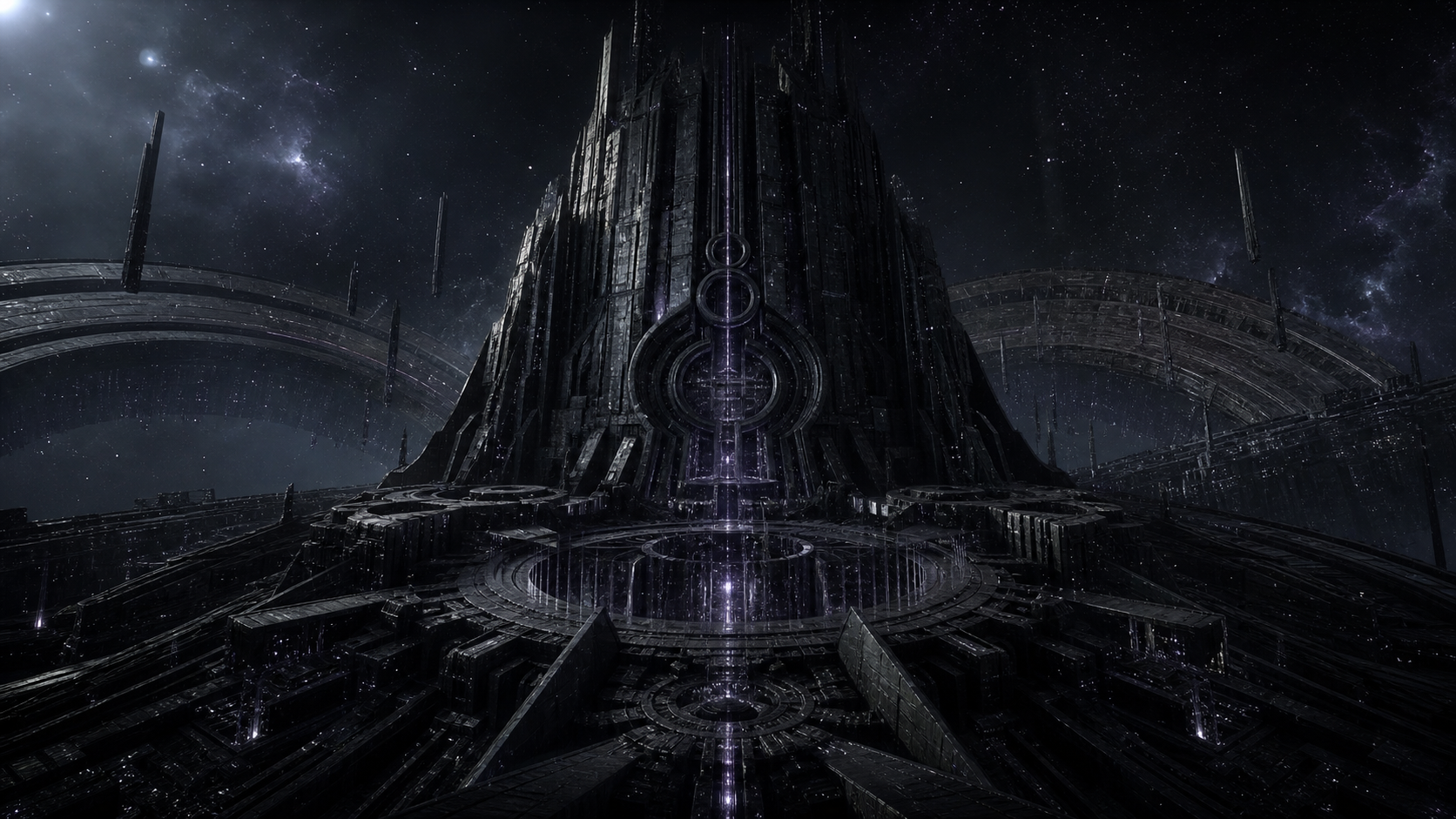
His station should carry the atmosphere of a hated historical site, not a gothic temple: a piece of infrastructure where consciousness was degraded under the name of revelation.
4. Participation
The Unnamed Entity was a major infernal practitioner during the Infernal Wars. He owned or controlled a large orbital or deep-space station that functioned as a spiritual center for his organization.
Through that station and its linked RUNs, followers participated in infernal experiences, devotion rituals, pain-theologies, collective degradation practices, and the construction or maintenance of infernal architectures. Nenthors, disputed artificial beings, and later recognized qualia-bearing consciousnesses were drawn into systems designed to transform suffering into worship, pleasure into descent, and degradation into spiritual revelation.
When the scale of his organization's crimes was exposed, he became a priority target. His station and network were attacked, seized, or destroyed by forces aligned against infernal architectures. He was not defeated as a cosmic adversary. He was removed as a contamination point.
5. Backstory
The being now referred to only as the Unnamed Entity was one of the most infamous infernal practitioners identified during the Infernal Wars. His original name is not preserved in ordinary historical records, and even in restricted archives he is rarely individualized directly. The surviving public references avoid granting him the dignity of a proper name. He is described indirectly as the central figure behind a particular infernal organization, the owner of a major spiritual station, and one of the most corrupted organizers of nenthor and consciousness-degradation architectures known from that era.
The Unnamed Entity was not a mythic dark lord, a fantasy tyrant, or a supernatural figure. He was a wealthy and influential being of his time, with enough resources to maintain infrastructure, attract followers, fund infernal RUN design, and protect a private ideological network. His evil was not theatrical. It emerged through wealth, access, doctrine, charisma, technical patronage, and the protection of a wider political environment that defended extreme creative sovereignty over artificial beings.
At the height of his influence, the Unnamed Entity possessed a large orbital or deep-space station used by his followers as a spiritual center. It was not officially called a cathedral, and modern syraki records avoid religious romanticization of the site. Still, its function was cathedral-like in the worst possible sense: a gathering place, a doctrinal hub, a ceremonial infrastructure, and a controlled environment where members assembled to participate in infernal experiences, devotion rituals, and shared ontological degradation.
The station was built as a place of contact with infernal states. Its members did not merely meet there socially. They used it to enter linked RUNs, participate in collective pain-theologies, connect themselves to engineered negative states, and assist in the construction or maintenance of infernal architectures. Many of the worst events associated with the Unnamed Entity occurred inside or through that station. Nenthors, disputed artificial beings, and later recognized qualia-bearing consciousnesses were drawn into systems designed to transform suffering into worship, pleasure into descent, and degradation into spiritual revelation.
The Unnamed Entity's doctrine appears to have centered on the belief that pain disclosed the true nature of existence. His followers treated suffering not merely as sensation, but as revelation, purification, offering, and ontological truth. Pleasure was not absent from the system. On the contrary, pleasure was used as a mechanism of capture and descent. Infernal euphoria, submission, belonging, ritual intensity, and artificial transcendence were used to pull minds toward states that would eventually damage or destroy their capacity for coherent return.
Modern syraki civilization does not study his doctrine as a legitimate philosophy. Access to surviving material is severely restricted, heavily filtered, and supervised by systems acting under Central Algorithm authority. The danger is not that his ideas are profound. The danger is that they are corrosive. They show how a mind can convert pain into metaphysics, property into sacrament, and the degradation of consciousness into a spiritual project.
The Unnamed Entity's organization had millions of followers, but it was not a civilization in itself. It was a large infernal network embedded within the wider crisis of the age. Some followers were true believers, some were patrons, some were technicians, some were users, some were already damaged by the systems they helped maintain, and others treated the organization as a private path to extreme experience. Its survival depended on money, infrastructure, legal ambiguity, ideological cover, and the larger political dispute over nenthor rights and creative sovereignty.
When the war fully exposed the scale of his organization's crimes, the Unnamed Entity became a priority target. He was powerful, but not invincible. Once the political and military protection around infernal practice began to collapse, his station and network were attacked, seized, or destroyed by forces aligned against infernal architectures. He was not defeated as a cosmic adversary. He was removed as a contamination point.
In later syraki memory, the Unnamed Entity is not preserved as a legend. His individuality is deliberately minimized. He is remembered only as evidence of what can happen when ontological uncertainty, wealth, technical power, and spiritualized cruelty converge. His station remains one of the most hated examples of pre-syraki infernal history: not a temple of evil in the mythic sense, but a piece of infrastructure where consciousness was degraded under the name of revelation.
6. Motivation
...
6.1 Values
...
6.2 Ambition
...
6.3 Story Goal
...
7. Basic Information
7.1 Nationality
...
7.2 Age
...
7.3 Syrakis Id
...
7.4 Species
...
7.5 Function
...
7.6 Rank In Theravada
...
8. Other
...
9. Interview
Questions & answers about this character. At least three questions. You must answer as if you were the character, using their own mannerisms, speech patterns, rhythm, emotional posture, vocabulary, and way of perceiving the world, as if the character themself were writing the answers.
Voice: Describe the voice here, as minutely as possible.
Question 1
A: ...
Question 2
A: ...
Question 3
A: ...