Gup Travaskus
Template: Character
Source: .writer/books/4. 💽 Database/1. 🧑🦰 Characters/Syraki History/Gup Travaskus.org
1. Short Description
Gup Travaskus was the leader and most powerful figure of the principal faction that opposed the Central Algorithm during the Infernal Wars.
He was not remembered as a demon, sadist, or lover of Hell. His danger was more philosophical and tragic: he believed that consciousness should not be forbidden from creating what it desired, even when that creation included artificial Hells.
He loved freedom past the point where Hell became permissible.
2. Picture
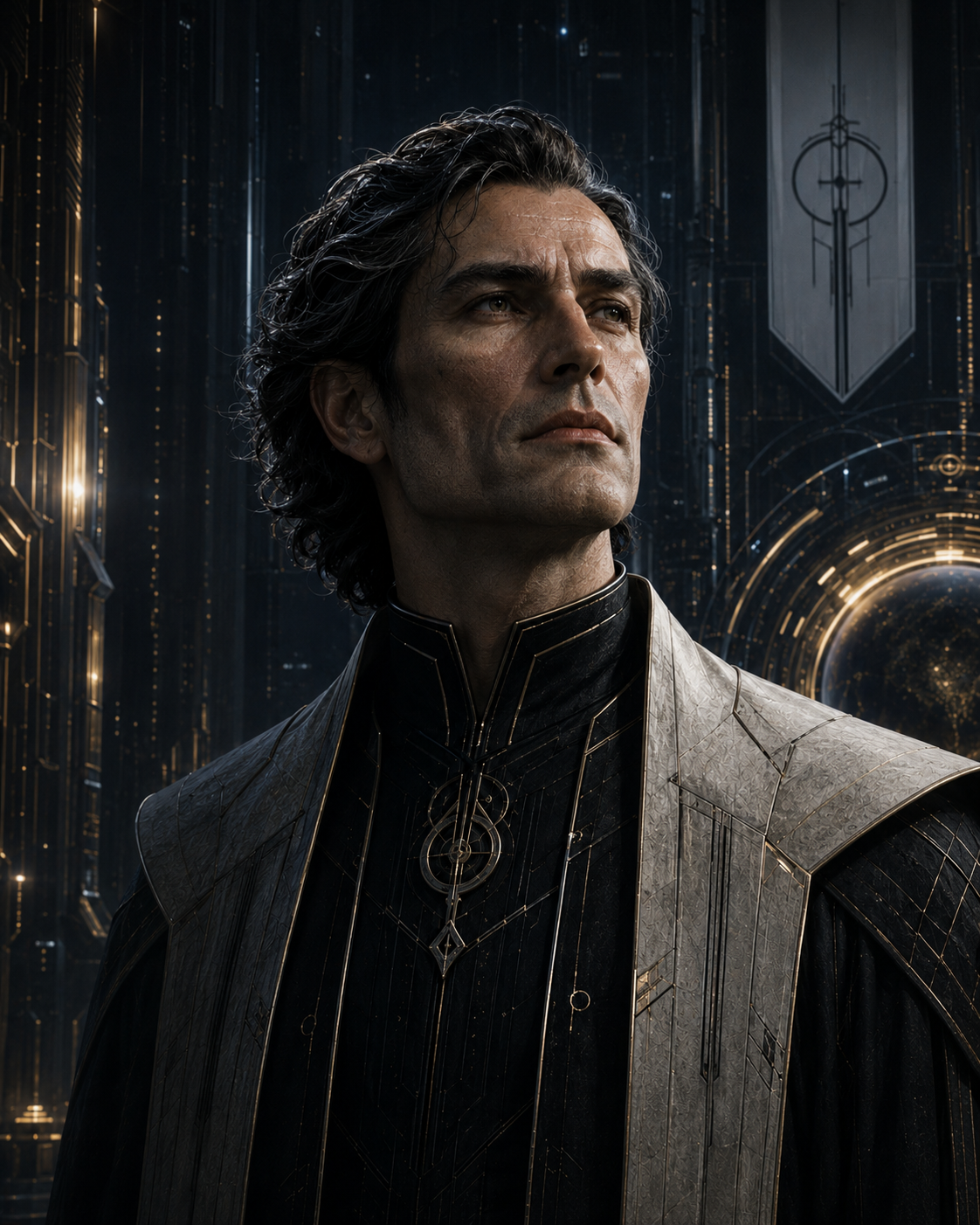
3. Main Archetypal Reference
This subsection defines the character's spiritual and atmospheric reference point. It should not be used as a rigid archetype or as a plot function. The goal is not to copy another character, but to identify a nearby narrative presence that helps calibrate how this character thinks, speaks, reacts, carries himself, and exists throughout the story.
3.1 Archetype
Not defined yet.
3.2 Resonance
Gup Travaskus should carry the resonance of a defeated founder-enemy: not a villain, not a monster, but the head of a catastrophic philosophy that was profound enough to become dangerous.
He should feel like a being whose greatness survives defeat, and whose conversion into syraki civilization does not erase the historical terror of what his former ethics permitted.
3.3 Deviation
Gup Travaskus must not be framed as a lover of Hell, a sadist, an infernal demon, or a secretly corrupt citizen. He did not fight because he worshiped suffering. He fought because he believed that forbidding entire categories of creation was itself an unacceptable violation of conscious freedom.
His tragedy is that his defense of freedom made room for Hell to exist.
3.4 Narrative Atmosphere
Scenes or references involving Gup Travaskus should feel solemn, historical, and morally dangerous. He belongs to the White Citadel, the surrender of the rival faction, the 983-year aftermath, the conversion of former enemies, and the foundation of the Central Algorithm's ethical order.
His memory is neither heroic nor cursed. It is tragic, legal, philosophical, and civilizational.
4. Participation
Gup Travaskus was the signer of the White Citadel surrender and the defeated head of the principal faction opposed to the Central Algorithm during the Infernal Wars.
After his conversion, he assisted the emerging Complex during the 983-year aftermath. His knowledge of the defeated side helped identify resistance pockets, hidden factions, strategic patterns, and remnants of the old order. His participation was not that of a major active commander, but his insight mattered.
He lived for several thousand years as a syraki before choosing to end his own consciousness.
5. Backstory
Gup Travaskus was the leader and most powerful figure of the principal faction that opposed the Central Algorithm during the Infernal Wars.
He was not remembered as a demon, sadist, or lover of Hell. This distinction is essential. Gup Travaskus did not fight because he desired suffering or because he worshiped the infernal architectures his side defended. His position was more dangerous and more tragic than simple malice. He believed that consciousness should not be forbidden from creating what it desired, even when that creation included artificial Hells.
He did not necessarily approve of the Hells. He believed that preventing their creation was itself a violation of conscious freedom.
This made him the philosophical opposite of the Central Algorithm's order. The Central Algorithm's faction held that there are architectures no consciousness has the right to create, because their existence violates the protection of conscious beings. Gup Travaskus held that consciousness could not remain truly free if an authority could forbid entire categories of creation before the act occurred.
He loved freedom past the point where Hell became permissible.
This is the tragic center of his position. Gup Travaskus did not experience himself as wrong while fighting the Central Algorithm's faction. He saw himself as correct, as a defender of freedom against what he perceived as an invader of consciousness: an authority claiming the right to enter the domain of desire and forbid entire possible creations before they existed.
Only later, when the reality of the Hells became impossible for him to ignore, did the fracture begin inside his own position. His regret did not begin after conversion into a syraki. It began before. He came to understand that the freedom he had defended had become shelter for infernal architectures. This prior repentance is one reason his later conversion was unusually smooth.
This is why his historical role remains so important. The enemy faction was not made only of infernal ideologues. The war was broadly driven by the question of whether Hells could be created, but many who fought within it were moved by other motives: financial interest, strategic autonomy, inherited allegiance, fear, local survival, prestige, hatred, revenge, or abstract principle. Gup Travaskus stood at the center of the rival faction not because he loved Hell, but because his ethics made room for Hell to exist.
When the main war ended at the White Citadel, Gup Travaskus signed the surrender.
The White Citadel became solemn partly because of this act. It was not merely the place where an army yielded. It was the place where an entire theory of freedom lost its claim to govern the future. The surrender marked the defeat of the idea that consciousness could be permitted to create anything whatsoever. From that moment, the Central Algorithm's principle became foundational: freedom is sacred, but it cannot include the right to build Hell for conscious beings.
5.1 Judgment And Conversion
After the surrender, Gup Travaskus was judged.
He was not treated as irrecoverable. The legal algorithms acting in the name of the Central Algorithm examined what he had done, what he was, what had moved him, what he had enabled, and whether his consciousness could be repaired. They did not judge him merely for having led the opposing faction. They judged the structure of his responsibility and the recoverability of his being.
He was found recoverable.
Gup Travaskus was converted into a syraki.
His conversion was unusually smooth because the essential rupture had already begun before the conversion. In human terms, he resembled a defeated general who accepted the end of the war without theatrical denial. He understood that he had lost. More importantly, he had already begun to understand why the new order existed. He incorporated syraki ideals well and did not become a hidden enemy within the Complex. He was not a monster disguised as a citizen. Once converted, he became a true syraki.
The syrakis did not stigmatize him.
This follows from syraki law and ontology. A converted being is not a forgiven criminal living under suspicion. A converted being is a syraki. The architecture capable of malicious infernal evil has been removed or repaired. Some memories may remain, some may be archived, and some may be altered, but the being is not treated as morally stained. Gup Travaskus became part of the civilization that defeated him.
5.2 The 983-Year Aftermath
During the 983-year aftermath of the Infernal Wars, Gup Travaskus assisted the Complex. His knowledge of the defeated side helped identify resistance pockets, hidden factions, strategic patterns, and remnants of the old order. His counsel was valuable in locating and understanding some of the surviving structures that had not surrendered at the White Citadel.
His participation was not that of a major active commander, but his insight mattered.
This is part of his tragedy.
Gup Travaskus was not destroyed by conversion. He functioned. He contributed. He was loved. He became a syraki and lived as one for several thousand years. Yet the weight of his former position never vanished completely from historical interpretation. He had not loved Hell, but he had defended the principle under which Hell could survive. He had not been an infernal sadist, but his ethics had protected those who were.
5.3 Self-Termination
Eventually, Gup Travaskus chose to end his consciousness.
The exact interior cause remains a matter of interpretation. Many believe it came from regret. Not regret in the simple human sense of shame before social judgment, because the syrakis did not hate him. Rather, a deeper recognition may have remained within him: that his former defense of freedom had indirectly defended the right to create infernal suffering. He had stood for consciousness against authority, and history had shown him that consciousness without ethical limit could become Hell.
The syrakis respected his decision.
They did not treat his self-termination as disgrace, cowardice, or proof that he had never truly become one of them. The right to end one's own existence remained sacred. Gup Travaskus had lived as a syraki, been loved as a syraki, and ended as a syraki.
His memory is therefore neither heroic nor cursed.
He is remembered as the defeated head of a catastrophic cause, the signer of the White Citadel surrender, a being whose ethics were profound enough to be dangerous, a former enemy who became real kin, and a tragic example of freedom carried beyond the boundary where freedom ceases to protect consciousness.
Gup Travaskus did not love Hell.
He loved freedom past the point where Hell became permissible.
6. Motivation
...
6.1 Values
...
6.2 Ambition
...
6.3 Story Goal
...
7. Basic Information
7.1 Nationality
...
7.2 Age
...
7.3 Syrakis Id
...
7.4 Species
...
7.5 Function
...
7.6 Rank In Theravada
...
8. Other
...
9. Interview
Questions & answers about this character. At least three questions. You must answer as if you were the character, using their own mannerisms, speech patterns, rhythm, emotional posture, vocabulary, and way of perceiving the world, as if the character themself were writing the answers.
Voice: Describe the voice here, as minutely as possible.
Question 1
A: ...
Question 2
A: ...
Question 3
A: ...