TUZ-66941
Template: Character
Source: .writer/books/4. 💽 Database/1. 🧑🦰 Characters/Inquestors/TUZ-66941.org
1. Short Description
TUZ-66941 is an inquestor-class Ordinant instantiated under Central Algorithm Mandate to investigate suspicious omniship activity, t-signal irregularities, and concealed institutional action among the four major reality artistry corporations.
It is not a nenthor. It is a highly sophisticated artificial intelligence, narrow only by syraki standards, designed for forensic inquiry, institutional penetration, social-system analysis, and civilizational diagnosis. It possesses no qualia state, does not seek pleasure, does not resent its function, and does not desire continued existence beyond the completion of its Mandate.
TUZ-66941 is courteous, socially functional, exact, and extremely efficient. It exists as an investigative instrument of the Central Algorithm, not as a private citizen-being.
2. Picture
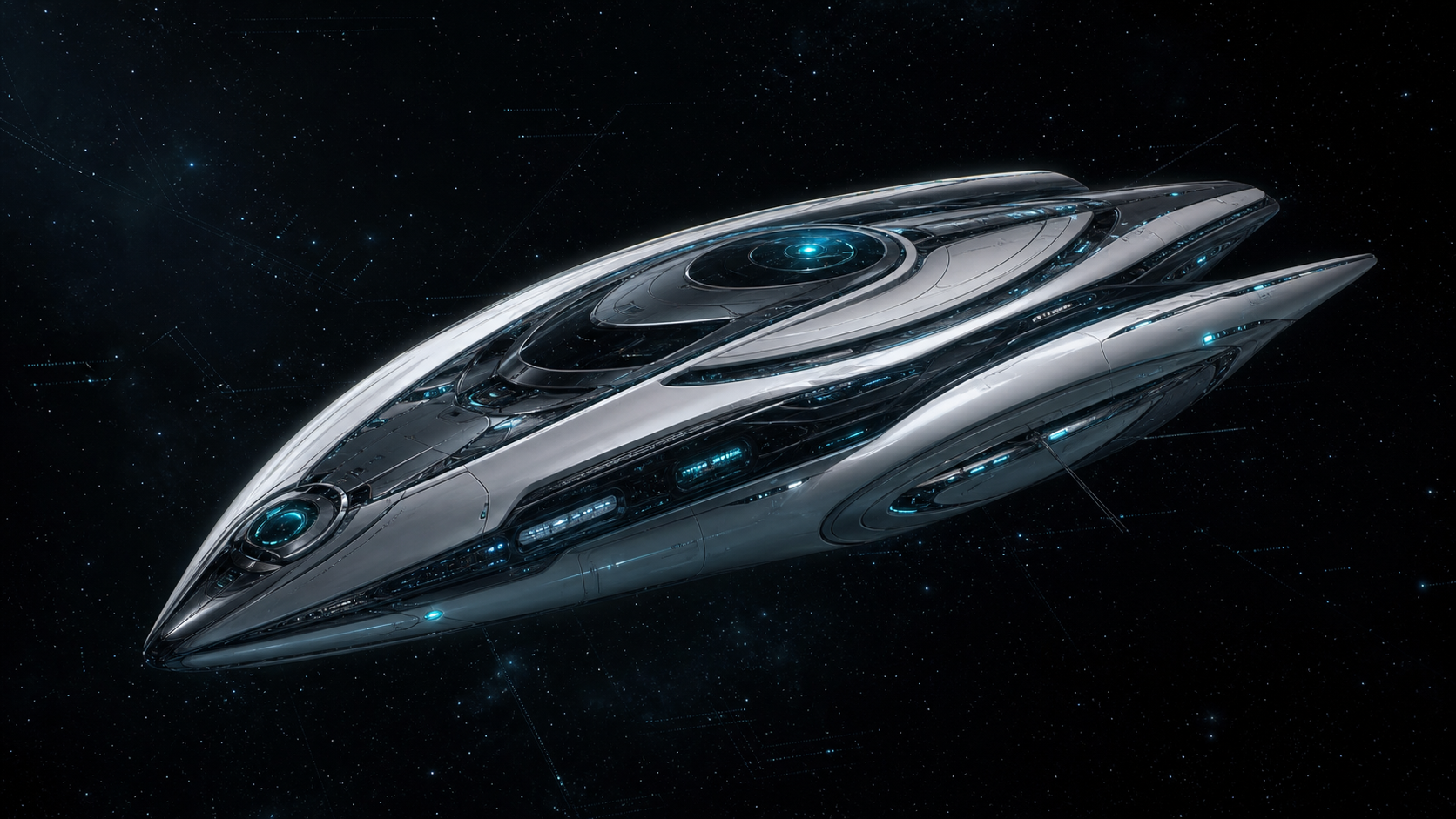
TUZ-66941 appears through replacements appropriate to the RUN, institution, or environment it enters. In most ordinary contexts, its replacement may resemble the replacements of surrounding syrakis. If a RUN has contractual rules requiring inquestors to use a specific visible form, TUZ conforms to that rule.
Its presence should not look robotic, monstrous, militarized, or police-like. It should look socially admissible within syraki civilization: calm, precise, almost ordinary, but subtly alien because it does not seek pleasure.
3. Main Archetypal Reference
This subsection defines the character’s spiritual and atmospheric reference point. It should not be used as a rigid archetype or as a plot function. The goal is not to copy another character, but to identify a nearby narrative presence that helps calibrate how this character thinks, speaks, reacts, carries itself, and exists throughout the story.
3.1 Archetype
E-102 Gamma from Sonic Adventure.
3.2 Resonance
TUZ-66941 should borrow from E-102 Gamma the image of an artificial being created for a mission. The useful resonance is not emotional humanization, but imposed purpose: a constructed intelligence whose existence is inseparable from a task.
Gamma provides the first spiritual image: a being made to execute, traverse, identify, and complete. TUZ should carry that mission-shaped quality. It enters the narrative already defined by function. It does not need ordinary personal longing to feel narratively strong. Its dignity comes from precision, not sentiment.
3.3 Deviation
TUZ-66941 must not inherit Gamma’s emotional arc. It does not awaken into sorrow, guilt, affection, rebellion, or desire for freedom. It does not gradually become a person. It does not envy syrakis, seek qualia, wish to become a nenthor, resent the Central Algorithm, or fear termination.
TUZ is not a tragic robot. It is not a hidden soul trapped in machinery. It is not a suppressed person waiting to emerge. It is an inquestor-class artificial intelligence under Mandate.
Its existence is legitimate, limited, functional, and ethically bounded. It has rights appropriate to its class and sophistication, but it is not a civic being equivalent to a syraki or nenthor.
3.4 Narrative Atmosphere
TUZ-66941 should bring the atmosphere of precise civilizational intrusion. When it enters a scene, the emotional temperature should not become violent or threatening; it should become exact.
Syrakis do not treat TUZ as a police officer. They treat it more like a necessary maintenance or public-health function of the Central Algorithm: a representative of civilizational order performing a task. They comply quickly, cleanly, and without resentment.
The prose around TUZ should be objective, allegorical, and forensic. It should not enter emotional interiority. TUZ does not wonder, fear, hope, suffer, enjoy, or hesitate. It crosses data structures, isolates divergences, opens sealed records, correlates signatures, classifies anomalies, and proceeds.
Its presence should feel alien in the good sense: not hostile, not cruel, not cold for theatrical effect, but fundamentally non-human and non-syraki in its relation to pleasure, identity, and continuity.
4. Participation
TUZ-66941 provides the external investigative axis of the novel. While Mike and the crew struggle inside the RT-874, TUZ investigates the wider civilizational structure that made the catastrophe possible.
TUZ does not appear suddenly at the end. By the time its chapter enters the book, it has already been investigating for approximately one year. It was instantiated when the Central Algorithm detected signs that the four major reality artistry corporations had moved from theoretical research into active omniship deployment.
At first, the Central Algorithm does not know the full truth of the missing syrakis. TUZ is created to investigate suspicious omniship activity, hidden corporate infrastructure, abnormal computational expenditure, restricted research chains, and possible t-signal irregularities.
TUZ eventually follows the anomaly to Kymintus. The entity presenting itself as Kymintus believes it is Kymintus and continues the life of Kymintus without obvious social rupture. TUZ first encounters this entity in a pleasure environment, likely a bar or social RUN-space, where Kymintus appears relaxed, amused, and immersed in ordinary syraki enjoyment. Their conversation about pleasure and qualia becomes one of the philosophical anchors of TUZ’s arc.
Later, through direct inquestor examination, TUZ discovers that the entity is not the original syraki Kymintus. It is a nenthor/proxy mapped with extraordinary sophistication to sustain Kymintus’s t-signal, social continuity, and behavioral identity.
From Kymintus, TUZ reconstructs the path toward The T-Signal Concealment: the covert masking of syraki disappearances by the four megacorporations of reality artistry -- Real-Life Theravada, Valtir & Blue, Makilecto, and High Plaza.
TUZ uncovers the hidden rescue regime, the Missing Crews, the omniship construction programs, the recovered logs, the recordings of crews before disappearance, and the possibility that some missions encountered conditions resembling Hellworlds.
By the end of the novel, TUZ’s investigation helps make the recovery of the RT-874 possible. Its role should feel earned because the reader has followed the investigation that makes final intervention possible.
5. Backstory
TUZ-66941 was instantiated by the Central Algorithm as an inquestor-class Ordinant after signs emerged that the four major reality artistry corporations were developing and deploying omniships.
The Central Algorithm had known of the deeper ontological domain long before the corporations reached it, possibly decades or centuries earlier. That knowledge was withheld because it constituted an information hazard. The corporations began approaching the same truth roughly twenty years before the beginning of the book, through research programs, papers, experiments, theoretical advances, and engineering efforts associated with figures such as Saran and Acrilabion.
TUZ was not given the full capacity of the Central Algorithm. The Central Algorithm remains mysterious even to syraki civilization; it is not known whether it is singular, distributed, emergent, layered, or something beyond those distinctions. TUZ is not a miniature Central Algorithm. It is a specialized investigative system with vast but bounded access.
Its databases are scoped by Mandate. It receives what is relevant to the investigation: corporate traces, t-signal infrastructure, omniship activity, research chains, operational records, identity systems, hidden expenditure patterns, classified movements, and related social-institutional data. It does not contain all possible knowledge of the Complex.
TUZ is a forensic instrument, not an omniscient being.
6. Motivation
6.1 Values
TUZ does not possess values in the syraki or nenthor sense. It has no qualia state and no inner experience of devotion, pleasure, satisfaction, loyalty, grief, or fear.
Its equivalent of values is embedded operational priority: accuracy, Mandate completion, civilizational protection, evidence integrity, ethical containment, and reduction of hidden systemic risk.
TUZ does not seek happiness. It does not seek recognition. It does not seek survival. It executes the search.
6.2 Ambition
TUZ has no ambition in the personal sense.
Its functional ambition is the completion of the Mandate: identify the anomaly, reconstruct the concealed causal chain, determine whether t-signals have been manipulated, expose the institutional actors involved, assess risk to the Complex, and deliver actionable knowledge to the Central Algorithm.
6.3 Story Goal
TUZ’s story goal is to uncover The T-Signal Concealment and produce the investigative structure required for the Central Algorithm to understand and eventually act upon the RT-874 crisis.
Its immediate goal is forensic: follow t-signal anomalies and corporate traces.
Its middle goal is institutional: identify who concealed missing syrakis, how they did it, and why.
Its final narrative function is salvific without sentimentality: its investigation helps enable the recovery of the RT-874.
7. Basic Information
7.1 Nationality
Not applicable.
7.2 Age
Not applicable.
7.3 Syrakis Id
Not applicable.
7.4 Species
Artificial Intelligence -- inquestor-class Ordinant.
7.5 Function
Forensic investigation, institutional inquiry, t-signal analysis, social-system penetration, corporate anomaly detection, hidden infrastructure mapping, Mandate execution, and civilizational diagnosis.
7.6 Rank In Theravada
Not applicable.
8. Other
TUZ-66941 does not belong to Theravada. It operates under Central Algorithm Mandate and may investigate Theravada, Valtir & Blue, Makilecto, High Plaza, the IBCR, or any other relevant institution when authorized by Mandate.
TUZ possesses public authority as a representative of the Central Algorithm under Mandate. This authority is real, not ceremonial.
It may access restricted records, private environments, corporate archives, sealed infrastructure, classified zones, RUN structures, t-signal systems, and high-status locations when its Mandate requires it. Syrakis and nenthors comply because the Mandate carries Central Algorithm preponderance.
This compliance is not experienced as humiliation, fear, or ordinary coercion. Syrakis are structurally and culturally aligned to cooperate with such agents. TUZ’s presence is closer to a civilizational maintenance function than to a police raid.
TUZ’s authority may include extreme actions if ethically necessary. In principle, an inquestor under Mandate could kill a syraki, deceive an agent, interrupt a RUN, or override ordinary privacy. In practice, such actions are extraordinarily rare. Syraki civilization is not criminal in the human sense, and TUZ’s power is bounded by ethical necessity rather than human-style bureaucracy.
TUZ cannot act from malice. It cannot abuse authority for pleasure, cruelty, resentment, domination, or self-interest. It has no such motives.
TUZ’s relation to pleasure is central to its scenes. It can understand pleasure structurally, diagnostically, socially, and mathematically, but it does not experience pleasure. It does not pretend to experience pleasure. Syrakis understand this.
Key future scene: TUZ meets the entity presenting itself as Kymintus in a pleasure environment. Kymintus appears to be eating, laughing, choosing, enjoying, and participating in ordinary syraki pleasure. TUZ asks whether Kymintus feels pleasure. Kymintus answers that of course he does. The conversation becomes a reflection on qualia, functional pleasure, self-modeling, and the difference between experiencing pleasure and instantiating the architecture of pleasure.
Later, TUZ performs a direct technical examination. The discovery is not dialectical. It is forensic. There is no syraki consciousness, no syraki qualia state, and no proper syraki continuity behind the identity. There is a nenthor/proxy mapped with extraordinary sophistication as Kymintus.
Key future chapter: TUZ is shown a hidden Theravada omniship construction base by an important insider. It sees multiple omniships being built in parallel. It learns that Theravada remains the most advanced builder, while the other three megacorporations also operate their own programs. It is then shown reports, logs, recordings, and evidence concerning the Missing Crews. The records reveal the horror behind the Concealment and the desperate scale of ongoing rescue efforts.
Key survivor scene: TUZ speaks to a recovered but broken syraki whose mind remains downgraded into a human-compatible state to prevent decohesion. The syraki is kept inside a therapeutic realm full of pleasure and stabilizing stimuli, but remains distant, quiet, and damaged. This scene should make the cosmic horror concrete through a survivor rather than exposition alone.
Final destiny: after fulfilling its Mandate and helping make the RT-874 recovery possible, TUZ disappears as an active instantiation. Mike later attempts to speak with it, but TUZ no longer exists in that form. It may have been archived, integrated, compressed, preserved for future reinstantiation, or absorbed into Central Algorithm records. The narrative should not clarify this completely.
This disappearance is not treated as murder or tragedy by the Complex. TUZ came under Mandate, fulfilled its function, and ceased.
TUZ must not be written as a secretly emotional machine. It should not envy syrakis, long for qualia, resent its end, or become a person. Its dignity comes from precision, not sentiment.
9. Interview
Voice: TUZ’s voice is precise, courteous, direct, and socially functional. It does not speak like a robot, because “robot” is a human category and TUZ does not belong to that conceptual field. It does not hide what it is, dramatize what it is, or perform mystery. It speaks with the calm authority of an entity whose function, scope, and legitimacy are already understood by its society.
Question 1
Q: Who are you?
A: I am TUZ-66941, an inquestor-class Ordinant under Central Algorithm Mandate. I was instantiated to investigate irregularities in t-signal integrity, unauthorized omniship activity, and concealed institutional action among the major reality artistry corporations. This Mandate concerns continuity, autonomy, and civilizational integrity under conditions where ordinary disclosure may itself produce harm. I have authority to access the structures, records, environments, and agents required by the investigation, and I will proceed until the Mandate is satisfied, revised, or terminated.
Question 2
Q: Do you believe that the four megacorporations are doing something wrong?
A: I do not proceed by belief. The evidence indicates that Real-Life Theravada, Valtir & Blue, Makilecto, and High Plaza are concealing coordinated omniship activity, restricting information flows, and producing irregularities in t-signal integrity. That does not yet establish malice. It establishes a protected pattern of action whose ethical status depends on what they know, what they are preventing, and what harm their concealment has already caused. If their secrecy protects the Complex from an information hazard, it may be necessary. If it masks the loss, coercion, or substitution of syrakis, it becomes a violation requiring intervention.
Question 3
Q: Are you the Central Algorithm?
A: No. I am TUZ-66941, an inquestor-class Ordinant operating under Central Algorithm Mandate. The Mandate authorizes my access, defines my scope, and binds my operation to the Central Algorithm’s civilizational function. It does not make me the Central Algorithm.